Showing posts with label Manitoba. Show all posts

Tuesday, June 20, 2017

Point Doulgas by-election: Post mortem

I haven't made many “post-election analysis” posts on this blog, but it's never too late to start, right? As expected, the NDP managed to win last week's provincial by-election in Point Douglas, Manitoba. A seat they have never lost, and which gave them their best result out of all ridings in the 2016 provincial election. Even though the NDP won, the by-election result was a bit of a disappointment for the party, as they won less than 50% of the vote for the first time in the riding's history.

Preliminary results show the NDP's Bernadette Smith winning 44% of the vote (down from 58% in 2016), with the Liberal's John Cacayuran winning 29% of the vote in second place (up from 19%). This was the Liberal's best showing in the riding since the 1990 election. The Tories finished third with 16% of the vote, only down a quarter of a percentage point from 2016. The Greens finished in fifth, behind the libertarian Manitoba Party. Overall turnout was down 10% from last year's election, to just 32%. While bad, it's not unusual of for by-elections to have turnouts in the low 30s, and considering how low turnout usually is in this riding, it's not that bad.

Elections Manitoba published the preliminary results by polling division, which has allowed me to delve deep into the results to see just what happened on election day. I sure hope they used the same poll map as in the last provincial election.
Race and income by census tract (2011 National Household Survey)

Except for the one polling division in the southeast corner of the riding, Point Douglas' electoral geography is usually quite homogeneous, as the NDP has historically swept almost every poll in this riding. Last week's by-election did identify a political cleavage in the riding, that I believe is most likely based on ethnic lines. The Liberals ended up winning 8 of the 40 polls in the riding, and tying the NDP in one other. Most of these poll wins came from the northwest part of the riding, which has a lower Aboriginal population than the rest of the riding, and a higher Filipino population. This part of the riding is over one-quarter Filipino, which is the highest proportion of Filipinos in the riding. Most of the rest of the riding has a large Aboriginal population (with about 50% of the population in these areas being Native), and these areas stuck with the NDP, who just so happened to be running an Aboriginal candidate. The poll in the southeast corner of the riding stuck with the Tory candidate. This one poll is in an area that is very different from the rest of the riding socioeconomically, with an average income of over $60,000 compared to the low $20,000 range in most of the rest of the riding.

The swing map reinforces my theory of Filipino voters switching their allegiances to the Liberals. Some polls in the northwest of the riding saw up to 30% swings away from the NDP. In fact the poll which was the NDP's best in 2016 was even won by the Liberals! That's not to say it was all bad news for the NDP, as a few polls actually swung in their direction. One poll even saw a nearly 30% swing away from the Liberals! These swings to the NDP came from areas that are the most Aboriginal in the riding, and are also among the poorest parts of the riding.

Contributing to the election results was a likely turnout difference between Filipino and Aboriginal voters, as the northwest part of the riding saw the highest election day turnout, while the poorest and most Aboriginal parts of the riding tended to see the lowest turnout. In fact, there is a clear correlation between swing and turnout; areas that swung the most to the Liberals had a higher turnout, while those areas that had the lowest turnout swung to the NDP (or at least had a lower swing to the Liberals).

What does this all mean for Manitoba politics going forward? Well, not too much, as both the Liberals and NDP are leaderless at the moment. However, it does expose a potential ethnic cleavage in Winnipeg's north end, which may cut into the NDP's dominance of this working class part of the city. We've already seen the Liberals not only make inroads, but sweep this part of the city in the last federal election. I'm not saying they will do this on the provincial level, but winning over Filipino voters will help the Liberals win a few more seats in the region.

Tuesday, June 13, 2017

Point Douglas by-election preview

Hello readers, it's been a while since my last blog post, due to being quite busy with work, but now that summer approaches, I have a bit more free time to focus on elections across this great country of ours. Of course, summer means a great lack of elections. Oh well. Anyway, those of you who follow me on Twitter will know that I have still been making maps and charts, something that I much prefer over writing, to be honest. It's a lot easier to provide analysis in 140 characters or less!

---


Today, Manitoba is seeing its first provincial by-election since the Progressive Conservatives were swept to power in last year's provincial election. The governing Tories have remained fairly popular over the last year, and enjoy a sizable lead in the polls, thanks to a split opposition, and the fact that both the NDP and Liberals are leaderless at the moment, with both parties set to elect new leaders in the Fall.

Today's by-election is in the riding of Point Douglas, perhaps the safest NDP seat in the whole province. In last year's election, the NDP saw its largest share of the vote out of any riding, when they won the seat with 58% of the vote. In the 2011 election, it was the NDP's second best riding in the province, when 73% of voters backed the party. Most of the riding has voted NDP in every election since the party was created, and for its predecessor the Co-Operative Commonwealth Federation (CCF) before that, going back to when single member constituencies were created in Winnipeg for the 1958 election. Even before that, the CCF would regularly win seats in this part of Winnipeg, which has a long working class history.

Point Douglas is located in Winnipeg's notorious north end, and is named for a bend in the Red River. The Red River forms the eastern boundary of the riding, while the northern boundary is formed by Church Street and the western boundary mostly follows Sinclair Street. The southern boundary follows the CPR Winnipeg Yard, and then follows Main Street south to Lombard Avenue, and then east to the Red River. This diversion creates a bit of a “panhandle” in the southeast of the riding. While this unites all of Point Douglas together, it lumps two very socioeconomically different neighbourhoods together.

The riding is one of the poorest in the province, with most census tracts reporting an average annual income of less than $25,000. One exception is the South Point Douglas area (the aforementioned “panhandle”), which reported an average income of $63,000 in 2010. The riding has a very large First Nations population, as well as a sizable Filipino population.

Results by neighbourhood (2016 provincial and 2015 federal elections)
Click to enlarge

In the last two elections, the NDP won nearly every single poll in the riding. In 2011 the NDP won all but one poll, and in 2016, the lost just two. In 2016, the Liberals won the Lord Dufferin Park apartments, while the furthest southerly poll has voted for the Tories in both elections. This poll covers the Exchange District and Civic Centre neighbourhoods, located right next to Downtown. In federal elections, Point Douglas usually always votes NDP. However, in the 2015 election, the area switched allegiances en masse to the Liberals, thanks in part to the popularity of Winnipeg North MP Kevin Lemoureux, whose support base had previously been further west in the district. Lamoureux won 62% of the vote in Point Douglas in 2011.

In both the 2011 and 2016 elections, the NDP won a majority of votes in every neighbourhood except the South Point Douglas area, where they still managed to win pluralities in both elections. In the 2015 federal election, the Liberals won a majority of the vote in every neighbourhood, with North Point Douglas being their worst at 55% of the vote. North Point Douglas was the NDP's best neighbourhood in the 2016 provincial election (63%) and second best in 2015, after Lord Selkirk Park. Interestingly, Lord Selkirk Park was the Liberals' best neighbourhood in the last two provincial elections. The Tories typically do the best in the South Point Douglas area, winning 35% of the vote in 2016 and 41% in 2011. However, their best neighbourhood in the federal election was actually St. John's Park, winning just 18% of the vote. The Greens also do their best in the South Point Douglas area, winning nearly 10% of the vote there in 2016.

Point Douglas representation history (since 1958)

Point Douglas was vacated last January when its MLA, Kevin Chief resigned citing family reasons. He had represented the seat since 2011. Since the riding was re-created in 1990, Point Douglas has continuously been represented by members of the First Nations community, as both Chief and his predecessor, George Hickes are Aboriginals.

The NDP hopes to continue the riding's tradition of electing First Nations MLAs, with their candidate Bernadette Smith. Smith's credentials include pushing for an inquiry into missing and murdered indigenous women, and advocacy for women's and indigenous rights. The Liberals are running John Cacuyaran, a former staffer for MP Maryann Mihychuk. The Tories are running electrician Jodi Moskal, the Greens are running Sabrina Koehn Binesi and the libertarian “Manitoba Party” is running their leader, Gary Marshall.

This should be an NDP hold, but turnout will be a big factor in this riding. The NDP can usually count on the support from First Nations residents in the riding, and it will help that they have an Aboriginal candidate. The NDP's main competition will be from the Liberals, who are notably not running a First Nations candidate. The Liberals' poll numbers are currently just below the NDP in province-wide polling, which would not ordinarily be enough to take this riding, but will be enough to ensure a second place finish, which they did not get in 2011 (but did get in 2016). That is not to say that this riding could not go Liberal in the future, as the federal election results prove that this is more than possible. But provincial politics in Manitoba is much differently aligned than in federal elections, and the provincial Liberal Party is too unorganized to pick this seat up.

We'll see who wins when polls close at 8pm (9pm Eastern).


Tuesday, April 19, 2016

Manitoba election prediction: PC landslide

Seat prediction map
Manitobans are heading to the polls today in what will be an historic provincial election. If all the polls are correct, then voters are set to elect a Progressive Conservative government in a landslide election, kicking out the governing NDP, which has run the province since 1999, winning four straight majority governments in the process.

Polls are suggesting the PCs are hovering around 50% in the popular vote, which would be their highest vote share since 1910. If they get a few points higher than that, it would be their highest vote share in the province's history. This means that the Tories will be winning seats they have never won before, some of them quite easily, like Brandon East, Interlake and Selkirk. The NDP meanwhile is polling in the mid-20s, which would be their worst result since 1988. The Liberals on the other hand are just looking to gain back relevancy. After winning just one seat and 8% of the vote in 2011, they are now polling in the mid-teens, and could see their best result since 1995. The Greens are also polling well, averaging at 8%, which would be their best result ever.

This has been an election of awful leaders. NDP Premier Greg Selinger is coming off of last year's controversial leadership election, which followed a caucus revolt. Selinger won the election by a narrow result, thanks in part to the backing of major unions in the province. Not only that, Selinger is carrying 17 years of governing baggage behind him. The man who will become Premier, PC leader Brian Pallister is carrying baggage of his own. Many see him as being too right wing for the province, and is currently embroiled in a scandal in where it was discovered he had been to Costa Rica 15 times since 2012, and had lied about his travels. As for Liberal leader Rana Bokhari, she has run a lacklustre campaign which included an awful debate performance. At the beginning of the campaign, the Liberals had been polling ahead of the NDP for second place, but have now fallen considerably behind. The only leader that seems to be popular is Green Party head, James Beddome, who will definitely benefit from a high protest vote this election.


Predictions

For my riding predictions, I have come up with a “rating” for each riding (safe, likely, lean or toss up), which rates how comfortable I am in my predictions for each seat. I've made these ratings by using recent regional poll numbers and comparing them to the last provincial election as well as an average result of the last provincial and federal elections (see maps below). In taking a look at both elections, I feel I have a way to identify any abnormal riding results, and account for this in my predictions. Where my numbers contradict each other in a riding, or where they show a close race, I've declared the seat a “toss up” and offered my gut prediction in that riding, based on its history and its candidates. I've also taken into consideration a couple of riding polls that have come out over the course of the campaign.


Overall, I am predicting a landslide Progressive Conservative victory, with the Tories winning 43 of the 57 seats in the legislature. This would be their biggest electoral win in the province's history. I am predicting that the governing NDP will be reduced to just 11 seats, which would be their worst election since 1966. And ss for the Liberals, I am predicting they will win three seats, their best total since 1995.

Polls are suggesting the Tories are winning about two-thirds of the vote in rural Manitoba, which means they will likely sweep all of rural southern Manitoba (including Brandon), leaving the NDP to their northern stronghold (though they could close Flin Flon to the Liberals). In Winnipeg, polls indicate that the Tories have at least a 15 point lead over the NDP, which will see the PCs win back their former suburban strongholds in the south and west ends, and eat into traditional NDP territory in the north and east of the city. This will reduce the NDP to their stronghold in the central and north central parts of the city. Meanwhile the Liberals should hold on to their lone seat of River Heights, and maybe pick up one or two more seats thanks to vote splits. The Greens may also win a seat or two. 

Here are my seat by seat ratings. Ridings are coloured in by how they voted in 2011. 

Seat by seat rating.

Ridings to watch


I've identified ten ridings as “toss ups” - ridings where my numbers have shown a close race. For each of these ridings I went with my gut (with detailed reasoning) as to how I believe they will go:

Concordia: This north Winnipeg riding is being defended by incumbent NDP MLA Matt Wiebe, who has represented the seat since 2009, when he took over the riding from its predecessor, former Premier Gary Doer. The seat has voted NDP in every election since it was created in 1981. Wiebe won the seat in 2011 by 35 points, and it is one of only five provincial ridings to go NDP in the last federal election. On paper it is a safe NDP seat, but with the amount of swing the polls are predicting, this riding could be in play. I'm still predicting the NDP to hold on though.

Elmwood: Right next door to Concordia is Elmwood, which is being defended by long-time NDP MLA Jim Maloway, who has held this seat from 1986 to 2008 and since 2011. This riding has also voted NDP (and its predecessor, the CCF) in every election since it was created in 1958. The result in the last election in this seat was relatively close though, with Maloway defeating his Tory opponent by 21 points. One glimmer of hope for the NDP is that they did win the transposed federal result here. However, my numbers show the PCs winning this seat in a close result, which is why I am predicting they will win it.

Flin Flon: This riding, located in northwestern Manitoba will see an interesting race, as its defending MLA Clarence Pettersen is running as an independent, after he lost the NDP nomination. Flin Flon has been an NDP seat since 1969, but Pettersen's candidacy is expected to split the NDP vote. In the federal election, the NDP won Flin Flon over the Liberals by a slim margin, suggesting the Liberals could be the party that has the best chance at benefiting from the split. The provincial Liberals are also polling better than the NDP in rural Manitoba. This is why I think they will win the seat.

Fort Garry-Riverview: The NDP won this central Winnipeg seat in 2011, but this should be a Green-PC race. Green Party leader James Beddome is running in this riding, and of the four party leaders, he has the highest approval ratings. The Greens are polling quite high in the city (around 10%) which is enough to put this riding in play. Without riding polling, Green Party targets are hard to predict, so it is hard to say whether Beddome will win this seat. I'd prefer to hedge my bets though, and go with the PCs here, who could come up the middle against a divided progressive vote.

Fort Rouge: This central Winnipeg seat is the riding where Liberal leader Rana Bokhari has chosen to run. A riding poll from the beginning of the campaign showed a three-way race with Bokhari ahead of the PC candidate by just two points. At that point in the campaign the Liberals were doing much better in province-wide and city-wide polling, but now they are doing much more poorly. It is entirely possible that this drop in Liberal fortunes has happened in Fort Rouge as well. The NDP is running a star candidate in First Nations musician Wab Kinew, and I predict that this split in the non-PC vote could cause the Tories to come up the middle and win this seat for the first time since 1969.

St. Johns: My numbers suggest a tight NDP win in this north-end riding, but what will make it hard for the New Democrats to keep this seat is the fact that incumbent MLA Gord Mackintosh has decided to retire, making this an open seat. This seat has been won by the NDP, and its predecessor the CCF in every election since it was created in 1958, and Mackintosh won the riding in 2011 by an impressive 44 point margin. Because of these factors, I believe the NDP will manage to hang on to this seat.

The Maples: This ethnically diverse riding in the northwest corner of Winnipeg has had a history of electing Liberals to the provincial government, but none since 1995. A rebound in Liberal fortunes suggests that they will be competitive there, but will it be enough for them to win? The NDP, which holds this riding, is hoping for a split in the anti-NDP vote in order to hold on to the riding. However, I believe the surging Tories will pick this up, thanks to a split in the anti-PC vote, winning this riding for the first time ever.

Thompson: Way up in the north of the province is the riding of Thompson, which has been held by the NDP's Steve Ashton (who had challenged NDP leader Greg Selinger in last year's leadership election, following a caucus revolt) since 1981. The riding has only voted for the Tories once in its existence, in 1977. However, my numbers suggest that this riding may be in play. It is hard to fathom the PCs winning this seat though, considering Ashton won it by 40 points in 2011, and his daughter, Nikki won Thompson in last year's federal election. Because of this, I think the NDP will hold on to the riding.

Tyndall Park: The Liberals came a close second in this northwest Winnipeg seat in the last election, losing to the NDP's Ted Marcelino by a 10 point margin. Because of this, my numbers are suggesting a narrow Liberal win here. Though, with their faltering campaign, it is not a given, and either the NDP or the PCs might be able to win it as a result. Though, I think I will trust my numbers and predict a Liberal win here.

Wolseley: This central Winnipeg seat saw the Green's best result in 2011, when their leader, James Beddome won 20% of the vote, coming in second place. Beddome chose to run in Fort Garry-Riverview though, but the Greens are still running a star candidate in environmentalist David Nickarz in this riding. NDP MLA Rob Altemeyer defeated Beddome by a 40 point margin in 2011, a difference that will be very hard for Nickarz to overcome. It is hard to predict insurgent Green campaigns, and so I will play it safe and predict an NDP hold here.


Outlook


While losing will obviously be bad news for the NDP, it will mean finally getting rid of Selinger, and replacing him with a stronger leader. Also, beating out the Liberals for second place would be a minor victory, as we know from the results of the federal election, Manitobans would be quite willing to vote Liberal with the right leader, and a third place finish for the NDP would be a disaster for them.

As for the Tories, many people are suggesting it could be a “one and done” government for the party, due to weaknesses of Brian Pallister. He is being likened to former PC Premier Stirling Lyon who only lasted one term, before voters ditched his government in 1981. But, we may be getting ahead of ourselves here.

For the Liberals, they would be wise to ditch Bokhari as leader, though she will want to hang on if they make any seat gains. However, she will probably have to keep her seat first!

For those who want to follow the results, the polls close at 8pm Central Time, which is 9pm Eastern.

Tuesday, April 21, 2015

The Pas, Manitoba provincial by-election today

While the Alberta and PEI provincial election campaigns are well under way, voters in the Manitoba riding of The Pas are heading to the polls today in a provincial by-election. The northern Manitoba riding has been vacant for over 11 months, following the resignation of New Democrat Frank Whitehead who resigned for health reasons. Whitehead himself was first elected in a by-election in 2009.

The Pas is considered a safe riding for the NDP. Whitehead won both of his elections (2009 by-election and 2011 provincial election) with three-quarters of the vote. The seat has also been held by the NDP continuously since 1969. NDP strength in the riding is helped by its large Aboriginal population, as about two-thirds of the riding's population is First Nations. Whitehead himself was chief of the Opaskwayak Cree Nation before being elected.

The Greg Selinger-led NDP government in Manitoba has had a habit of waiting as long as possible to call provincial by-elections. The last provincial by-elections held last year saw the riding of Morris also go vacant for over 11 months. Legally, the Premier is compelled to call by-elections within 12 months of a seat becoming vacant, and Selinger waited as long as possible for both Morris and now The Pas. The fact that The Pas is considered a safe seat did nothing to speed the process. To Selinger's credit, he was involved in a challenge to his leadership race for much of the last year, which concluded with him narrowly winning a leadership election last month.


Geography


The riding of The Pas is located in Northern Manitoba and is geographically immense. It runs from the Saskatchewan border in the west, almost to the Ontario border in the east. In the south, the riding extends to the northern shores of Lake Winnipeg, and in the north it goes as far as Cross Lake. The remote Town of The Pas (pronounced “Paw”) is the largest community in the riding, located close to the Saskatchewan border. Most of the population of the riding lives in the western part of the riding, located close to The Pas. Other communities in this area include Wanless, Cormorant, Moose Lake, Carrot Valley and the Opaskwayak Cree Nation. The eastern half of the riding includes the remote Aboriginal communities of Cross Lake and Norway House. About a quarter of the population lives within the Town of The Pas itself.


Demographics


With about two thirds of the riding being First Nations, the riding is the second most Aboriginal riding in Manitoba, and most of the Aboriginal population is Cree. While the Town of The Pas and the surrounding area (Carrot Valley, Clearwater Lake area, Wanless) is a majority White, Aboriginals still make up a sizable percentage in the region. 47% of the Town of The Pas is Aboriginal, while the surrounding Rural Municipality of Kelsey is 44% Aboriginal. This part of the riding is the only area with a significant White population. The rest of the riding is dotted with Cree-majority communities. Much of the White population in the riding is of British Isles, French and Ukrainian ancestry. Catholicism and Anglicanism are the main religions. Despite the French pronunciation of the riding's name, French is not the first language of very many people in the riding. After English, Cree is the second most widely-spoken language.


History


The Pas has existed as a riding since Manitoba's northern boundary was extended northward in 1912. The NDP and its predecessor the CCF has held the riding for half of its history. In 1912, a by-election was held held in the newly annexed territory with Conservative Robert Orok becoming its first MLA. He held the riding until the Liberals swept into power in 1915. In 1922, the United Farmers of Manitoba won the provincial election, and the leader-less party asked the seat-less John Bracken to lead them in the legislature. At the time, due to its remoteness, The Pas held its elections weeks after the general election. This allowed Bracken to run for a seat in the Assembly and be Premier without having had to run in the general election. When Bracken resigned to enter federal politics in 1943, the CCF won the seat in a by-election. The Liberals took back the riding when they won the 1949 election, and the Tories won it back when they won in 1958. When the NDP won their first ever election in the province in 1969, they won The Pas and have held the riding ever since. Since then, the NDP nearly lost the seat in 1990 and in 1999, but have won the seat easily the rest of the time.


MLAs:


1) R.D. Orok, Cons. (1912-1915)
2) E. Brown, Liberal (1915-1922)
3) Jn. Bracken, Prog./Liberal-Prog. (1922-1943)
4) B. Richards, C.C.F./Ind. C.C.F. (1943-1949)
5) F.L. Jobin, Liberal-Prog. (1949-1958)
6) J.B. Carroll, Prog. Cons. (1958-1969)
7) S.R. McBryde, N.D.P. (1969-1977)
8) H.M. Harapiak, N.D.P. (1977-1990)
9) Oscar Lathlin, N.D.P. (1990-2008)
10) F. Whitehead, N.D.P. (2009-2014)


Source: Elections Manitoba


Political geography


In both federal and provincial elections, the main political cleavage in the riding is usually between Aboriginal voters and White voters. First Nations communities almost always vote NDP on the provincial level. Federally, some Aboriginal communities occasionally back the Liberals, as was the case in 1997, 2004 and 2006. The Town of The Pas usually always backs the NDP, but some of the surrounding communities are often prone to backing the Tories. In the 2011 provincial election, the Tories won just one poll (near Clearwater Lake), while every other poll was won by the NDP. In most First Nations communities the NDP won over 90% of the vote, while they performed more poorly in Whiter communities. Even in the White majority communities, the NDP still won a majority of the vote in every community except for the Clearwater Lake area. The best community for the NDP was Cross Lake, where they won 96% of the vote. The Liberals were a non factor in 2011 across the riding, not winning more than 4% of the vote in any community.

2011 provincial election results by community

Outlook


The NDP has the biggest name of the ballot of the three candidates running. They are running Amanda Lathlin, the daughter of former MLA and cabinet minister Oscar Lathlin. She defeated former The Pas mayor Al McLaughlin for the NDP nomination that was decided by a coin toss after a tie vote (the disgruntled McLaughlin is considering backing another party in the race). The Tories are running former Moose Lake band councillor and social worker Jacob Nasekapow. The Liberals, who are still in the political wilderness in Manitoba (but seeing a small resurgence) are running Inez Vystrcil-Spence, the health director for Manitoba Keewatinkowi Okimakanak. She is being criticized as she is the only candidate who does not live in the riding. All three candidates have Cree ancestry. Candidate strength will play a large factor in who wins the race, as the riding does not always follow province wide voting trends.

The recent NDP leadership race in Manitoba was hugely divisive, and may have badly hurt the reputation of the New Democrats, which was already languishing in the polls. The party had a chance at renewal, but narrowly (re)-elected Selinger when his popularity among Manitobans was at an all time low. Could this hurt the NDP in one of its safest seats? The NDP has had some close calls here in the past. While the NDP won a majority government in 1999, it almost lost this seat to the Tories. If First Nations voters don't come out to vote for the NDP, or switch to the Tories, it could mean a surprise victory for the PCs, and a huge blow for the NDP. Having said that, the safe bet is to pick the NDP to win. Owing to the highly contested nomination race, the NDP has sold a lot of memberships in the riding, and it is now the riding with the most NDP members in the entire province (it had the most delegates in the NDP leadership race). While the riding backed one of Selinger's opponents in the leadership election, it would still be a huge surprise if the Tories won it. Another factor in the riding is it had the lowest voter turnout out of any riding in 2011 (meaning a lot of voters, especially First Nations voters did note vote). Despite this, the NDP still won the seat by a large margin. They can afford the kind of depressed turnout that comes with by-elections. While I still think the NDP will win, I believe it will be much closer than the landslide that happened in the provincial election. We'll know for sure when the polls close at 8:00pm tonight (9:00pm Eastern).


Monday, March 9, 2015

Re-cap of the Manitoba NDP leadership election: An excercise in futility?

Yesterday, the governing New Democratic Party of Manitoba held a leadership convention and re-elected their leader, Premier Greg Selinger. Back in the Fall, there was a caucus revolt in the party, following two years of trailing the opposition Progressive Conservative Party in the polls, due in part to recent unpopular policies, such as raising the Provincial Sales Tax. The NDP has been in power since 1999, and Selinger has been Premier since the last leadership vote in 2009. Following the revolt, which involved the resignation of five cabinet ministers, Selinger refused to step down as Premier, and called a leadership election.


Polls in Manitoba now show the NDP trailing the Tories by at least 20 points, and are now in threat of being surpassed by the Liberals, who hold just one seat in the legislature. This was no matter for a majority delegates at the convention this weekend, as they narrowly chose to keep Selinger as Premier. 50.9% of delegates voted for Selinger on the second ballot yesterday, defeating MLA Theresa Oswald. Another MLA, Steve Ashton (father of MP Nikki Ashton) also ran for leader, but was eliminated on the first ballot, in a close three way race. After the first ballot, Selinger had the support of 36% of delegates, Oswald had 34% and Ashton had 30%. Normally when party's have their annual or biennial leadership reviews, leaders need at least 70% support to feel comfortable enough to stay on as leader. This wasn't a leadership review, but it's clear Selinger barely even has majority support in his party, which means he will be in tough to lead the party into the next election, scheduled for the Spring of 2016.

The leadership candidates

The Manitoba NDP uses a traditional delegated leadership convention, which is relatively unheard for other provincial New Democratic Parties. Delegates are selected in a number of different fashions. More than half of the delegates were chosen at delegate meetings held across the province in February. Local members of the NDP in each riding elected slates of delegates representing the candidates. Slates were elected using plurality-at-large voting, meaning that in most cases one candidate would win all or almost all of the delegates in a riding. The number of delegates a riding has was determined based on the party's membership in that riding. Of all the ridings, The Pas, in Northern Manitoba had the most delegates with 145, owing in part to an expected by-election there, which has increased party memberships. Members in The Pas, and in four other ridings in Northern Manitoba had to mail in their ballots, as delegates meetings would have been impossible to hold in such geographically large ridings. The minimum amount of delegates a riding could have was five, which 10 ridings had. All but nine of those ridings are held by the Tories.


After all the delegate meetings were held across the province, it was clear that a close three-way race was emerging. Steve Ashton won the most constituency delegates with 482. Selinger was next with 415, and Theresa Oswald was close behind with 336. Another 7 delegates were unpledged. Oswald won an additional 91 delegates from the Manitoba NDP youth, while Ashton won one. Only 77 youth delegates showed up to the actual leadership convention, however. 1,212 of the 1,240 elected constituency delegates showed up to the convention. In order to vote, delegates had to attend the convention held at the Canad Inns Polo Park in Winnipeg.


Candidate delegate geography 


Delegate winners by riding

Selinger saw his best delegate meeting results in Winnipeg's working class north end, an area that is home to the NDP's base in the province. Outside of this area, Selinger won a splattering of ridings across the province, including both Brandon seats. His big delegate-haul was The Maples, in the northwest corner of Winnipeg, where he won all 117 delegates. His next best delegate win was Point Douglas in the north end of the city, where he won 34 delegates. Ashton won the most amount of constituency delegates, thanks in part to his big win in The Pas (126 of 145 delegates), which is right next door to his home riding of Thompson. Ashton did not sweep the north however (another strong NDP region of the province), as The Pas and Thompson were the only seats he won. He won most of his seats in suburban Winnipeg, and won a few rural seats as well. Ashton's other big wins were Thompson (61 delegates), Elmwood (59 of 61), Concordia (46) and St. Norbert (44). Despite winning the least amount of constituency delegates, Oswald won the most amount of constituencies. She did this by winning ridings with fewer delegates, in areas such as the south end suburbs of Winnipeg and in rural southern Manitoba. Oswald represents Seine River in the legisulatre, a suburban riding in the south end of Winnipeg, which is an important swing area that was key for past NDP election victories. Oswald did well in these swing areas, indicating that she may have been the best candidate for the party to retain these seats. Oswald's only major delegate win came from Wolseley, a seat in central Winnipeg, where she won 45 of a possible 48 delegates. Other than Wolseley, she did not win any seats with fewer than 25 delegates.


Other delegates


Owing in part to the NDP's formation in 1961 as a merger of the Co-operative Commonwealth Federation and the Canadian Labour Congress, unions still have a major influence in the NDP and are often still awarded delegates in some provincial leadership races. The Manitoba NDP, which still uses an archaic delegated convention anyways, is no exception in this regard. Selinger received endorsements from the two biggest affiliated unions, CUPE and the UFCW. While not all union delegates are bound to vote for who their union endorsed, these high profile union endorsements were key for Selinger to win the nomination, and to over come his lack of constituency delegates. Unions were initially entitled 691 delegates, but were only able to fill up 296 slots at the convention. Even still, this was enough to held Selinger get elected. Despite winning the endorsement of two unions (United Fire Fighters and the United Steelworkers), it is clear from the results that Ashton did not win very many actual union delegates (no more than 12 by my estimation), despite both unions being worth a combined 86 delegates.


In addition to the constituency, youth a union delegates, 157 ex-officio delegates (of a possible 200) attended the convention, representing the party's riding associations, plus MLAs, Members of Parliament and other officials. While a caucus revolt spurred the leadership election, Selinger still had a lot of support from caucus members. 15 of the 37 members of caucus backed Selinger, compared to eight for Oswald and seven for Ashton (the rest were neutral). Assuming Ashton won a handful of union delegates, he probably won very if ex-officios other than the support of those seven caucus members, and presumably his daughter. Oswald must have won many ex-officios, considering her weak union support.


1,742 delegates (out of a possible 2,217) attended the convention, and thus were able to vote for leader yesterday. 1,699 delegates voted on the first ballot, and just 1,490 on the second. One would think that once Ashton was eliminated after the first ballot, most of his delegates would go to Oswald, to stop Selinger. However, this did not quite happen. It looks like a plurality of his delegates did not even vote on the second ballot. Those who did were evenly split between Oswald and Selinger. Oswald gained 151 votes on the second ballot, while Selinger gained 147 (while 209 fewer delegates voted on the second ballot). All three candidates were seen as polarizing figures, with deep flaws ,preventing much cross-support. It appears there were just as many people who did not want to see Oswald or Ashton win than who did not want to see Selinger win. This polarization was another factor that helped Selinger win, as delegates of his opponents could not unite against him.


Outlook 


In my opinion, the Manitoba NDP's archaic delegated voting system and union delegates helped Selinger win despite his clear lack of popular support. With a more democratic one member, one vote system, Selinger would probably have lost the leadership race, allowing the Manitoba NDP a chance at renewal. While it's likely the NDP was going to lose the next election no matter who they chose as leader, choosing to keep Selinger was probably the worst thing the party could have done. They had a chance to save grace, but instead will likely face a metaphorical blood bath in the next election. And with the Liberal brand on the rise across the country, the next election could be a repeat of the 1988 election (where the Liberals formed the opposition, with the NDP in third), but with a large majority for the Tories. And for now, the Selinger has to lead a beleaguered, divided party for at most, another 13 months.

Wednesday, October 22, 2014

Manitoba municipal elections today

Residents in 134 of Manitoba's 137 municipalities will be heading to the polls today to elect their mayors, reeves, municipal councils and school trustees. The municipalities of Dunnottar, Victoria Beach and Winnipeg Beach went to the polls already, back in July, but the rest of the province votes today. Since the last municipal elections held in 2010, there have been a series of amalgamations across the province which are set to take effect on January 1. Elections for these new municipalities will be held today as well. These amalgamations were necessitated by new legislation limiting the population of municipalities in the province to at least 1000 people. Some municipalities in the province won't be going to the polls today because their entire councils have been acclaimed. These include Altona, Arborg, Carman, Elton, Gillam, Killarney-Turtle Mountain, Lac du Bonnet (town), Melita, Morris (town), Rhineland, St. Pierre-Jolys and Virden.

Newly amalgamated municipalities identified with red text.


Brandon

The race for mayor in Manitoba's second largest city is expected to be a close one between current mayor and former NDP MLA Shari Decter Hirst and former Deputy Mayor Rick Chrest. Chrest, who also has a background in business has been described as a centrist in contrast to the life-long New Democrat in Decter Hirst. Decter Hirst's mayoralty has been dogged by controversies over the last four years, but nonetheless could still eke out a victory. There haven't been any recent polls that I could find, but one conducted in January by Probe Research showed that Decter Hirtst was losing to Chrest by 5 points. However, that was a whole 10 months ago. There are two other candidates running for mayor, former teacher John Pauld Jacobson and businessman Mark Kovatch.

Map of Brandon's wards

In 2010, Decter Hirst unseated the incumbent mayor Dave Burgess, a Tory. Dexter Hirst won every ward in the city, despite only having won by 1500 votes. Burgess won a few polling stations in the more suburban, conservative-leaning suburbs in the western part of the city. However his support was not concentrated enough to win any wards. He came the closest to winning Linden Lanes Ward in the southwest corner of the city, which he lost by just three votes. Decter Hirst's strongest areas were in the more left-leaning central parts of the city. Her best ward was Rosser Ward which covers the city's downtown. If there's one ward Decter Hirst wins today, it will be Rosser. Chrest is likely to win a number of the wards in the western part of the city, and possibly some in the east part of the city, where he's from.


Winnipeg

By far, Manitoba's largest city is Winnipeg, which is home to more than half the province's population. The race for mayor of the city will be a free-for-all, as outgoing mayor Sam Katz will not be running again. The race to replace him is expected to be quite close between former NDP MP Judy Wasylycia-Leis and centre-right candidate Brian Bowman, the former chair of the Winnipeg Chamber of Commerce. A poll released by Inisghtrix Research conducted earlier this month showed Bowman leading 38% to Wasylycia-Leis' 36%. University of Manitoba administrator Robert-Falcon Ouellette was at 14% and former city councillor Gord Steeves was at 9%. Wasylycia-Leis had been leading in polls for most of the campaign, but now that the election is here it appears the conservative vote in the city has coalesced behind Bowman, and could be enough to put him in the mayor's chair. Other candidates in the race are exotic dancer booking manager Michel Fillion, city councillor Paula Havixbeck and public administration executive David Sanders.

Map of Winnipeg's wards

Wasylycia-Leis ran for mayor back in 2010 as well, losing to Katz 55% to 43%. Katz had been mayor of the city since 2004, when he won a rare mayoral by-election to replace outgoing mayor Glen Murray who would later become a cabinet minister in Ontario. In 2010, Katz won 11 of the city's 15 wards, while Wasylycia-Leis won the remaining four wards. His strongest wards were in the west end of the city, which is also the most conservative part of the city. His strongest ward was Charleswood-Tuxedo where he won 70% of the vote. This ward covers three of the city's four Progressive Conservative-held ridings in the Manitoba Legislative Assembly. Wasylycia-Leis' four wards were in the north and central part of the city, Winnipeg's traditional working class and staunch NDP voting areas. Her strongest ward was Daniel McIntyre, which covers the Minto and Wolseley areas in the central part of the city. Interestingly, this area is in the federal riding of Winnipeg Centre, which was never held by Wasylycia-Leis herself. Wasylycia-Leis represented neighbouring Winnipeg North, which is still an area she did well in.

Winnipeg has historically been a very polarized city between its working class left-leaning north side, and the wealthier right-leaning south and west. In order to win elections in the city, parties and candidates have to be able to bridge this gap. The more centrist provincial NDP have been able to do this very successfully in recent provincial elections. In the 2011 election, only five of the city's 31 ridings did not go to the NDP. For the NDP, this meant winning several seats (a majority, in fact) in the south end of the city. Federally, the Conservatives have been able to bridge this gap in recent elections. They hold all but two seats in the city, including the (former) NDP stronghold of Elmwood—Transcona. Sam Katz also bridged this gap in the mayoral election in 2010. For Judy Wasylycia-Leis, she needs to not only win the north side, but break into the more wealthy south side of the city. For Bowman, he needs to hold on to most of Katz's wards in order to win.


It is quite fortunate for political watchers that both of Manitoba's major cities will see exciting elections today, with two candidates representing very different visions in each city. Polls close tonight at 8pm local time, or 9pm Eastern.


Tuesday, January 28, 2014

Manitoba provincial by-elections today (Morris & Arthur-Virden)

Location of Arthur-Virden and Morris
Voters in two Manitoba provincial ridings go to the polls today to elect new members of the Legislative Assembly of Manitoba. The two vacated ridings are located in rural Manitoba, and are considered safe Tory ridings. The vacated ridings are Morris and Arthur-Virden. Morris borders the city of Winnipeg on the southwest, while Arthur-Virden is located in the southwest corner of the province.

The governing New Democratic Party has come under huge scrutiny for waiting to call these by-elections. Morris in particular has been vacant for nearly a year!- 11 ½ months to be exact. Premier Greg Selinger has made many excuses for the delay, but the politically cynical would suggest that he was in no hurry to call by-elections in two safe Tory seats. After all, Manitoba law dictates that a by-election can be called as late as a year after a seat becomes vacant. Selinger’s inaction may have cost his party in the polls. A recent poll conducted by Probe Research gave the opposition Progressive Conservatives a 48-29 lead over the NDP in the province.

Large parts of both ridings just had federal by-elections in November. The Morris, Ste. Agathe and Niverville areas of Morris are part of the Provencher federal riding, while most of Arthur-Virden is located in the Brandon—Souris federal riding. In fact, Arthur-Virden was vacated in October because its MLA, Larry Maguire, ran (and won) in the Brandon—Souris by-election for the federal Conservatives. Morris however was vacated in February when its MLA, Mavis Tailleiu resigned due to family and health reasons.


Morris


Morris is a sprawling rural riding on the west, and southwest of Winnipeg. It stretches from the Assiniboine River valley in the north, down to the Town of Morris in the south. On the northeast, it stretches to the Winnipeg City limits, and consists of the Red River valley south of the city. The riding contains the communities of Morris, Niverville, Ste. Agathe, Sanford, Oak Bluff, La Salle, Starbuck and Elie. It has a sizable German and French population. Niverville is the largest community.

History

The riding has existed for most of Manitoba’s history, having been created in 1879. Before that, it was part of Ste. Agathe riding.  The riding is very safe for the Progressive Conservatives. They have held the riding since the 1940s, and have won every election in the seat comfortably since 1969. In 2011, Taillieu won 74% of the vote for the Tories. The NDP has never won the riding, and the Liberals haven’t won the riding in 118 years.

MLAs:

Geo. Klyne, Ind. (1870-1874)
A.-F. Martin, Opp. (1874-1878)
J.N. Taillefer, Govt. (1878-1883)
H.J. Tennant, Cons. (1883-1886)

A.-F. Martin, Liberal (1886-1896) 2nd time
Stewart Mulvey, Liberal (1896-1899)

C.H. Campbell, Cons. (1899-1913)
Jacques Parent, Cons. (1913-1918)

W.R. Clubb, Farmer/UFM/Lib.-Prog. (1920-1941)
J.C. Dryden, Ind./Lib.-Prog. (1941-1949)

H.P. Shewman, Ind/Prog. Cons. (1949-1968)
W.H. Jorgenson, Prog. Cons. (1969-1981)
Clayton Manness, Prog. Cons. (1981-1995)
F. Pitura, Prog. Cons. (1995-2003)
Ms. Mavis Taillieu, Prog. Cons. (2003-2013)


Political geography

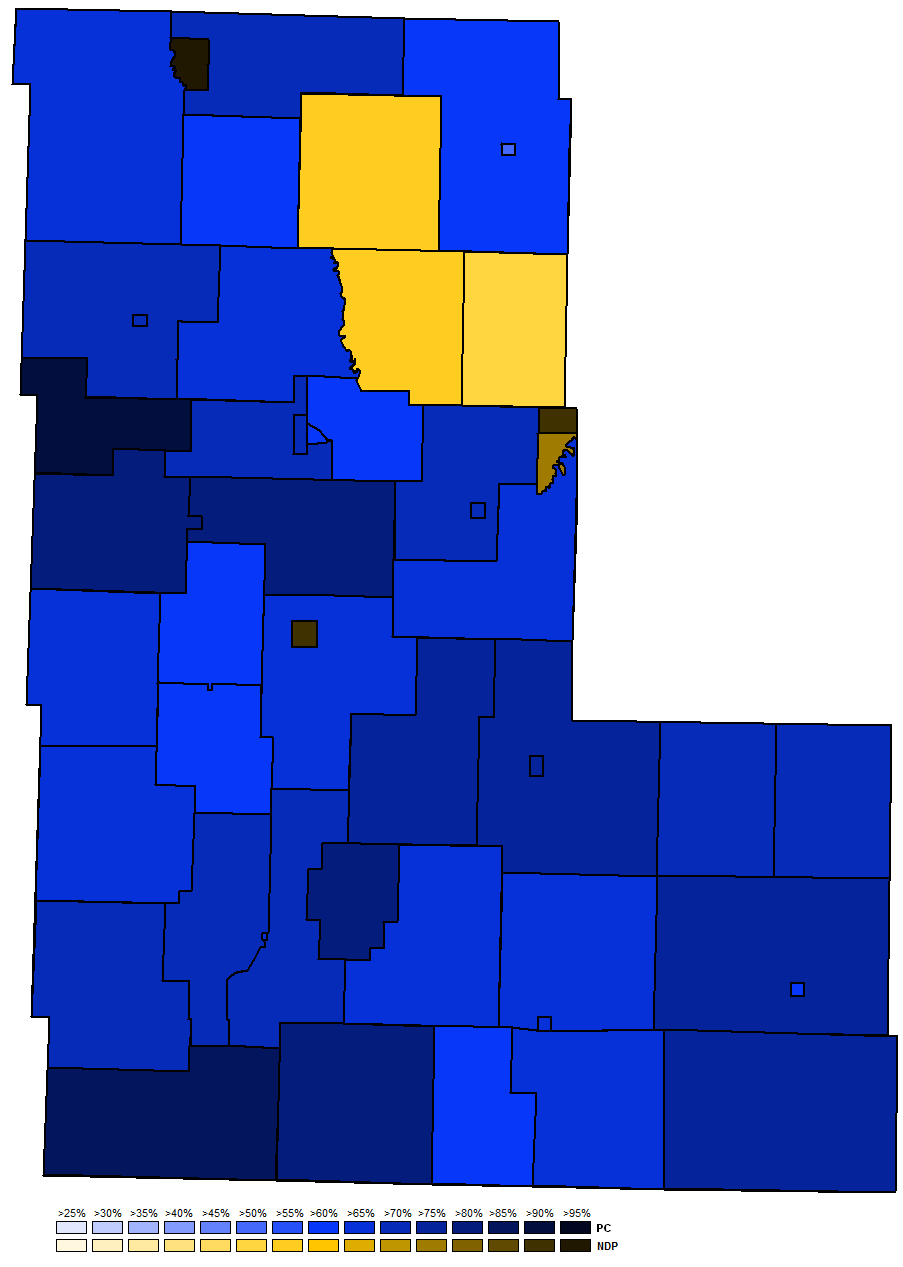
2011 results by polling division in Morris (urban polls combined)
PC MLA Mavis Taillieu’s steamroll victory over the NDP’s Mohamed Alli in 2011 (she defeated him by over 4000 votes or 74%-19%) ensured that every poll in the riding backed her. Her strongest poll was #17, located in Cartier Rural Municipality in the northwest of the riding. In this poll, she won 93% of the vote. The poll contains a number of Hutterite Colonies surrounding the community of Elie. Her worst poll was also located in Cartier, which was poll #11. In this poll, she won just 57% of the vote. Poll 11 is concentrated on the community of Lido Plage, on the south shore of the Assiniboine River. Federally, the riding is split between Provencher and Portage—Lisgar. All of the Morris polls in both federal ridings also went Tory in the last election.

Outlook

The Tories are running former Manitoba director of the Canadian Federation of Independent Business Shannon Martin. He has been the candidate since May of last year. Opposing him from the NDP is actor/director/writer Dean Harder. The Liberals are running University of Manitoba student Jeremy Barber. It is no question that the Tories should easily win this riding. They won it easily in 2011 when they lost the provincial election as a whole, so now that they have a massive lead in the polls, it should be a cakewalk. The real question is, how big of a victory can they get? Can they reach 80%? And who will finish second? The Liberals only won 7% of the vote in 2011, but they are currently polling at 20% province-wide, which is a 12-point gain from the 2011 election. Plus, the last provincial by-election held in Fort Whyte, another safe Tory seat- saw the Liberals vault from third to second.  It is quite possible that this will happen again in Morris. The Liberals last finished second in this riding in 1999.


Arthur-Virden


Arthur-Virden is nestled in the southwest corner of the province, and is almost completely rural in nature. Its western boundary is the province of Saskatchewan, and on the south it’s bounded by the United States. The riding is shaped like an "L", with its northern wing extending northward past the community of Hamiota, and its eastern wing extending east past Boissevain. In addition to Hamiota and Boissevain, the riding also includes the communities of Hartney, Melita, Deloraine, Oak Lake, Virden and Elkhorn. Virden is the largest community. The riding also has a large German population.

History 

The riding was created in 1989 when the previous ridings of Arthur and Virden were merged into one. The area became part of Manitoba in 1881 when the western boundary of the province moved west. The area was covered by the riding of Turtle Mountain from 1881 to 1886 and then by Souris from 1886 to 1903. Virden was created in 1899 and Arthur was created in 1903. The Tories have dominated the region since 1953, with the Progressive Conservatives winning both Arthur and Virden in every election since. The NDP has never won either riding, and the Liberals haven’t held either seat since 1922.  Since Arthur-Virden was created in 1989, the Tories have won a majority of the vote in the riding in every election except 1999 when Larry Maguire won with 49% and the NDP winning 36%. In 2011, Maguire won 66% of the vote, with the NDP winning 30%. 

MLAs:

Arthur (Turtle Mountain 1881-1886; Souris 1886-1903)

J.P. Alexander, Cons. (1881-1883)
F.M. Young, Liberal (1883-1886)
J.P. Alexander, Cons. (1886-1888) 2nd time
A.M. Campbell, Liberal (1888-1899)
A.E. Thompson, Cons. (1899-1907)
Jn. Williams, Liberal (1907-1910)
A.M. Lyle, Cons. (1910-1914)
Jn. Williams, Liberal (1914-1922) 2nd time
D.L. McLeod, Prog./Lib.-Prog. (1922-1936)
J.R. Pitt, Lib.-Prog. (1936-1953)

J.A. Ross, Prog. Cons. (1953-1958)
J.G. Cobb, Prog. Cons (1958-1962)
J.D. Watt, Prog. Cons. (1962-1977)
J.E. Downey, Prog. Cons. (1977-1990)


Virden
Jas. Simpson, Cons. (1899-1903)
J.H. Agnew, Cons. (1903-1908)
H.C. Simpson, Cons. (1909-1914)

Geo. Clingan, Liberal (1914-1922)
R.H. Mooney, Prog./Lib.-Prog. (1922-1953)
J.W.M. Thompson, Prog. Cons. (1953-1962)
D.M. McGregor, Prog. Cons. (1962-1981)
H.E. Graham, Prog. Cons. (1981-1986)
G.M. Findlay, Prog. Cons. (1986-1990)

Arthur-Virden
J.E. Downey, Prog. Cons. (1990-1999) continued
L. Maguire, Prog. Cons. (1999-2013)


Political geography
2011 results by polling division in Arthur-Virden (urban polls combined)


Unlike Morris, the NDP actually did win polls in Arthur-Virden in the 2011 election. The NDP won a total of 7 polls, 4 of which were on Indian Reserves. The other 3 polls the NDP won were rural polls in the northern part of the riding. The Tories did win every other poll in the riding. The best poll for the Tories was #14, in the west-central part of the riding, where they won 93% of the vote. This poll is located in the Wallace Rural Municipality, and contains the community of Kola, and a Hutterite colony. The Strongest NDP poll was #2, which covers the Birdtail Sioux First Nation, located near the northern boundary of the riding. The NDP’s Garry Draper won 95% of the vote on the reserve, with Maguire unable to win a single vote. The Liberal candidate won one vote there. Federally, the riding is mostly located in Brandon—Souris, with the far northern portion located in Dauphin—Swan River—Marquette. In the 2011 federal election, all but one poll in Arthur-Virden went Conservative.


Outlook

Running for the Tories is Russell native Doyle Piwniuk, who is a local businessman. The NDP is running local educator Bob Senff, who ran previously for the party in 2007 as well as in the 2006 federal election.  The Liberals are running Floyd Buhler, the CAO of Wallace Rural Municipality. Just like Morris, the race in Arthur-Virden will be for second place. The way the polls are going, it would take a lot to stop Piwniuk from winning. It will be an uphill battle for the Liberals to place 2nd, as they won just 4% of the vote in 2011. They haven’t received more than 10% since 1999. However, the Liberals did finish second in 1990.

Conclusion 

For the Tories to “win” tonight, they will need to increase their vote share in both ridings. For the Liberals, they will need to finish 2nd in at least Morris to have a successful night. For the NDP, they need to hold their ground, by staying in 2nd place in both ridings. We’ll find out what happens when the polls close at 8:00pm Central (9:00 pm Eastern).

Monday, November 25, 2013

November 25 federal by-election profiles: Brandon-Souris

The final installment in my four-part series covering today's by-elections takes a look at Brandon—Souris, in the southwestern corner of the province. Somewhat unexpectedly, due to mostly local factors, this formerly safe Conservative district has become the most likely to switch hands of the four by-elections today. The seat was vacated in August when Tory backbencher Merv Tweed resigned.

Brandon—Souris is dominated by the City of Brandon, which makes up just over half of the riding's population. Brandon is the hub of western Manitoba, and is the province's second largest city. The rest of the riding is very rural in nature, covering most of the southwest corner of the province, running from the community of Rivers in the north, and past Highway 5 in the east. Smaller communities in the riding include Virden, Killarney, Souris, Carberry, Boissevain and Melita.

Brandon-Souris guide map

History


Brandon-Souris was created in the 1952 redistribution following a merger of the former Brandon and Souris ridings. At the time, the riding was slightly smaller than today's boundaries, but contained mostly the same communities. The northern boundary passed just north of Virden and Brandon, the northeast boundary was formed by the Assiniboine River, and the eastern boundary was just east of Killarney. In 1966, the riding boundary was moved westward to exclude Killarney, and also moved northward to include the Elkhorn area. In 1976, the boundary was moved back east to include Killareny. In 1987, the Riverside Rural Municipality was removed from the riding. In 1996, Riverside was added back, and the eastern and northern boundaries were pushed outward to include the South Cypress Rural Municipality in the northeast, and the Rivers area in the north. In 2003, the boundaries were pushed further outward to include Carberry and North Cypress Rural Municipality in the northeast and Argyle and Roblin Rural Municipalities in the southeast.

From 1903 to 1952, the area was covered by two ridings, Brandon and Souris. During this time, the Brandon riding always consisted of the communities of Brandon, Souris and Virden, while the Souris riding always consisted of the communities of Killarney, Boissevain and Melita. The northern boundary of the Brandon riding remained the same during this period, running along the north side of the 12th Townships, while the boundary between Brandon and Souris remained static as well, running along the north side of the 6th townships. However, the eastern boundaries of both ridings fluctuated over time. In 1903, Brandon riding extended just east of the City of Brandon, while Souris extended much further to include Argyle and Roblin Rural Municipalities. In 1914, Souris' eastern boundary as moved westward slightly. In 1924, both ridings' eastern boundaries were moved westward by one range. In 1933, Brandon's boundaries remained the same, while Souris' eastern boundary was moved east by one range, but the area north of Killarney and east of the Souris River were removed from the riding. Finally, in 1947, Brandon's eastern boundary was moved eastward by 3 ranges, to include the communities of Shilo and Wawanesa, while Souris eastern and northeastern boundary were extended outward to include the Tiger Hills area north of Killarney. It should be noted that during this time, the community of Souris was confusingly never located in the riding of Souris. Instead, the riding was most likely named for the Souris River, which flowed through the riding. Thus, when the riding's were merged in 1952, the new riding took the name of both of its predecessors, which is why the riding is named “Brandon—Souris” to this day. The “Souris” is named for this predecessor riding, not for the town, which is not even the second largest community in the riding.

From 1896 to 1903, the area was covered by the riding of Brandon (Souris was split off of it in 1903). The Brandon riding of 1892 covered most of the same area as today's Brandon-Souris riding, except for the eastern end, excluding communities such as Killarney and Carberry. At the time, Killarney was in the riding of Lisgar.
This region of the province was annexed by Manitoba in 1881. Only a small sliver (the area around Dry River) of today's Brandon—Souris was located in Manitoba before this time. Upon the first redistribution after joining the province, the Brandon and Souris areas were first found in the riding of Selkirk. Prior to this time, the riding of Selkirk was located in the Winnipeg area. However, for some reason, the Selkirk riding was moved to the southwestern corner of the province, to include the areas south and west of Brandon, as well as the border region of the province, running along the southern border as far east as Plum Coulee (just east of Winkler). The Selkirk riding during this time was not located anywhere near the City of Selkirk, north of Winnipeg. In 1896, Selkirk was moved back to a more logical location north of Winnipeg, and the southwestern corner of the province was transferred to the riding of Brandon.

Members of Parliament:

Selkirk (1882-1896)
  • H.M. Sutherland, Liberal (1882-1887)
  • T.M. Daly, Cons. (1887-1896)

Brandon (1896-1953)
  • Dalton McCarthy, McCarthyite (1896)
  • Clifford Sifton, Liberal (1896-1911)
  • J.A.M. Aikins, Cons. (1911-1917)
  • H.P. Whidden, Unionist (1917-1921)
  • Rbt. Forke, Prog. (1921-1926); Liberal Prog. (1926-1930)
  • T.A. Crerar, Liberal (1930)
  • D.W. Beaubier, Cons. (1930-1938)
  • J.E. Matthews, Liberal (1938-1950)
  • W.G. Dinsdale, Prog. Cons. (1951-1953)

Souris (1904-1953)
  • F.L. Schaffner, Cons. (1904-1917)
  • A.E. Finley, Unionist (1917-1921)
  • Jas. Steedsman, Prog. (1921-1930)
  • E.F. Willis, Cons. (1930-1935)
  • G.W. McDonald, Liberal Prog. (1935-1940)
  • J.A. Ross, Prog. Cons. (1949-1953)

Brandon—Souris (1953-present)
  • W.G. Dinsdale, Prog. Cons. (1953-1982) continued
  • W.L.R. Clark, Prog. Cons. (1982-1993)
  • Glen McKinnon, Liberal (1993-1997)
  • R. Borotsik, Prog. Cons. (1997-2004)
  • M. Tweed, Cons. (2004-2013)

Brandon—Soruis' boundaries are set to change again. The recent federal electoral district boundary commission has changed the boundaries of the riding, set to take effect in the next federal election. The northern boundary will move southward, as the Rural Municipalities of Woodworth, Daly, Elton and North Cypress and the Towns of Rivers and Carberry will be moved to the riding of Dauphin—Swan River—Neepawa. The eastern boundary will move eastward, taking in the Rural Municipalities of Victoria and Louise, the town of Pilot Mound and the Village of Crystal City.

Conservatives have dominated the Brandon—Souris area since the 1950s, with the Liberals only winning the riding once- in the Chretien wave of 1993 since then. Interestingly though, the riding was the only one in Western Canada to elect a Progressive Conservative in 1997, when Brandon mayor Rick Borostik was elected. The riding never voted for the Reform Party or the Canadian Alliance during this time, with Borostik being re-elected in 2000. A red Tory, he reluctantly joined the new Conservative Party in 2003 after the Canadian Alliance and Progressive Conservatives merged, but he did not run for re-election in 2004. Tory Merv Tweed has held the riding since then.

Prior to the 1950s, the area swung back and forth between the Liberals and Tories. However, the Liberals never held the more rural riding of Souris. The Progressive Party also did well in both Brandon and Souris, with Progressive leader Robert Forke holding Brandon between 1921 and 1930, James Steedsman holding Souris for the Progressives from 1921 to 1930 and Liberal Progressive G.W. McDonald representing Souris from 1935 to 1940. Thomas Crerar, who was also a Progressive Party leader held the riding of Brandon briefly in 1930, but as a Liberal. Additionally, Brandon was one of two ridings where the Anti-Catholic, Anti-French McCartyhite leader Dalton McCarthy ran in 1896. He won in Brandon as well as the Ontario riding of Simcoe North, where he chose to represent instead.


Political geography


Recent political dominance in this riding by the Conservatives dwarfs the political polarity in this riding between the city of Brandon and the rest of the riding. Brandon is far more moderate then the rural conservative parts of the riding. Except for a couple of Indian Reserves, the only polls the Tories have lost in the last three elections were in Brandon. If you go back to the 1997 and 2000 elections, Brandon backed their former mayor Progressive Conservative Rick Borostik, while rural Brandon—Souris backed the Reform or Canadian Alliance candidates. In provincial elections, the rural area surrounding Brandon votes overwhelmingly Tory, while Brandon itself is usually more competitive. Currently the NDP holds the provincial constituency of Brandon East, while the Tories have Brandon West.

Since first being elected in 2004, Merv Tweed has been able to win a majority of the vote in every election, including the 2011 election which was the first time he broke 60%. Since finishing second in 2004 with a quarter of the vote, the Liberal Party has been in steady decline in the riding, having their vote share decrease in every subsequent election. In 2006 they finished third with 18%, in 2008 they dropped to fourth with just 8%, and in 2011 they dropped to just 5%.This mark was the lowest ever for the Liberals since the riding was created over 60 years ago. The NDP has been the 2nd place party in this riding since 2006, and their 25.2% of the vote in 2011 was their best showing ever in the riding since its creation. While the Greens only won 6% of the vote in 2011, it was enough to eclipse the Liberals. The Greens were particularly strong in 2008, where they won 16% of the vote, just 600 votes fewer than the NDP candidate, and 2,600 votes more than the Liberal.

2011

2011 results by polling division

The 2011 race in Brandon—Souris saw Merv Tweed win with his highest vote share of his federal electoral career, winning 64% of the vote. He defeated the second place NDP candidate, Jean Luc Bouche by over 13,500 votes. Geographically, his win gave him every single rural poll in the riding (that is outside of Brandon) except for two Indian Reserves. Within Brandon, Tweed won most of the polls as well, but performed poorly within the central part of the city. Outside of Brandon, Tweed's support wasn't concentrated particularly in any specific region of the riding, generally however, the further one gets from Brandon, the better he did. The NDP was the only other party to win any polls. All but two of the NDP's poll wins came from within the city of Brandon. The NDP won 9 polls and tied in one more in Brandon. Six of wins came from within the Downtown area (plus the tie). Outside of Brandon, the NDP won the two Indian Reserve polls: the Sioux Valley Dakota Nation and the Canupawakpa Dakota First Nation (Oak Lake Reserve).

The Strongest Conservative poll in 2011 was Poll #3, which comprises of the community of Kola in the Wallace Rural Municipality in the northwest part of the riding. Tweed won 91% of the vote there. The second best Conservative poll was in the adjacent poll #4, centered on the community of Scarth. In this poll, the Tories won 89% of the vote. The strongest NDP poll was #22, covering the Sioux Valley Reserve, where they won 73% of the vote. The NDP also did well in Poll #21, which covers the Oak Lake Reserve, where they won 61% of the vote. Poll #55 was the best Brandon poll for the NDP, where they won 54% of the vote. This poll covers the Assiniboine Gardens neighbourhood of Brandon, which is located just north of Downtown.

2008

2008 results by polling division
 The 2008 election in Brandon—Souris was similar to 2011 in that the Tories won with a large majority of the vote, and won all of the rural polls (except the two Indian Reserves) and most of the city polls. The margin of victory was nearly the same as 2011 as well, with Tweed winning by 13,500 votes, as well the top two candidates were the same in the Conservative's Merv Tweed and the NDP's Jean Luc Bouche. The major difference between 2008 and 2011 was the strength of the Greens. The Green candidate, Dave Barnes ran a strong campaign, which resulted in a strong 16% of the vote. This resulted in 3rd place finish, behind the NDP, but allowed him to win a number of polls, all of which were in Brandon. Both the NDP and the Greens did well in Brandon, but the two parties split the non-Conservative vote, allowing the Tories to win more polls there than they did in 2011. Both the Greens and the NDP won four polls in Brandon, while the NDP tied in two more with the Conservatives. The Greens won three polls in the Downtown, plus the one poll that covers Brandon University. The NDP won two polls Downtown as well, plus their two ties.

As in 2011, the strongest poll for the Conservatives was poll #3 in Kola. The Tories picked up 88% of the vote there. Their second best poll this time was #173 in Holmfield, in the opposite (southeast) corner of the province. Holmfield is located just southeast of Killarney, and the Conservatives won 85% there. For the NDP, once again their two strongest polls came from the two Indian Reserves. They won 67% in Sioux Valley and 58% in Oak Lake. Their strongest Brandon poll was #116 in the East End of the city, where they won 47%. For the Greens, their best poll was #119, in Downtown Brandon, between 9 Street, 14 Street, Lorne Avenue and Victoria Avenue, winning 41% of the vote.

2008-2011 two-party swing

2008-2011 Conservative vs. NDP two-party swing

Both the 2008 and 2011 elections were races between the Conservatives and the NDP, so my two-party swing map analyzes the swing between those two parties from the 2008 election to the 2011 election. Both parties saw an increase in their vote share, with the Tories going up by 6.7% and the NDP up by 7.5%. This resulted in a small 0.4% swing to the NDP. The NDP benefited tremendously from the collapse of the Greens and the Liberals within the city of Brandon. Both the Greens and the Liberals had proportionally higher vote totals there, and with their collapse in 2011, much of their support went to the NDP. Outside of the Brandon area, most of the swing was towards the Conservatives, but usually only marginally so.


Demographics

Brandon—Souris is a fairly homogenous WASPy riding. 83% of the riding is White, and 10% is Aboriginal. Two-thirds of the riding is Christian, with the United Church leading all Christian denominations at 23%. 17% of the riding is Catholic, 6% Are Anglican, and nearly one third is non religious. Income levels are average for Manitoba, with the median income at $30,000 and the average income at $37,000. According to the 2011 National Household Survey, well over half the riding reported having British Isles origins, with English, Scottish and Irish having large proportions. The riding also has a significant German and Ukrainian population. 

 
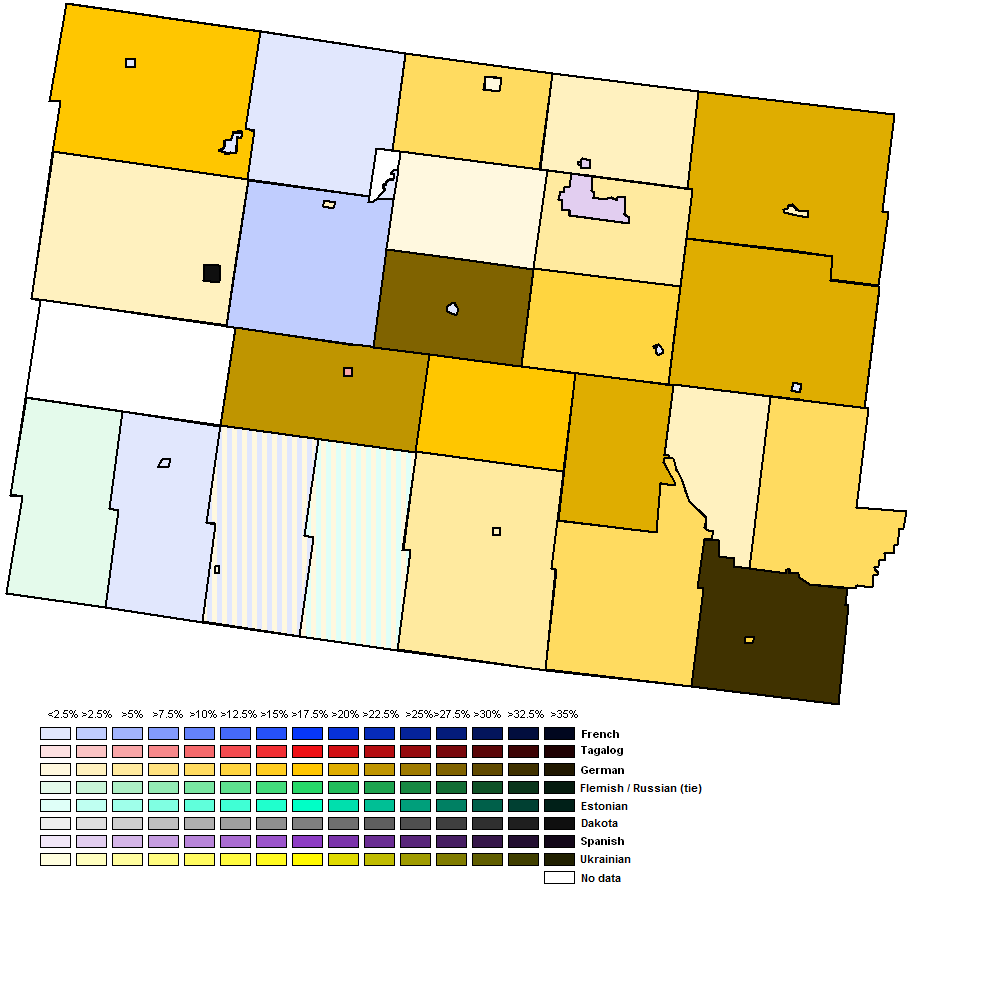
Leading non-English native language by Census Subdivision

Linguistically, English is by far the most common native language, with 86% of the riding having it as its mother tongue. The number two native language in the riding is German, at 4%, followed by Spanish (2%) and French (2%). German is the dominant second language in most parts of the riding, but they are concentrated mostly in the east. There are significant numbers of German native speakers (more than 20%) in the Rural Municipalities of Roblin, Glenwood, Cameron, North Cypress, South Cypress and Riverside. One other significant linguistic population lies in the Canupawakpa Dakota First Nation (Oak Lake), where 43% of residents are native Dakota speakers. One can assume that Dakota is widely spoken in Sioux Valley- the other Dakota Reserve, but no enumeration took place there. Also of note, Spanish is the second language of Brandon, although only 4% of the city are native Spanish speakers. Much of the southwestern corner of the riding lacks any linguistic diversity, which explains the light colours on the map. English is often the native language for 95-100% of the inhabitants in these areas. 


Candidates and expectations

Polls are suggesting that not only are the Liberals back to relevancy, but they are leading in this riding. Forum Research's most recent poll has the Liberals up 50-36 in this riding, an impressive lead indeed. So, what explains this? Well, the Liberal candidate in the riding brings some impressive name recognition. Their candidate is Rolf Dindsdale, who is the son of former Progressive Conservative MP Walter Dinsdale, who represented the area for 31 years. Rolf Dinsdale is a media executive with a colourful past, but the Dinsdale name runs deep in the city. Not only was his father a long time MP, but his grandfather was mayor of Brandon, and his brother is a two-time provincial Tory candidate. The Conservatives have a pretty strong candidate of their own in (now) former Athur-Virden MLA Larry Maguire. What's really hurting the Conservatives, however, is the ongoing Senate expenses scandal, among other things- that are really hurting the party. Another issue was with the nomination process with the Conservatives, which involved a candidate's nomination papers being rejected under dubious circumstances. With the riding supporting a Red Tory instead of a Reform or Canadian Alliance MP from 1997-2004 when surrounding ridings were electing Reform-Alliance Members of Parliament, it's not surprising to see the riding possibly going against the Conservatives, and electing a Liberal, son of a Tory MP. The NDP is running Labour Council president and Wawanesa resident Cory Szczepanski while the Greens are running greenhouse owner and Turtle Mountain resident David Neufeld.

If Forum Research is to be believed, the Liberals should take this riding, it what could be the only pick-up on by-election night. A Liberal win, would be the party would be sweeping the city of Brandon, where the Dinsdale name carries the most weight. Outside of Brandon will probably stay solidly conservative, especially the western part of the riding, which Maguire represented in the Manitoba Legislature. For the Liberals to win though, they have to break into the rural areas surrounding Brandon, as winning just the city will not be enough to win the riding. A Liberal pick up would be huge for the party, as it would be promoted as showing the public that they are the true alternative to the Conservatives, and would be a clear indicator that they are the number one party in the country at the moment.

Polls close in all four by-elections at 9:30 Eastern (8:30 Central).