Monday, March 9, 2015

Provincial by-election in Richelieu, Quebec today

Voters in the Quebec riding of Richelieu head to the polls today to elect a new Member of the Quebec National Assembly in a provincial by-election. The riding has been sitting vacant since September, when its MNA, Elaine Zakaib resigned to work as chief of restructuring and vice president of strategy for the struggling women's clothing chain, Jacob (which would later go bankrupt). Zakaib, a member of the Parti Quebecois was first elected in the 2012 election, and was re-elected in 2014.

Richelieu is anchored by the city of Sorel-Tracy, whose 35,000 inhabitants make up two-thirds of the riding's population. It is located on the south shore of the St. Lawrence River, between Montreal and Trois-Rivieres. The riding contains all of the Pierre-De Saurel Regional County Municipality plus four rural municipalities in Les Maskoutains Regional County Municipality. Roughly speaking, the riding takes in the lower valleys of the Richelieu and Yamaska Rivers, and the area between them.


Demographics


Richelieu's demographics is that of a typical homogeneous French Canadian riding. It has very few immigrants, and is overwhelmingly Francophone, with 98% of its inhabitants citing French as their mother tongue. The riding is 98% White, and is 91% Catholic (with 7% being irreligious). Outside of the dominant French Canadian ancestry, about 2% of the riding is of Aboriginal ancestry, and at least 3% have Irish ancestry. Manufacturing is the main industry in the riding, employing nearly 20% of the work force. The riding is slightly poorer than the provincial average. The median income is $26,000, while the provincial median is $28,000. The average income in Richelieu is $32,000, compared to $36,000 in the whole of Quebec.


History


Richelieu has existed as a riding since confederation, except for a brief period during World War II when it was part of Richelieu-Vercheres. The riding voted mostly Conservative in the 19th Century, but then backed the Liberals continuously until 1948. Between 1948 and the rise of the PQ in 1976, the riding flipped back and forth between the Liberals and the conservative Union Nationale party. The PQ has held the riding almost continuously since then, except for the period between 1985 and 1994 when the Liberals had last held it. Despite being a PQ stronghold, the PQ has not been able win a majority of the votes here since 1998. Since then, the anti-PQ vote has been split between the Liberals and the ADQ/CAQ. In 2007, the ADQ came within 2000 votes of winning the riding, but fell back to a distant third in 2008, when the Liberals finished second, 3000 votes behind the PQ's Sylvain Simard. Zakaib's first win in 2012 was more comfortable, as she defeated the CAQ candidate by 3,600 votes. Her win in 2014 was another 3,600 vote margin against the CAQ candidate. However, both her and the CAQ lost a significant chunk of votes to the Liberals, who finished a relatively close second place, 4000 votes behind Zakaib.

MNAs:


1) Jos. Beaudreau, Cons. (1867-1869)
2) Pierre Gelinas, Cons. (1969-1871)
3) J.-A. Dorion, Cons. (1871-1875)
4) Michel Mathieu, Cons. (1875-1881)
5) Leon Leduc, Cons. (1881-1886)
6) L.-P-.P. Cardin, Liberal (1886-1892)
7) Louis Lacouture, Cons. (1892-1897)
*) L.-P.-P. Cardin, Liberal (1897-1912) 2nd time
8) M.-L. Peloquin, Liberal (1912-1923)
9) J.-B. Lafreniere, Liberal (1923-1929)
10) Avilla Turoctt, Liberal (1929-1939)
11) Felix Messier, Liberal (1939-1942)
12) J.-W. Robidoux, Liberal (1942-1948)
13) Bernard Gagne, U.N. (1948-1952)
14) Gerard Cournoyer, Liberal (1952-1956)
*) Bernard Gagne, UN (1956-1960) 2nd time
*) Gerard Cournoyer, Liberal (1960-1966) 2nd time
15) Maurice Martel, U.N. (1966-1970)
16) Claude Simard, Liberal (1970-1976)
*) Maurice Martel, P.Q. (1976-1985) 2nd time
17) Albert Khelfa, Liberal (1985-1994)
18) Sylvain Simard, P.Q. (1994-2012)
19) Ms. Elaine Zakaib, P.Q. (2012-2014)

Political geography


Richelieu is located in Quebec's sovereigntist heartland, an area north of Montreal that is one of the most reliably separatist parts of the province. Despite the orange wave of the 2011 federal election, the Richelieu area was still one of the few areas in the province to back the Bloc Quebecois. Before 2011, every federal riding along the St. Lawrence between Montreal and Trois-Rivieres voted for the Bloc, going back as far as their first election in 1993. In the 1980s the area backed Mulroney's Progressive Conservatives, which had the support of Quebec nationalists. Federally, the Richelieu area has not gone Liberal since 1980.

While Richelieu is a very homogenous riding, the fact that all three of the major parties did well in the 2014 election, revealed some political cleavages in the riding. The most noticeable cleavage is the urban-rural split. The PQ did slightly better in Sorel-Tracy than in the rural parts of the riding, while the centre-right CAQ party did slightly better in rural Richelieu. The Liberal's urban and rural numbers were about even, but most of their rural support was concentrated in the municipalities of Saint-Gerard-Majella, Saint-David and Yamaska in the eastern part of the riding. Saint-Gerard-Majella was the best municipality for the Liberals, where they won 49% of the vote. The central part of the riding was the best area for the CAQ. They won over 40% of the vote in the three rural municipalities there, Saint-Robert, Saint-Aime and Saint-Marcel-de-Richelieu. The strongest area for the PQ was also in the central part of the riding. The village of Massueville gave 45% of the vote to Zakaib, despite being surrounded by the Municipality of Saint-Aime, which went CAQ.

Historically, the rural parts of the riding have been less prone to support sovereigntist parties than in the urban centre of Sorel-Tracy. In 2008, much of the rural part of the riding went to the Liberals, but a lot of this vote had shifted to the CAQ in 2012. Federally, the BQ normally sweeps almost every poll in the riding. The 2011 federal election created a weird map, where the NDP won some suburban polls in Sorel-Tracy, as well as the village of Massueville, which was the PQ's best area in the last provincial election. The NDP also won a scattering of rural polls across Richelieu, and won all the Richelieu polls in the federal riding of Saint-Hyacinthe—Bagot (most of Richelieu is in the federal riding of Bas-Richelieu—Nicolet--Becancour). Most of the riding still backed the Bloc, however. Also of note was the municipality of Saint-Gerard-Majella, which may be the most conservative part of the riding. Not only was it the provincial Liberal's best poll in 2014, its lone poll was the only poll in Richelieu to vote Conservative in the 2011 federal election, and it also voted Conservative in 2006.


2014 election day results by municipality (or former municipality)

Outlook


Running to replace Zakaib for the PQ is Sylvain Rochon, a former journalist who had also served as her adviser. Running for the CAQ is businessman Jean-Bernard Emond, the Liberals are running financial adviser Benoit Theroux and QS is running professor Marie-Eve Mathieu. The sovereigntist Option Nationale party is running their leader, Sol Zanetti, though that party has been irrelevant since the 2012 election. The Greens, Conservatives and Equipe Aotonomiste are also running candidates.

Province-wide polling in Quebec has been fairly constant since the provincial election last Spring. The Liberals are polling a little bit worse than the 42% they won in 2014 (they are now in the high 30s), while the PQ and CAQ are about even in the polls, at about the mid-20s, which is around what they won last Spring. Quebec Solidaire seems to have benefited the most from the Liberal dip in the polls, and are up into the low-teens from the 8% they won in 2014. With the little volatility in the polls, it stands to reason that the PQ's Sylvain Rochon should be able to win today's by-election. In 2014, the CAQ candidate finished 12 points behind Zakaib, and without a CAQ surge, I do not think they will be able to make up the difference. For what it's worth, SorelTracy Magazine conducted a poll last month showing Rochon with a 14 point lead over Emond (41 % to 27%). Theroux was at 20%. 

Polls close at 8pm.

Re-cap of the Manitoba NDP leadership election: An excercise in futility?

Yesterday, the governing New Democratic Party of Manitoba held a leadership convention and re-elected their leader, Premier Greg Selinger. Back in the Fall, there was a caucus revolt in the party, following two years of trailing the opposition Progressive Conservative Party in the polls, due in part to recent unpopular policies, such as raising the Provincial Sales Tax. The NDP has been in power since 1999, and Selinger has been Premier since the last leadership vote in 2009. Following the revolt, which involved the resignation of five cabinet ministers, Selinger refused to step down as Premier, and called a leadership election.


Polls in Manitoba now show the NDP trailing the Tories by at least 20 points, and are now in threat of being surpassed by the Liberals, who hold just one seat in the legislature. This was no matter for a majority delegates at the convention this weekend, as they narrowly chose to keep Selinger as Premier. 50.9% of delegates voted for Selinger on the second ballot yesterday, defeating MLA Theresa Oswald. Another MLA, Steve Ashton (father of MP Nikki Ashton) also ran for leader, but was eliminated on the first ballot, in a close three way race. After the first ballot, Selinger had the support of 36% of delegates, Oswald had 34% and Ashton had 30%. Normally when party's have their annual or biennial leadership reviews, leaders need at least 70% support to feel comfortable enough to stay on as leader. This wasn't a leadership review, but it's clear Selinger barely even has majority support in his party, which means he will be in tough to lead the party into the next election, scheduled for the Spring of 2016.

The leadership candidates

The Manitoba NDP uses a traditional delegated leadership convention, which is relatively unheard for other provincial New Democratic Parties. Delegates are selected in a number of different fashions. More than half of the delegates were chosen at delegate meetings held across the province in February. Local members of the NDP in each riding elected slates of delegates representing the candidates. Slates were elected using plurality-at-large voting, meaning that in most cases one candidate would win all or almost all of the delegates in a riding. The number of delegates a riding has was determined based on the party's membership in that riding. Of all the ridings, The Pas, in Northern Manitoba had the most delegates with 145, owing in part to an expected by-election there, which has increased party memberships. Members in The Pas, and in four other ridings in Northern Manitoba had to mail in their ballots, as delegates meetings would have been impossible to hold in such geographically large ridings. The minimum amount of delegates a riding could have was five, which 10 ridings had. All but nine of those ridings are held by the Tories.


After all the delegate meetings were held across the province, it was clear that a close three-way race was emerging. Steve Ashton won the most constituency delegates with 482. Selinger was next with 415, and Theresa Oswald was close behind with 336. Another 7 delegates were unpledged. Oswald won an additional 91 delegates from the Manitoba NDP youth, while Ashton won one. Only 77 youth delegates showed up to the actual leadership convention, however. 1,212 of the 1,240 elected constituency delegates showed up to the convention. In order to vote, delegates had to attend the convention held at the Canad Inns Polo Park in Winnipeg.


Candidate delegate geography 


Delegate winners by riding

Selinger saw his best delegate meeting results in Winnipeg's working class north end, an area that is home to the NDP's base in the province. Outside of this area, Selinger won a splattering of ridings across the province, including both Brandon seats. His big delegate-haul was The Maples, in the northwest corner of Winnipeg, where he won all 117 delegates. His next best delegate win was Point Douglas in the north end of the city, where he won 34 delegates. Ashton won the most amount of constituency delegates, thanks in part to his big win in The Pas (126 of 145 delegates), which is right next door to his home riding of Thompson. Ashton did not sweep the north however (another strong NDP region of the province), as The Pas and Thompson were the only seats he won. He won most of his seats in suburban Winnipeg, and won a few rural seats as well. Ashton's other big wins were Thompson (61 delegates), Elmwood (59 of 61), Concordia (46) and St. Norbert (44). Despite winning the least amount of constituency delegates, Oswald won the most amount of constituencies. She did this by winning ridings with fewer delegates, in areas such as the south end suburbs of Winnipeg and in rural southern Manitoba. Oswald represents Seine River in the legisulatre, a suburban riding in the south end of Winnipeg, which is an important swing area that was key for past NDP election victories. Oswald did well in these swing areas, indicating that she may have been the best candidate for the party to retain these seats. Oswald's only major delegate win came from Wolseley, a seat in central Winnipeg, where she won 45 of a possible 48 delegates. Other than Wolseley, she did not win any seats with fewer than 25 delegates.


Other delegates


Owing in part to the NDP's formation in 1961 as a merger of the Co-operative Commonwealth Federation and the Canadian Labour Congress, unions still have a major influence in the NDP and are often still awarded delegates in some provincial leadership races. The Manitoba NDP, which still uses an archaic delegated convention anyways, is no exception in this regard. Selinger received endorsements from the two biggest affiliated unions, CUPE and the UFCW. While not all union delegates are bound to vote for who their union endorsed, these high profile union endorsements were key for Selinger to win the nomination, and to over come his lack of constituency delegates. Unions were initially entitled 691 delegates, but were only able to fill up 296 slots at the convention. Even still, this was enough to held Selinger get elected. Despite winning the endorsement of two unions (United Fire Fighters and the United Steelworkers), it is clear from the results that Ashton did not win very many actual union delegates (no more than 12 by my estimation), despite both unions being worth a combined 86 delegates.


In addition to the constituency, youth a union delegates, 157 ex-officio delegates (of a possible 200) attended the convention, representing the party's riding associations, plus MLAs, Members of Parliament and other officials. While a caucus revolt spurred the leadership election, Selinger still had a lot of support from caucus members. 15 of the 37 members of caucus backed Selinger, compared to eight for Oswald and seven for Ashton (the rest were neutral). Assuming Ashton won a handful of union delegates, he probably won very if ex-officios other than the support of those seven caucus members, and presumably his daughter. Oswald must have won many ex-officios, considering her weak union support.


1,742 delegates (out of a possible 2,217) attended the convention, and thus were able to vote for leader yesterday. 1,699 delegates voted on the first ballot, and just 1,490 on the second. One would think that once Ashton was eliminated after the first ballot, most of his delegates would go to Oswald, to stop Selinger. However, this did not quite happen. It looks like a plurality of his delegates did not even vote on the second ballot. Those who did were evenly split between Oswald and Selinger. Oswald gained 151 votes on the second ballot, while Selinger gained 147 (while 209 fewer delegates voted on the second ballot). All three candidates were seen as polarizing figures, with deep flaws ,preventing much cross-support. It appears there were just as many people who did not want to see Oswald or Ashton win than who did not want to see Selinger win. This polarization was another factor that helped Selinger win, as delegates of his opponents could not unite against him.


Outlook 


In my opinion, the Manitoba NDP's archaic delegated voting system and union delegates helped Selinger win despite his clear lack of popular support. With a more democratic one member, one vote system, Selinger would probably have lost the leadership race, allowing the Manitoba NDP a chance at renewal. While it's likely the NDP was going to lose the next election no matter who they chose as leader, choosing to keep Selinger was probably the worst thing the party could have done. They had a chance to save grace, but instead will likely face a metaphorical blood bath in the next election. And with the Liberal brand on the rise across the country, the next election could be a repeat of the 1988 election (where the Liberals formed the opposition, with the NDP in third), but with a large majority for the Tories. And for now, the Selinger has to lead a beleaguered, divided party for at most, another 13 months.

Thursday, February 5, 2015

Sudbury provincial by-election today

The Kathleen Wynne-led Liberal government in Ontario will see its first electoral test today, after winning a majority government last June. In that election, the Liberals won an impressive majority government, gaining a net of ten seats from the 48 that they won in 2011. Out of all seats the Liberals had held prior to the 2014 election, they lost just two, both to the NDP. One of those two seats was Sudbury, where voters are heading to the polls today in a controversial by-election.


Background


Liberal Rick Bartolucci held Sudbury from nearly two decades before deciding to retire before the 2014 election. The 2011 election proved to be the toughest test of Bartolucci's career, as he was re-elected by a margin 500 votes over the NDP's Paul Loewenberg. Sudbury had been trending NDP for a while, ever since the federal party won a surprise election in the city in 2008. Bartolucci's departure meant that Sudbury became ripe for the NDP to pick up, despite the rising tide of the Liberal Party across the province in the 2014 election. The NDP nominated Greater Sudbury city councillor Joe Cimino as their candidate, who defeated Loewenberg for the nomination. On election day, Cimino picked up the seat with a narrow 980-vote victory, defeating the Liberal's Andrew Olivier. However, being an MPP proved too much of a challenge for Cimino, who resigned in November, after just five months at the job, citing health reasons and being apart from his family.

Cimino's early departure was a significant blow to the NDP. As we found out in a recent provincial by-election in New Brunswick, voters do not like it when politicians resign just a few months after being elected. Additionally, the Liberals have been polling well since the election, while the NDP has not. Had the Liberals played it safe, they would be looking for an easy victory today. However, the Liberals courted Sudbury's Member of Parliament, Glenn Thibeault, a New Democrat to be their candidate. This came much to the chagrin of Olivier, their past candidate, who had still had his eyes on the seat. Olivier had claimed he was offered a job or an appointment if he promised not to seek the nomination, in favour of Thibeault. This could be interpreted as bribery, and the OPP has already confiscated recorded conversations with Olivier and high profile Liberals to investigate the matter. Meanwhile, New Democrats were incensed that Thibeault would unexpectedly jump ship to the Liberals, a move that is sure to have angered some voters as well, who will have to deal with another politician leaving his seat (in this case however, there will likely be no federal by-election in Sudbury, which will leave the seat vacant until this year's federal election, scheduled for October). With Olivier deciding to run as an independent, a three-way race has emerged, and the outcome of today's by-election is less than certain.


Geography


The riding of Sudbury is located in Northern Ontario, taking in most of the former city of Sudbury, which was amalgamated with the rest of the Regional Municipality of Sudbury in 2001. While it shares the name of the federal riding of Sudbury, it has slightly different boundaries, as the provincial ridings in Northern Ontario have maintained their boundaries from 1999, while the rest of Ontario's provincial ridings have the same boundaries as the federal counterparts. This discrepancy was implemented in order to retain an extra seat in Northern Ontario, which was lost in the 2004 federal redistribution.

Sudbury's north, west and eastern borders follow the former Sudbury city limits, while the southern border follows a straight line through Kelley Lake to Long Lake Road, and then follows Highway 69 in the southeast. It contains most of the urban portions of Greater Sudbury, including Downtown Sudbury, and the city's inner-suburbs such as New Sudbury, Copper Cliff, Minnow Lake, Lo-Ellen and McFarlane Lake. For an urban riding, Sudbury has several lakes, the largest of which is Ramsey Lake in the east.


Demographics


Sudbury has a fairly low immigrant population, resulting in the riding being very White (88%), although there is a decent Aboriginal population at 8%. Most residents are of British Isles or French ancestry, but there is a small Italian and German community. Two thirds (69%) of the riding are Anglophones, while almost a quarter (24%) are Francophones. Italian is the third language of the riding, with 3% being native speakers. Over three quarters (78%) of the riding are Christian, with over half (56%) being Catholic. The United Church is the largest Protestant denomination at 5%, while 21% of the riding is irreligious. While Northern Ontario has a reputation of being poor, Sudbury is not much poorer than the rest of the province. The federal riding has an average income just $2000 less than the provincial average. Retail and health care are the predominant industries in the riding.


History


Sudbury has been represented at Queen's Park by its own electoral district since 1908. During this time, all three parties have held the riding, though the Tories have not won it since 1985. Since then it has gone back and forth between the Liberals and NDP, but the Tories still managed to finish second in the 1999 and 2003 elections. During this time, Rick Bartolucci won the seat for the Liberals with massive majorities, getting his best result in 2003 when he won 69% of the vote.


MPPs:

Algoma
*F.W. Cumberland, Cons. (1867-1874)
*S.J. Dawson, Liberal (1875-1878)

*R.A. Lyon, Liberal (1878-1883)

Algoma East
*R.A. Lyon, Liberal (1883-1890) continued

Nipissing
*Jn. Loughrin, Liberal (1890-1902)

Nipissing West
*J. Michaud, Liberal (1902-1905)
*A.A. Aubin, Cons. (1905-1908)

Sudbury
*F. Cochrane, Cons. (1908-1911)
*Chas. McCrea, Cons. (1911-1934)
*E.A. Lapierre, Liberal (1934-1937)
*J.M. Cooper, Liberal (1937-1943)
*R.H. Carlin, CCF (1943-1498)
*W.S. Gemmell, Prog. Cons. (1948-1954)
*G.J. Monaghan, Prog. Cons. (1955-1959)
*E.W. Sopha, Liberal (1959-1971)
*M.C. Germa, Liberal (1971-1981)
*J.K. Gordon, Prog. Cons. (1981-1987)
*Sterling Campbell, Liberal (1987-1990)
*Ms. S.M. Murdock, NDP (1990-1995)
*R. Bartolucci, Liberal (1995-2014)
*G. Cimino, NDP (2014)


Political geography


In 2014, the NDP saw its strongest support in the west part of the city, with the neighbourhood of Cambrian Heights being their best neighbourhood, winning 62% of the vote there. Other strong neighbourhoods for the NDP were Gatchell (58%), Flour Mill (56%) and the area south of Ontario St and west of Regent St (56%), all areas in the west and northwest parts of the city. Gatchell and the area west of Regent Street were especially strong for the NDP, as those neighbourhoods are in Ward 1, which Cimino had represented on city council. For the Liberals, they failed to get a majority of the votes in any neighbourhood, but were closest in Bell Park (49.8%) and the area around Laurentian University (49.5%). Both of these areas border along Ramsey Lake. Liberal support was the strongest in areas close to lakes, as the areas along both Ramsey and Nephawin Lake were strong areas for the Liberals. The only part of the city not close to a lake where the Liberals beat the NDP was the New Sudbury subdivision in the northeast corner of the city, where the Liberals edged the NDP 43%-39%. The Tories didn't win any polls in the riding, but they saw their strongest support in the University area along the south shore of Ramsey Lake, winning 27% of the vote (ahead of the NDP). Green support was highest in Bell Park (6%).

Historically, the NDP sees its best results in the northwest of the city, in neighbourhoods like the Donovan, as well as parts of Downtown and Minnow Lake. The Liberals tend to do better in the south of the riding, along Ramsey and Nephawin Lakes, and in parts of New Sudbury. Federally in recent elections, opposition to the NDP has been split between the Liberals and Conservatives in the city, which has allowed the Tories to make inroads in these traditional Liberal areas. In the 2011 federal election, the Liberals were shutout of the city, winning zero polls.

Results of the 2014 provincial election by neighbourhood


Outlook


Challenging Thibeault and Olivier is the NDP's Suzanne Shawbonquit, an Ojibwe businesswoman. Running for the Tories is Catholic School Trustee Paula Peroni and running for the Greens is Laurentian University professor David Robinson. Forum Research has released a number of polls of the riding, with the most recent one released yesterday (and conducted on Monday). It shows Shawbonquit with a narrow three-point lead over Thibeault (36%-33%), and Olivier at 14%. Trailing the three main candidates are Peroni at 11% and Robinson at 6%. Shawbonquit and Thibeault have been basically tied throughout the campaign, with Olivier's independent candidacy playing the wild card. Forum's mid-campaign poll had Olivier at 22%, but has seen his vote share drop considerably with their most recent poll. Interestingly, this drop has helped the NDP the most, with Shawbonquit up 6 points since January 21, while Thibeault hasn't budged. Local Sudbury pollster OraclePoll has also been polling the race, with their most recent poll (conducted in late January) showing Thibeault leading Shawbonquit 41%-26% (Olivier at 19%). Another pollster, MainStreet Technologies has also been polling the race, with their most recent poll (also conducted Monday) showing Thibeault ahead 32%-28% (Olivier at 14%).

It is likely that Olivier's support will erode even more, as the race has shaped into two-way battle between Thibeault and Shawbonquit. Where will his voters go? So far his erosion has benefited Shawbonquit, but much of his leftover support comes from voters who went Liberal last year. Will those voters hold their nose and vote for Thibeault, or will they hang on and stuck with Olivier? Will Tories switch to Thibeault to stop Shawbonquit, or would they be unwilling to to back a former New Democrat? Another factor I'd be concerned about is possible racism against Shawbonquit. Areas with high Aboriginal populations tend to deal with issues of racism (see Maclean's declaring Winnipeg to be Canada's most racist city), including in electoral politics. I've heard racism may have played a factor in the federal candidacy of Tania Cameron in Kenora, another Northern Ontario riding. While Shawbonquit has an accomplished back story, it might not be enough to quell any racist sentiment.

This race, with its turncoats and bribery (not to mention a politician quitting only a few months after getting elected) can make even the most optimistic citizen feel cynical about politics. And yet, there is a lot at stake for the Liberals and NDP. After the NDP's performance in the last election, many pundits were calling for Andrea Horwath's head, as they felt her party did not do as well as expected, despite the NDP seeing its best result since 1990. A loss tonight, after everything that has happened in this campaign would be a huge blow, and might be the straw to break the camel's back when it comes to Horwath's leadership. For the Liberals, it would mean picking up an important seat in Northern Ontario, which has been trending away from them in recent elections. It would also mean that even after everything that happened, it would prove that they are still very popular. Plus, governments have a reputation for losing by-elections. For Olivier, getting a good result (with Thibeault losing) would be a blow to the Liberals, and would send them a message that they did not play fair in this by-election, and would be at least a personal victory for him. Personally, I believe that Shawbonquit will squeak out a narrow victory, with a margin of anywhere from 1% to 5%. We'll see what happens when polls close at 9pm.

Tuesday, November 25, 2014

Provincial by-elections today in Newfoundland

In the 2011 provincial election, the Liberal Party of Newfoundland and Labrador won just six seats in the 48 member House of Assembly, and were nearly relegated to third party status, behind the NDP. They even finished in third place in the popular vote. Today, the Liberals have more than doubled their seat total, and are up to 14 seats. Tonight, they are likely to increase this to 16. Why? The rise of the Liberal brand across Atlantic Canada, coupled with the lack of popularity of both the governing Progressive Conservatives and the New Democrats in the province has allowed the Liberals to win all five by-elections held in the province since 2011, and have benefited from a number of floor crossings from both the Tories and the NDP. Today, there are to more by-elections in the province, and both are currently held by the PCs. They are in Trinity-Bay de Verde on the Avalon Peninsula, and Humber East on the west coast of the province.


Trinity-Bay de Verde


Trinity-Bay de Verde has sat vacant since early in September, when the province's then-Finance Charlene Johnson resigned to move to Asia, where her husband works. Johnson was the youngest woman to ever be elected as an MHA in the province, and was the first member to give birth while in office. It will be a huge shift from managing the province's finances to being a stay-at-home mother in a different country.

The riding is made up entirely of small fishing villages along the coast of the Bay de Verde peninsula, which forms the northwest wing of the larger “H” shaped Avalon Peninsula. The riding begins at the Town of Salmon Cove on Conception Bay in the southeast, and consists of the entirety of the Bay de Verde peninsula north of this point. The riding ends at the community of Hopeall in the southwest, on Trinity Bay. None of communities have more than 1000 people. The largest municipality in the riding is Heart's Delight-Islington with 704 people. Salmon Cove (691) and Old Perlican (661) are the next largest municipalities.

Trinity-Bay de Verde was formed in 1975 when the riding of Trinity South (communities on the south and east coasts of Tinity Bay) was merged the riding of Bay de Verde (communities on the west coast of Conception Bay). Since 1982, the riding has been a perfect bellwether, electing members of the governing party in the province in every election since then.


MHAs:

Carbonear-Bay de Verde
-H.L. Pottle, Liberal (1949-1956)
-G.W. Clarke, Liberal (1956-1971)

Bay de Verde
-W.P. Saunders, Liberal (1962-1972)
-Brendan Howard, Prog. Cons. (1972-1975)

Trinity-Bay de Verde
-F.B. Rowe, Liberal (1975-1982)
-J.G. Reid, Prog. Cons. (1982-1989)
-L.G. Snow, Liberal (1989-2003)
-Ms. Charlene Johnson, Prog. Cons. (2003-2014)


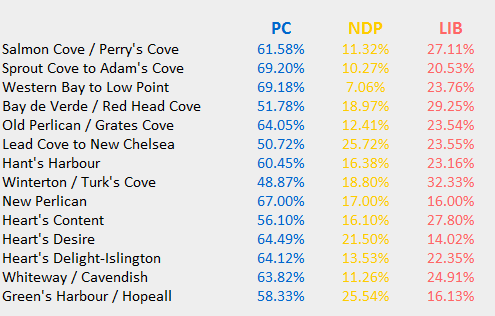
In 2011, Johnson won 62% of the vote in the riding. The Liberals finished second at 24%, and the NDP finished third with 14%. Johnson all but one poll in the riding, losing the community of New Chelsea to the NDP candidate, Sheina Lerman. The Liberals did not win any polls, despite placing second. Johnson's best area in the riding was the villages between Sprout Cove and Low Point along Conception Bay, where she won over 69% of the vote. Her weakest part of the riding was the Winterton/Turk's Cove area on Trinity Bay, where she won 49%. This was the best area for the Liberal candidate, Barry Snow, who won 32% there. Federally, the Bay de Verde peninsula is the most Liberal part of the entire Avalon Peninsula.

Trinity-Bay de Verde 2011 election results by area

Running for the Liberals is Steve Crocker, who is the assistant to Liberal leader Dwight Ball. Running for the Tories is Ronald Johnson, the father of the outgoing MHA. Running for the NDP is Tolson Rendell, who is a town councillor in Heart's Content, a small community on Trinity Bay. As the riding is a bellwether, and with the Liberals way ahead in the polls in the province, there is no doubt in my mind that the riding will be picked up by Crocker. After all, the next-door riding of Carbonear-Harbour Grace was recently won by the Liberals in a by-election, after the Tories won it by an even larger margin than Trinity-Bay de Verde in 2011.


Humber East


Tom Marhsall, Newfoundland's interim Premier before Paul Davis took over in September, not only resigned from the interim premiership, he resigned his seat as well, Humber East. This riding is located in Western Newfoundland, taking in the eastern half of the City of Corner Brook, and extending eastward to include part of the town of Pasadena. While the riding contains a handful of communities in between Corner Brook and Pasadena, the overwhelming majority of the population lives in Corner Brook. The riding is named for the Humber River, which bifurcates the riding, running from Pasadena to Corner Brook.

Humber East is historically much more conservative than Trinity-Bay de Verde. Since 1971, the Liberals have only held it for 7 years, when Bob Mercer represented the riding from 1996 to 2003. Marhsall easily won the riding in 2011 with 78% of the vote, with the Liberals in distant third at 8%. In addition to Marshall, the riding has been represented by one other premier, Clyde Wells, who held the riding from 1966 to 1971.


MHAs:

Humber
-C.H. Ballam, Liberal (1949-1956)

Humber East
-J.A. Forsey, Liberal (1956-1962)
-N.F. Murphy, Prog. Cons. (1962-1966)
-C.K. Wells, Liberal. (1966-1971)
-T.C. Farrell, Prog. Cons. (1971-1979)
-Ms. V.L. Verge, Prog. Cons. (1979-1996)
-R.D. Mercer, Liberal (1996-2003)
-T.W. Marshall, Prog. Cons. (2003-2014)


With Marshall winning easily in 2011, it stands as no surprise that he easily won every poll in the riding in 2011. Not only that, he won every single poll with at least 62% of the vote. Marhsall's strongest part of the riding was in the Corner Brook suburbs, winning 83% in Massey Drive and 84% in the Wheeler's Road / Elizabeth Drive area. His weakest area was the community of Humber Village, located halfway between Corner Brook and Pasadena, where he won 73% of the vote. Across the Humber River from Humber Village is the community of Little Rapids, where the NDP did the best, winning 20% of the vote. Steady Brook, a ski resort (as close as one can get to a ski resort in Newfoundland) just east of Corner Brook was the Liberals' best area, where they won 10%. Federally, this area is safe Liberal territory. The Tories have not won any polls in Humber East since 2000 (winning just 2), and have not done well in the area since 1997.

Humber East 2011 election results by area

Out of all by-elections held since 2011, Humber East is the riding that saw the best result for the Tories, and the worst result for the Liberals. The Liberals have been able to pick up four ridings from the Tories since 2011, but none have been safer for the Tories than Humber East. Having said that, other than it being a safer Tory seat than most, I don't see why the Liberals can't eke out a victory even here, as it has gone Liberal in the past, and it's very Liberal on a federal territory. Running for the Liberals is businessman Stelman Flynn, the former president of hospitality Newfoundland and Labrador. Hoping to stop the Liberal onslaught is the PC candidate, Larry Wells, who is the longtime executive assistant to Tom Marshall. The NDP is running Pasadena resident Martin Ware, a retired English professor at the Grenfell Campus (in Corner Brook) of Memorial University.

Polls close at 8pm (6:30 Eastern).


Monday, November 17, 2014

Federal by-elections in Yellowhead and Whitby-Oshawa today

There's snow on the ground in Ottawa, and in many other parts of the country, which means the end of a very busy Fall election season is almost upon us. Today is especially busy with a provincial by-election in Saint John East, New Brunswick (covered in my previous post) and two federal by-elections, one in Yellowhead, Alberta and the other in Whitby—Oshawa in Ontario. There is just a couple of provincial by-elections in Newfoundland next week, and then there shouldn't be any more electoral events until the new year. I usually cover each riding separately when doing riding profiles for federal by-elections, but this time, I'm including both Yellowhead and Whitby—Oshawa in one post.


Whitby—Oshawa

Map of Whitby-Oshawa's neighbourhoods


The more interesting of the two federal by-elections today will be in the riding of Whitby—Oshawa. The riding became vacant in April under unfortunate circumstances when its MP, former Finance Minister Jim Flaherty, a Conservative, passed away after suffering a heart attack. The riding could have been included in the by-elections held on June 30, but was delayed by the Prime Minster, perhaps out of respect for the departed.

Whitby—Oshawa is a sprawling, suburban riding, located east of Toronto in the politically infamous “905” belt, that circles the city. The riding contains the entirety of the Town of Whitby, and the northwest and rural northern part of the city of Oshawa. The riding is mostly suburban in nature, but contains a large rural area in the north, which is separated by the urbanized south by woods and conservation areas. Within this rural area is the bedroom community of Brooklin, which is geographically separated from the rest of Whitby by a wooded area and farm land.


Demographics


Whitby—Oshawa is one of the faster growing ridings in Ontario, due to its suburban nature and proximity to Toronto. About half of all homes in the riding were built since 1990. With nearly 150,000 people, it is the 11th most populous riding in the province. The riding is 81% White, but is home to large Black and South Asian populations. Most of the White population is of British Isles descent, that is English, Irish and Scottish. Most of the population (83%) has English as its mother tongue, with French next at just 2%. 71% of the riding is Christian, with less than half of that number being Catholic. United Church and Anglicans make up the largest Protestant denominations. Islam is the largest non Christian faith at 3%, while nearly a quarter of the riding belongs to no religion. The riding is slightly wealthier than the province as a whole, with the average individual income at $48,000 compared to the provincial average of $42,000. The largest industry in the riding is retail, employing nearly 10,000 people.


History


The riding of Whitby—Oshawa does not have a very long history, as it was only created in the 2003 redistribution. Rapid suburbanization has meant that over the course of history, Whitby has found itself in smaller, and smaller ridings. At Confederation, Whitby was only a small village, which was part of the rural riding of Ontario South (named for the now-defunct County of Ontario). Ontario South flipped back and forth from the Conservatives to the Liberals throughout its history. The riding changed names in 1925, becoming just “Ontario”. In the 1940s, due to the rise of the manufacturing sector in Oshawa, the socialist Co-operative Commonwealth Federation (CCF) became more popular, and elected an MP in a 1948 by-election. The CCF, and its successor, the NDP would remain competitive in the Ontario riding, but only won it once.

The area was dominated in the 1950s and 1960s by Ukrainian Immigrant Michael Starr, a Tory, who served as Minister of Labour under John Diefenbaker. Starr was finally defeated in a razor thin 15-vote margin in 1968, against future NDP leader Ed Broadbent in the new riding of Oshawa—Whitby. As the Toronto suburbs rapidly grew, Whitby re-joined the Ontario riding in 1976, then joined the riding of Whitby—Ajax in 1997, and then finally Whitby—Oshawa in 2004. Since 1984, Whitby has always voted for the party that has formed government, making it a fairly reliable bellwether. Tories Scott Fennell and Rene Soetens held represented the area during the Mulroney era, Liberals Dan McTeague and Judi Longfield during the Chretien and Martin eras, and Jim Flaherty had held the riding beginning in 2006, when Harper became Prime Minister.


Members of Parliament:


Ontario South (1867-1925)

Whitby and Oshawa were both in the riding of Ontario South from Confederation until 1925. This riding also included at different times, Pickering, and the Scugog area.

1) T.N. Gibbs, Liberal-Cons. (1867-1873)
2) Malcolm Gibson, Liberal (1874-1876)
*) T.N. Gibbs, Liberal-Cons. (1876-1878) 2nd time
3) F.W. Glen, Liberal (1878-1887)
4) Wm. Smith, Cons. (1887-1891)
5) J.I. Davidson, Liberal (1891-1892)
*) Wm. Smith, Cons. (1892-1896) 2nd time
6) Leo. Burnett, Liberal (1896-1900)

7) Wm. Ross, Liberal (1900-1904)
8) Peter Christie, Cons. (1904-1908)
9) F.L. Fowke, Liberal (1908-1911)
*) Wm. Smith, Cons./Unionist (1911-1921) 3rd time
10) L.O. Clifford, Liberal (1921-1925)

Ontario (1925-1968)

Ontario South was renamed “Ontario” in 1925. Oshawa and Whitby both remained in the riding until 1968.

11) T.E. Kaiser, Cons. (1925-1930)
12) W.H. Moore, Liberal (1930-1945)

13) W.E.N. Sinclair, Liberal (1945-1947)
14) A.H. Williams, C.C.F. (1948-1949)
15) W.C. Thomson, Liberal (1949-1951)
16) Michael Starr, Prog. Cons. (1952-1968)

Oshawa—Whitby (1968-1976)

In 1968, Oshawa, the Town of Whitby and part of the Townsip of Whitby were carved out of the riding of Ontario to form the new riding of Oshawa—Whitby. This arrangement only lasted until 1979.

17) J.E. Broadbent, N.D.P. (1968-1979)

Ontario (1976-1997)

In 1976, the Town of Whitby re-joined the Ontario riding, leaving the rest of Oshawa in the re-named riding of “Oshawa”. At this time, the riding of Ontario also included Uxbridge, Ajax and Pickering. In 1988, the more rural northern end of Whitby and Uxbridge joined the new riding of Durham.

18) T.S. Fennell, Prog. Cons. (1979-1988)

19) R.J. Soetens, Prog. Cons. (1988-1993)
20) D.P. McTeague, Liberal (1993-1997)

Whitby—Ajax (1997-2004)

Following the 1996 redistribution, Whitby joined with the southern half of Ajax to form the riding of Whitby—Ajax, which only lasted until 2004.

21) Mrs. J. Longfield, Liberal (1997-2004)

Whitby—Oshawa (2004-present)

The 2003 redistribution joined Whitby with the northern rural part of Oshawa, and some neighbourhoods in the northwest end of the city.

*) Mrs. J. Longfield, Liberal (2004-2006) continued
22) J.M. Flaherty, Cons. (2006-2014)

The 2015 federal election will see the creation of a new riding just called “Whitby”, consisting of the entirety of the Town of Whitby. The part of the riding in Oshawa north of Taunton Road will become part of the riding of Durham, while the area south of Taunton Road will become part of the riding of Oshawa.

2011 results by neighbourhood in Whitby-Oshawa


Political geography


Back in 2011, Flaherty nearly swept all polls in the riding. Only two polls in the Oshawa neighbourhood of McLaughlin were won by the NDP, which finished in second place in the riding for the first time since the area was in Ed Broadbent's Oshawa—Whitby riding. McLaughlin is the neighbourhood that is located closest to Oshawa's working class core, and was also the NDP's best neighbourhood in the riding, winning 31% of the vote. Flaherty's best numbers came in the rural parts of the neighbourhood, and in Brooklin, which is surrounded by rural areas. Flaherty's best neighbourhood was rural Oshawa, where he won 66%. Due to Oshawa's history of being a manufacturing centre with a large labour presence, Whitby is slightly more Conservative and less NDP-friendly than the Oshawa part of the riding. The Liberals finished third in the 2011 election, and were not the factor they usually are. Their top neighbourhood was Taunton North in Whitby. Historically, the Liberals have been able to win across the suburban neighbourhoods of the riding, but are much weaker in the rural north.
Whitby-Oshawa 2011 results by polling division

Provincially, Flaherty's widow, Christine Elliott is the local MPP. She was one of only two Tories to win in the inner 905 in last June's provincial election. Elliott is a popular MPP, and could have won some sympathy for having just lost her husband. In that election, the Liberals won a splattering of polls across the suburban areas, while the NDP won a cluster of polls in Oshawa, and even a few in Whitby. However, Elliott won an overwhelming majority of the polls, including all of the rural polls.

Whitby-Oshawa 2008-2011 two party swing by polling division (Cons vs NDP)


Outlook


Running for the Conservatives in this riding is former Whitby mayor Pat Perkins, who was mayor of the municipality from 2006 until resigning to run for parliament. Before that, she served on town council. The Liberals are running businesswoman Celina Caesar-Chavennes, a Black Canadian, who is also the President of ReSolve Research Solutions Inc. The NDP is running community organizer Trish McAuliffe, who was the party's candidate in 2011. The Greens are running local resident Craig Cameron.

Whitby—Oshawa will be the most exciting by-election to watch tonight, because polls show it as being a close race, and because of its history as being a bellwether riding, that usually votes for the government (if the Liberals are ahead in the national polls, it stands to reason they will win bellwether ridings like this one). Forum Research conducted an IVR poll yesterday that showed Liberal candidate Celina Caesar-Chavannes ahead of Conservative candidate Pat Perkins 45% to 42%. While conducting an IVR poll on a Sunday is suspect methodology at best, it is logical that this race would be close, but with the Liberals ahead.


Yellowhead

Map of Yellowhead

Head west of Edmonton, past the city's western exurbs, and you'll find the riding of Yellowhead, which extends westward from those exurbs, all the way to the British Columbia border in the west. This predominantly rural riding was vacated in September, when Alberta Premier Jim Prentice appointed him to the province's envoy to the U.S. to lobby for the Keystone XL pipepline.

Yellowhead is named for the famous Yellowhead Highway (Trans-Canada Highway #16), which runs through the riding like a ribbon, from Edmonton until the B.C. border, near Jasper, the riding's most famous community. Most of the riding lives in the eastern part of the riding, in the Pembina and McLeod River valleys. The riding does not consist of any major cities on which it is centred. Instead, the riding is populated by a number of small to medium sized towns, dotting the western prairie. The largest community in the riding is Hinton, which had 9,640 people as of the last census. This was just 35 more than the next largest community, Whitecourt. Edson and Drayton Valley are also major communities in the riding.


Demographics

Yellowhead is predominantly White, with about 85% of residents being neither a visible minority nor Aboriginal. Most of the rest of the population (12%) are Aboriginal, a mix of Cree, Saulteaux and Stoney First Nations. Much of the White population has British Isles ancestry (English, Scottish, Irish), but there is also a significant population with French ancestry. Francophones settled in the region in the 19th Century, with Lac La Biche being an important trading post. The riding also has a large German population and a significant Ukrainian. Nine tenths of riding have English as their mother tongue, with only small numbers of German and French speakers left. The riding is a majority Christian (58%), with about a third of Christians being Catholic, and one sixth being United Church. Most of the rest of the riding (40%) have no religion. In terms of income, the riding is about average for Alberta, if not slightly poorer. The median income is $35,000, compared to the provincial median of $36,000. The main industry in the riding is the resources sector, with 8,000 people employed in mining, quarrying, and oil and gas extraction.


History


Yellowhead has existed since 1979, but ridings that have covered similar territories have existed as far back as 1924. The area has been held by right wing parties since 1972, when Progressive Conservative Joe Clark won the riding, then known as “Rocky Mountain”. He held Yellowhead when he served as Prime Minister from 1979 to 1980, and continued to represent the riding until 1993. Cliff Breitkreuz of the Reform Party won it in 1993, and held it as Canadian Alliance member. Rob Merrifield was first elected in 2000 for the Canadian Alliance, and remained the MP when the party merged with the Progressive Conservatives to form the modern Conservative Party. The riding last went Liberal in 1968, when Allen Sulatycky was elected, benefiting from the height of Trudeaumania, and also having literally two Tories on the ballot, splitting the conservative vote. The last time a left wing party won the seat was when Donald MacBeth Kennedy won in 1930 for the United Farmers, though the CCF was competitive in the area during the 1940s.


Members of Parliament:


Edmonton (1904-1914)

Before Alberta became a province, it was a district in the Northwest Territories. The northern third of the district, including the Yellowhead area was found in the riding of Edmonton. The Yellowhead area remained in the riding of Edmonton until 1914 when it split in two parts (east and west).

1) F. Oliver, Liberal (1904-1917)

Edmonton West (1914-1924)

Edmonton West contained the western half of the Edmonton area, as well as everything west of the city, including the Yellowhead area.

2) W.A. Griesbach, Unionist (1917-1921)
3) D.M. Kennedy, Prog. (1921-1925)


Peace River (1924-1933)

In 1924, the riding of Peace River was created out of Edmonton, covering much of the same territory that Yellowhead does now.

*) D.M. Kennedy, Prog (1925-1926); U.F.A. (1926-1935) continued

Jasper—Edson (1935-1968)

In 1935, the riding grew larger, taking in more territory near Edmonton, and was re-named “Jasper—Edson”. A new riding of Peace River was created to the north.

4) W.F. Kuhl, Soc. Credit (1935-1949)
5) J.W. Welbourn, Liberal (1949-1953)
6) Chas. Yuill, Soc. Credit (1953-1958)
7) H.M. Horner, Prog. Cons. (1958-1967)

8) D.C. Caston, Prog. Cons. (1967-1968)

Rocky Mountain (1968-1979)

In 1968, most of the Yellowhead area was transferred to the new riding of “Rocky Mountain”, which extended south along the British Columbia border, all the way to the U.S. border in the south. Other parts of what is today the Yellowhead riding were transferred to Pembina and Wetaskiwin.

9) A.B. Sulatycky, Liberal (1968-1972)
10) C.J. Clark, Prog. Cons. (1972-1979)

Yellowhead (1979-present)

The riding of Rocky Mountain was dissolved in 1979. Out of the northern part of the riding came the new riding of Yellowhead. When it was created, Yellowhead's eastern boundary began at the western city limits of Edmonton. This boundary was shifted westward in 1987 to exclude Edmonton's western suburbs, like Spruce Grove. The riding has undergone only minor boundary changes since then.

*) C.J. Clark, Prog. Cons. (1979-1993) continued
11) C.N. Breitkreuz, Reform / Cdn. Alliance (1993-2000)

12) R. Merrifield, Cdn. Alliance (2000-204); Cons. (2000-2014)

The 2013 redistribution saw some major shifts in Yellowhead's boundaries to be used in the next federal election. Yellowhead loses the Fox Creek, Whitecourt and Barrhead areas to the new riding of Peace River—Westlock. To compensate, Yellowhead gains territory to its south, gaining the Rocky Mountain House area, and some new territory south of the North Saskatchewan River.

2011 Results by area in Yellowhead


Political geography


As is the case in all of rural Alberta, Conservatives win almost everything in this riding, and by large margins. In 2011, Merrifield won almost every poll in the riding en route to winning 77% of the vote. The Tories only lost six polls, all to the NDP, and tied another with the NDP. Two of those six polls were on Indian Reserves (the O'Chiese Band and the Sunchild First Nation in the southeast corner). The tied poll was also an Indian Reserve, the Alexis Band. The remaining four poll wins by the NDP were all in the resort community of Jasper, which has a progressive bent to it, similar to other ski resort communities in North America. The Greens were also strong in Jasper, winning 20% there. Overall, the Tories just beat out the NDP in Jasper, by 0.06% of Election Day votes. The Conservatives were strong every where else in the riding, winning at least two thirds of the vote in every town and rural area. Their strongest area in the riding was rural Brazeau County in the southeast of the riding, which surrounds Drayton Valley. In Brazeau County, the Tories won a massive 87%. The strongest Liberal area was the Alexis Band, where they won 16%.

Yellowhead 2011 election results by polling division

Historically, the only areas of the riding that aren't Conservative are the Indian Reserves and in Jasper. The NDP usually does well in Jasper, though the Greens won more polls there in 2006. The riding's Indian Reserves backed the NDP in 2008 and 2011, but were won by the Liberals before then. Provincially, the last election in West Yellowhead went mostly Tory, although the Alberta Party leader, won some polls in his hometown of Hinton. Wild Rose did not fare well, only winning two polls. Wild Rose fared much better in the rural eastern parts of Yellowhead, which is divided into the provincial ridings of Barrhead-Morinville-Westlock, Whitecourt-Ste. Anne and Drayton Valley-Devon. However, the larger towns in the area backed the Progressive Conservatives enough to win those ridings.
Yellowhead 2008-2011 two party (Cons vs NDP) swing by polling division

Outlook

Due to its long history of supporting right wing parties, it is obvious that the Conservatives will easily win here. Their candidate is retired RCMP officer Jim Eglinski, who lives in Edson, and has past political experience from being mayor of Fort St. John, B.C., nearly a decade ago. Since Eglinski's victory is a sure bet, the real race in the riding is for second place. The NDP has been the “second place” party here since 2006, and has some history in the riding, as they had won the provincial riding of West Yellowhead in 1989. Their candidate is retired Pulp Mill worker and Hinton resident Eric Rosendahl. The Liberals look to surpass the NDP into second place, with their candidate, Hinton town councillor Ryan Maguhn. The Greens are not running a candidate. Forum Research also polled Yellowhead on Sunday, showing Eglinski to be comfortably ahead at 51%. It showed Maguhn in second place at 24%, and Rosendahl far behind at 13%.


For the Liberals and Conservatives, fortunes tonight will be won and lost in Oshawa—Whitby. A win there would be huge for the Liberals, as it would show that they can win a 905 bellwether, which is key to forming government in this country. For the Conservatives, they need to win to show that they can still compete with the surging Liberals. For the NDP, all they can do is hope to maintain second place in Yellowhead, to show that they are still the default opposition party in Alberta. But if the results in Yellowhead are anything like the June by-election in nearby Macleod, where the NDP went from second place in 2011 to finishing in 5th place (behind the Christian Heritage Party), then disaster is surely on the horizon.

Polls close in both ridings at 9:30 Eastern / 7:30 Mountain.