Showing posts with label Newfoundland and Labrador. Show all posts

Tuesday, November 21, 2017

Mount Pearl North by-election preview

Voters in the riding of Mount Pearl North head to the polls today to elect a new member of the Newfoundland and Labrador House of Assembly. The riding has only been vacant since October 11, when its MHA, Steve Kent resigned to become the Chief Administrative Officer of the City of Mount Pearl. Kent was a member of the Progressive Conservative Party, and had been Deputy Prime Minister of the province under the Premiership of Kathy Dunderdale from 2014 to 2015. He was also mayor of Mount Pearl from 2003 to 2007, prior to being elected to the House. Mount Pearl North will be the first by-election held in the province since the Liberals swept into power in 2015, when they won a landslide majority government, capturing 31 of province's 40 seats. Mount Pearl North was one of only seven seats the Tories had won in the election.


Profile


Mount Pearl North is a suburban riding that covers the northern half of the City of Mount Pearl, the second largest city in the province, and the third largest municipality (after St. John's and the Town of Conception Bay South), located west of St. John's. The riding also covers two small subdivisions in St. John's itself: Brookfield Plains and Edison, which are made up of newly-built homes. The riding is shaped like an upside-down “U”, surrounding the central part of Mount Pearl. It covers the older part of the city in the east (mostly built before 1980), and newer subdivisions in the west and north which were mainly built in the 1980s, and since the 1990s respectively. The riding is more wealthy than the rest of of the province, with the average income being in the mid-$30,000 range (compared to $27,000 for the province) and is overwhelmingly White, with most residents being of English or Irish descent. 


MHAs since 1956

The riding is generally a safe Tory seat; it has elected Progressive Conservatives continuously since 1971 except for a by-election in 1988 which elected Liberal Eric Gullage and the subsequent provincial election in 1989 when he was re-elected (though, at the time the riding, then known as “Waterford-Kenmount” also covered what is now the riding of St. John's West). Gullage lost the seat in 1993 to Harvey Hodder, making the riding only one of 16 ridings to elect a Tory MHA that election. Hodder was re-elected in the new riding of Waterford Valley in 1996, a riding with similar borders to today's Mount Pearl North. The riding was one of only nine Tory seats won in 1996, with Hodder winning the seat by a nine-point margin. Hodder continued to represent the seat until Kent's election in 2007, winning increased majorities in 1999 (13 points) and 2003 (53 points!). Kent's first election win was a huge win, thanks to the coattails of the very popular Premier Danny Williams, winning the seat by a whopping 76 point margin over his Liberal opponent. He was re-elected in 2011 by a 54 point margin over the NDP candidate, and faced stiffer competition in 2015 against Mount Pearl mayor (Kent's successor) Randy Simms, whom he beat by nine points.

In the 2015 election, Kent won most of the polls on election day, but Simms won a scattering of polls across the riding. Kent's best neighbourhood was the new Brookfield Plains subdivision, where he won 59% of the election day vote. Simms only won one neighbourhood, that of Masonic Park which covers a nursing home which has since been shut down. 

Results by neighbourhood from the 2015 federal and provincial elections

In the federal election, the Tories were a non-factor, as the race was between incumbent NDP Member of Parliament Ryan Cleary and his Liberal opponent, Seamus O'Regan in the greater riding of St. John's South—Mount Pearl. O'Regan defeated Cleary, and easily won the election day polls corresponding to Mount Pearl North 60% to 35%. O'Regan won all but two polls in the area, with his best neighbourhood being Masonic Park (67%) and his worst neighbouhood being the Old part of the city, where he still won 55% of the vote (to Cleary's 41%).


Outlook

The front-runner in this race has to be the Tory candidate, Jim Lester, a farmer who owns and operates “Lester's Farm”, which is located on the southeastern border of the riding. He was the Tory candidate in the neighbouring Mount Pearl Southlands seat in the 2015 election, which he lost narrowly. The Liberal candidate in the by-election is St. John's businessman Jim Burton, who had previously sought the federal Liberal nomination in St. John's South—Mount Pearl, but withdrew in favour of O'Regan. The NDP candidate is Nicole Kieley, who is the executive director for the Newfoundland and Labrador Sexual Assault Crisis and Prevention Centre. There is a fourth candidate, businessman Hudson Stratton who is running as an independent.

Since winning the 2015 election, the popularity of the governing Liberals took a huge hit in 2016 after the government introduced a number of austerity measures, including the closing of most of the province's libraries. However, Liberal Party support has rebounded, but it is not back to where it was at the time of the last election. Both the Tories and the NDP have benefited from the Liberal's unpopularity, but Tory support is now back to where it was at the election, and the NDP, which currently has no leader is not fairing that much better. Needless to say though, I do not expect the Tories to lose this ordinarily safe-Tory seat.

Polls close at 8:00pm local time, which is 6:30 Eastern Time.


Tuesday, September 26, 2017

Newfoundland and Labrador municipal elections today

Newfoundlanders and Labradorians head to the polls today to elect municipal governments across the province’s 276 municipalities. Up for election are municipal councils; mayors, councillors and in some cases deputy mayors.

Across the province...


Among the province’s largest communities (over 5000 people), only the Town of Clarenville is seeing its mayor re-elected with no opposition. However, two other towns over 5000 people will not have an election for mayor, as only one candidate stepped forward to replace an outgoing mayor. Former Tory MHA Terry French has been acclaimed as mayor of Conception Bay South and town councillor Craig Scott has been acclaimed as mayor of Torbay. 

Municipalities on Newfoundland
Municipalities of Labrador

In addition to Conception Bay South and Torbay, the municipalities of Gander, Happy Valley-Goose Bay, Labrador City, Mount Pearl, Portugal Cove-St. Philip's and St. John's will all definitely be getting new mayors, as their incumbent mayors are not running for re-election. In Labrador City, they've switched voting systems, so that there will no longer be a direct election for mayor at all. Instead, voters there will get up to seven votes to elect the seven members of town council, and the candidate with the most votes of those seven will be elected mayor.

Most communities in the province elect their councils on an at-large basis, with no municipal ward system. In fact, only two municipalities have municipal wards: St. John’s and Conception Bay South. St. John’s has five municipal wards, and Conception Bay South has four.  In both cases, these wards elect one member of council, but both cities also have at-large councillors elected across the city, who do not stand in one particular ward.


St. John's


As St. John’s is by far the largest city in the province, and the province’s capital, most of my focus on today’s municipal elections will be there. St. John’s has an 11 member city council consisting of the mayor, deputy mayor, five councillors elected from each of the five city wards, and four councillors elected on an at-large basis. Both the mayor and deputy mayor positions are elected at-large as well.


St. John's mayoral candidates

The race for mayor of St. John's could be quite interesting, as incumbent mayor Dennis O'Keefe is not running for re-election. The race to replace him is between three candidates: former mayor Andy Wells, city councillor Danny Breen and community activist Renee Sharpe.

Wells, a former union negotiator, served as mayor of St. John's from 1997 until resigning amidst controversy in 2008, after being appointed as chair of the provincial public utilities board. He had initially refused to resign after his appointment. While he was mayor, he was known for his numerous scandals and outspoken, abrasive personality. He decided to run for mayor after being suspended from his position with the public utilities board due to criticizing the St. John's City Council using a government email.

Danny Breen has served on St. John's City Council since 2009, representing Ward 1. He was re-elected in 2013 without opposition. Breen is seen as a contrast to Wells, being non-confrontational and consensus building. He is a Tory; he ran for the Progressive Conservative Party in a 2014 by-election in Virginia Waters, losing to Liberal Cathy Bennett.

Renee Sharpe is an ironworker welder with a local union, and her grandfather was mayor of Paradise. She is also a self-defence instructor and has worked with a number of community organizations. Not surprisingly, her platform is the most left wing of the three candidates.

(Oh, and there's also a tongue-in-cheek campaign for “Finn” a five year old Australian cattle dog, whose campaign on YouTube has become something of a sensation. Finn is an acting dog, having appeared in a movie and on TV.)


The 2009 election was also an interesting race, between mayor Dennis O'Keefe, a Tory and city councillor Sheilagh O'Leary, a New Democrat. O'Keefe won the election with 57% of the vote to O'Leary's 42%, which is relatively close for municipal election standards, and closer than polls had predicted. O'Keefe won four of the five wards in the city, doing especially well in the city's conservative western and southern suburbs. O'Leary won the remaining ward (Ward 2), which covers the downtown and part of the east end, an area that typically votes NDP both federally and provincially.

Compared to 2009, which was a race between two conservative leaning candidates, O'Keefe increased his vote share by a slight amount in four of the city's five wards. However, his vote share took a large hit in Ward 2, going from 56% to 42%, thanks to the presence of O'Leary's candidacy. Overall, O'Keefe saw a slight decrease in his share of the vote, thanks entirely to the vote shift in Ward 2. Special thanks to the City of St. John’s elections office who sent me the ward-by-ward results of the 2013 mayoral race (data not available on the city's website).

O'Leary got back onto council in a by-election last year (in Ward 4), and is looking for a promotion as she is running for the deputy mayor position against Michelle Worthman. 

New St. John's Ward map

St. John's' ward boundaries were changed since the last election:
- Ward 1 loses the Pleasantville neighbourhood (to Ward 2) but gains the Penetanguishene neighbourhood (from Ward 4)
- Ward 2 loses the Cornwall Crescent and Albany Street areas (to Ward 3) but gains Pleasantville (from Ward 1)
- Ward 3 gains the Cornwall Crescent and Albany Street areas from Ward 2
- Ward 4 loses Penetanguishene from Ward 1
- Ward 5 does not have any boundary changes.

On council, the incumbents in three wards are not running for re-election. As noted, Ward 1 councillor Danny Breen is running for mayor and Ward 4 councillor Sheilagh O'Leary is running for Deputy Mayor. Ward 3 will also see an open race, as its councillor, Bruce Tilley is resigning. One notable candidate in that ward is Olympic gold medal winning curler Jamie Korab is running. As a fellow curler, I wish him the best!

In terms of predictions, I'm thinking that Danny Breen will probably win the mayoral election quite handily, as I think St. John's voters aren't going to want to deal with Wells' shenanigans again (crazier things have happened though, you only have to look south of the border to know what I mean!). I do wonder if Wells will even place second, as Sharpe appears to be running a more active campaign. We will know for certain after polls close at 8pm local time (6:30 Eastern).

Monday, November 30, 2015

Newfoundland and Labrador election forecast

A very qualitative seat forecast for today's election
Today is the day of the 2015 Newfoundland and Labrador provincial election, where voters in that province will be electing members to the 40 seat Newfoundland and Labrador House of Assembly. After governing the province since 2003, the Progressive Conservative Party, led by Premier Paul Davis is expected to go down to defeat to the opposition Liberal Party, led by Dwight Ball. Polls have continuously shown the Liberals with the lead over the Tories since 2013, and their lead in recent polls has been quite substantial. With the outcome all but a certainty, the question will be, which seats will the Liberals not win, if any? The Liberals have been an unstoppable force since the 2011 election, winning every single by-election, and gaining a number of defectors from other parties along the way. The Liberals went from winning just six seats in 2011 to having 16 when the writs were dropped.

Recent polls by Abacus and Corporate Research Associates (CRA) both show the Liberals with more than a 40 point lead over the Tories (64-22 and 67-22, respectively), while Forum Research published a recent poll showing a closer race, with the Liberals at 52% to the Tories' 29%. All three polls showed the NDP in third, in the teens. If Abacus and CRA are correct, it would be the largest Liberal victory in the province since 1956. In that election, the Liberals won 32 of 36 seats in the Assembly and 66% of the vote. This was the highest share of the votes the Liberals have ever won in the province.

Newfoundland and Labrador voters are no strangers to voting en masse for one party, whether its in provincial or in federal elections. Just last month, 64.5% of voters in the province voted for the federal Liberals, leading to that party sweeping the province's seven seats. In the last three provincial elections, the Tories won the support of a healthy majority of voters, including winning 70% of the vote in 2007, the highest vote share any party has won in Canadian history. Despite that historic number, voters in four ridings bucked the trend, electing three Liberals and one New Democrat to oppose the PCs, who won 44 seats.

If winning 70% of the vote wasn't enough for the Tories to win every seat in the 2007 election, will the Liberals be able to do it today? The Tories could not win at least two of those four seats they lost in that election due to socio-economic and demographic factors in those ridings. Two of those seats, Burgeo-La Poile and Cartwright-L'Anse au Clair are both very remote, impoverished ridings facing large declines in their populations. They have the kind of demographics that are the very antithesis of Tory politics, even though the PC leader at the time was the populist Danny Williams, who built his majority on attacking the federal Conservatives. So, are there any ridings in the province that are the antithesis to Liberal politics, which will buck the trend tonight? Maybe, though I would argue the Liberal brand is strong enough in the province that they could win just about anywhere. There are three ridings in particular where I believe the Liberals may not win:

Cape St. Francis
This riding stands out in particular, because the Liberals have never won this riding located just north of St. John's. The St. John's area has long been the least friendly to Liberals, so if there is anywhere they will not win, it will be in historically Tory seats like this one. The Liberals did almost win the riding in 1996, in an election where they won 55% of the province-wide popular vote. PC MHA Jack Byrne held it by just 141 votes in that election. There was no NDP candidate however, and the NDP has proven to be competitive in this riding in subsequent elections. The NDP did quite well here in the 2011 election, winning 38% of the vote (while the Liberals won just 3%). How strongly the NDP does in Cape St. Francis will determine whether or not the Tories will be able to hold it. Their candidate in 2011, Geoff Gallant is now running for the Liberals, but they still have a strong candidate in defence attorney Mark Gruchy. If Gruchy can take enough votes away from Gallant, the Tories should manage to hold this seat. Tory fortunes are pinned on Kevin Parsons, who has held the seat since 2008, was the mayor of Flatrock before that, and is the son Kevin Parsons, Sr. who held the seat from 1986 to 1993.

Ferryland
This riding, located just south of St. John's is also a Tory stronghold, having voted for the Progressive Conservatives in every election since 1971. And unlike Cape St. Francis, the Liberals have not come close here in recent memory. In 2007, Tory Keith Hutchings won 84% of the vote in this riding, and was re-elected in 2011 with 72% of the vote. The NDP candidate won 24% of the vote here in 2011, while the Liberal candidate won just 4%. Hutchings, who is the province's Minister of Municipal and Intergovernmental Affairs is running for re-election. The Liberals are still aiming to pick this seat up though; their candidate, Jeff Marshall has been “campaigning for months” according to the CBC.

St. John's East-Quidi Vidi
This is the riding that former NDP leader Lorraine Michael has chosen to run in. It contains parts of two ridings that went NDP in 2011, St. John's East and Signal Hill-Quidi Vidi. Michael has held Signal Hill-Quidi Vidi since 2006, and the NDP have held on to this area since 1990, avoiding landslide elections that elected both Liberals and Tories. If there's one seat the NDP should keep in this election, it will be this one. Michael led the NDP to an historic five-seat victory in 2011, but her leadership of the party was divisive, and two of her MHAs defected to the Liberals. She resigned as leader, but will be running again in this seat. She may not be popular among many members of her party, but she remains popular in her riding.

Others?
Those are the ridings I believe will not go Liberal in today's election. However, there are other ridings either the PCs and NDP could win. Two historical Tory seats that could buck the trend are Baie Verte-Green Bay (Tory held since 1993) and Bonavista (also Tory held since 1993). Their chances are increased by the fact that they have incumbents running for re-election in both seats. Conception Bay East-Bell Island is another Tory-victory possibility. While the Liberals last won the riding in 1999, they only won 4% of the vote there in 2011. The NDP candidate, Bill Kavanagh won 41% of the vote in that election, and is trying again this time. The Liberals do have a strong candidate in former Labrador MHA Danny Dumaresque. The incumbent MHA, David Brazil, who is also the Minister of Transportation and Works is running for re-election, and could come up the middle to win the seat. There of course could be other seats the Tories could win, based on the personal popularity of their incumbents, but it's anyone's guess where those will be.

For the NDP, their next best hope after St. John's East-Quidi Vidi is St. John's Centre, where NDP MHA Gerry Rogers is running for re-election. Other than Lorraine Michael, Rogers is the only other MHA running for re-election for the New Democrats. When Rogers won the seat in 2011, it was the first time ever that the party won the riding. She won the seat with 54% of the vote, defeating the Tory incumbent by over 500 votes. The Liberals only won 2% of the vote. However in this election, her main competition will come from the Liberal candidate, accountant Lynn Sullivan.

Other than the Tories and the NDP, the best chance for an independent (there are no other parties running) to win is former MP Rex Barnes, who is running in Grand Falls-Windsor-Buchans. He was a Progressive Conservative MP for Gander—Grand Falls from 2002 to 2004, and served as mayor of Grand Falls-Windsor from 2005 to 2009.

Abacus conducted four riding level polls during the campaign for VOCM, including polling the ridings of Premier Paul Davis, who is running in Topsail-Paradise and NDP leader Earle McCurdy, who is running in St. John's West. Abacus' poll showed Davis losing in his riding to Liberal candidate (and Conception Bay South MHA) Rex Hillier 56-35. Abacus also showed the Liberals ahead in St. John's West, with their candidate, former MP Siobhan Coady leading McCurdy 57%-24%. If these polls prove to be correct, then both the Tories and NDP could be looking for new leaders fairly soon.

Forecast


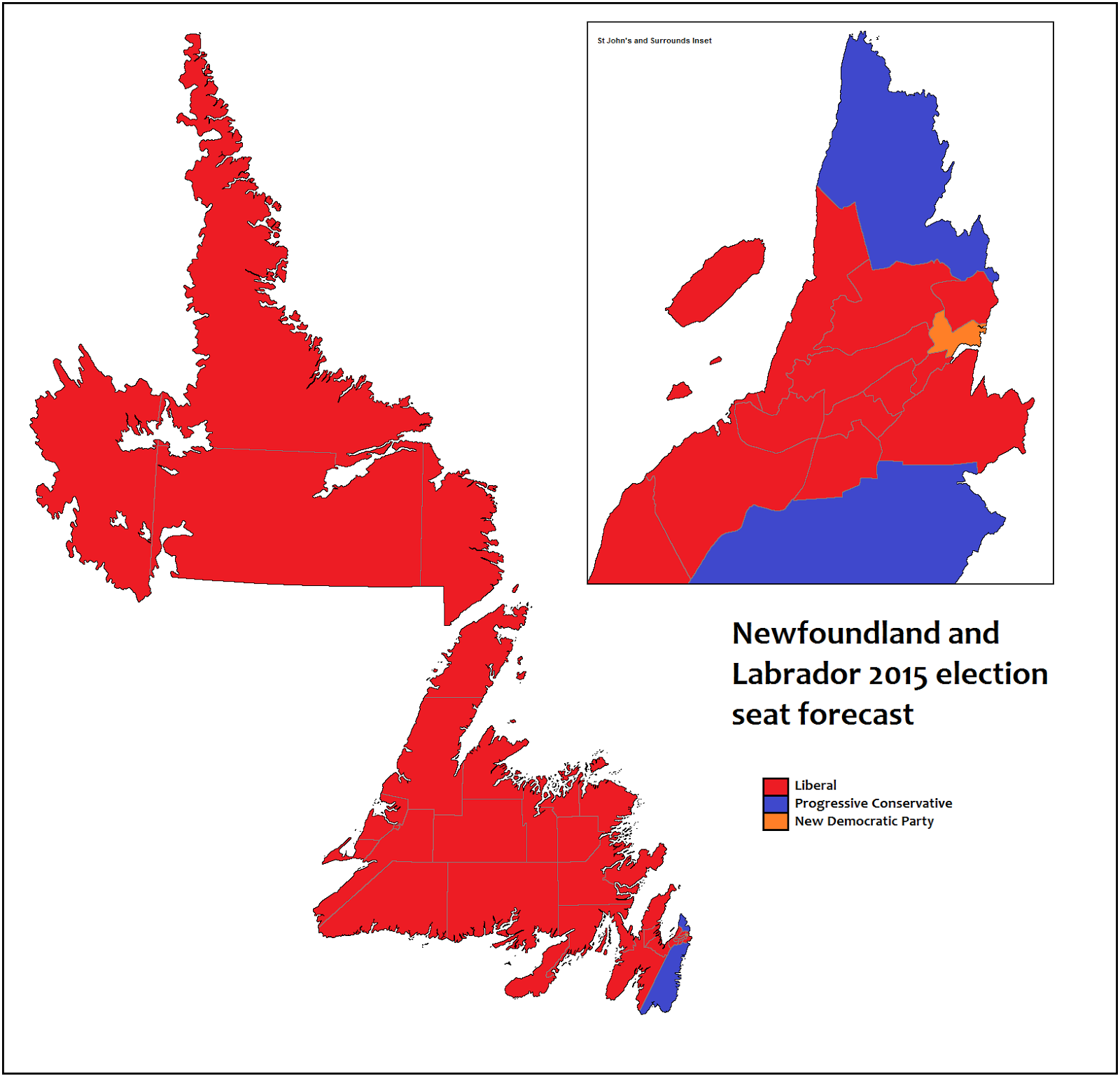
Given all of this information, my (mostly) qualitative seat forecast is that the Liberals will win 37 of the 40 ridings in the province (the legislature will be reduced to 40 seats from 48 following a redistribution this year). The Tories will win two seats, and the NDP should win just one. Due to time constraints, I have not done a formal quantitative seat model for this election, but I do not expect to get many seats wrong, unless the polls are well off. In landslide elections, seat predictions become much easier, as the question only comes down to guessing which seats the winning party will not win.

In this seat-by-seat forecast, the riding names have been coloured based on how they voted in 2011:


We shall see the extent of the damage (both electorally, and to my forecast) after the polls close at 8:00pm local time (6:30 Eastern). It likely won't be a very long night.


Wednesday, November 18, 2015

Newfoundland and Labrador's new electoral map

The results of the 2011 election on the new map
Voters in Newfoundland and Labrador will be heading to the polls on November 30th in the province's 19th election held since joining confederation in 1949. This election will be held on a new electoral map, as the size of the House of Assembly (the province's legislature) has been reduced from 48 seats to 40. This will be the first election since 1959 that the province will have this few seats.

Due to these changes, I took the initiative to calculate the results of the last provincial election in 2011 and transpose them on the new boundaries, using the same process I had done for New Brunswick's recent redistribution. Much like New Brunswick, Elections Newfoundland and Labrador did not publicly release their own transposition numbers, unlike Elections Canada and some other provincial elections agencies.

Actual results of the 2011 election

Background

New premier Paul Davis was gung-ho in his plan to reduce the size of the legislature, and was quick to do so after becoming leader. A boundary commission was created, and new boundaries were drawn over the course of the Spring, in order to give the province's election agency enough time to be ready for the November 30 election. What is usually a long and drawn out process that can take a couple of years (as we saw with the last federal redistribution) was done in a few months.

While the reduction of government is consistent with conservative ideology (Davis is a Tory), the move may backfire for his party. Recent polls have shown the Tories could be wiped off the electoral map, a feat that is easier to do with larger, more populated ridings. Smaller ridings are more likely to overlap with pockets of opposition support, and are therefore more likely to elect more opposition members. It is harder for opposition members to get elected (especially in landslide elections) with larger ridings, as areas of traditional opposition support are more likely to be lumped in with non-opposition areas, when the ridings grow in size. 


This redistribution process has already hurt one of those opposition parties, the NDP. The NDP won five seats in the 2011 election, but would have only won three seats on the new map. This is because in two of those ridings, the boundaries were extended to encompass enough non-NDP areas to have swung the seats to other parties. The Liberals were less hurt, as they would have won five seats on the new map, compared to the six seats they actually won in 2011. The Tories saw a bigger numerical drop, winning 32 seats on the new map, down from the 37 they actually won.  Proportionally however, they were not hurt as bad, as the two other parties, and losing five seats is no big deal considering they still would have won a majority government on the new map.

Redistributed results of the 2011 election by riding

Regional analysis

The St. John's area loses one riding, with the resulting domino effect meaning the NDP would only have won three seats in the city on the new map (down from the four they actually won). This loss is due to the riding of St. John's North (renamed to “Mount Scio”) gaining some heavily Tory areas in the Paradise area. The PCs would have won the remaining 10 seats in the region. While the boundary shifts in Mount Scio gave the Tories an extra seat, they would have lost one in the south end of the city, with the merger of St. John's South and Kilbride into the new riding of Waterford Valley. Another big shift in the city was in the east end, where the two ridings of St. John's East and Signal Hill-Quidi Vidi have re-oriented themselves into St. John's East-Quidi Vidi and Virginia Waters-Pleasantville. Both seats went NDP in 2011.

The rest of the Avalon Peninsula also loses one seat. This seat loss is on the west side of Conception Bay, where the riding of Carbonear-Harbour Grace is being split up. The Carbonear half is going to the new riding of Carbonear-Trinity-Bay de Verde (formed from the former riding of Trinity-Bay de Verde), while the Harbour Grace half has joined the new riding of Harbour Grace-Port de Grave (formed from the old riding of Port de Grave). All the ridings in this region voted PC in 2011, meaning a net loss of one seat for the Tories.

Eastern Newfoundland goes from having six seats to just four, following the redistribution. One seat (Burin-Placentia West) was removed from the Burin Peninsula, with a part going to the new riding of Burin-Grand Bank and a part going to the new riding of Placentia West-Bellevue. The other seat loss comes from the Bonavista Bay area, which will see the old ridings of Terra Nova and Trinity North be merged together forming a new Terra Nova riding. This seat loss hurts the Tories the most, as all six ridings voted PC in 2011.

Central Newfoundland also loses two seats. The former riding of “The Isles of Notre Dame” will see the Twillingate area join the new riding of Lewisporte-Twillingate while Fogo Island joins the new riding of Fogo Island-Cape Freels. Meanwhile, the riding of Grand Falls-Windsor-Green Bay South will split up with the Grand Falls-Windsor area of that riding being absorbed by the riding of Grand Falls-Windsor-Buchans while the Green Bay South area will join the new redundantly named riding of Baie Verte-Green Bay. All nine ridings in the region voted PC in 2011, so the seat reduction is a net loss of two ridings for the party.

Western Newfoundland also loses two seats, with the Humber area losing both ridings. The new riding of Humber-Grose Morne was created as a merger of St. Barbe and Humber Valley while Humber East has been fragmented into the new riding of Corner Brook (formed from Humber West), St. George's-Humber (formed from St. George's-Stephenville East) and Humber-Bay of Islands (formed from Bay of Islands) Both the NDP and the Liberals were the losers in this region. The addition of part of Humber East into the new Humber-Bay of Islands would have made that riding go PC in 2011, when its predecessor riding of Bay of Islands went Liberal.  Meanwhile, the northern riding of The Straits-White Bay North, which went NDP in 2011, has been increased in size, taking in a Liberal part of St. Barbe,. This boundary change would have been enough to shift the riding to the Liberals, and to compensate for the merger of the two Liberal ridings of St. Barbe and Humber Valley. While the new map gives would have given the PCs the new Humber-Bay of Islands riding, the abolition of the Humber East riding gives them a net gain of 0 seats in the region.

The redistribution process came with the promise that Labrador would retain its four seats in the House of Assembly. As such, the region saw no boundary changes, despite two of the ridings (Torngat Mountains and Cartwright-L'Anse au Clair) being extremely underpopulated. In 2011, the Liberals won those two seats, while the Tories won the other two (Lake Melville and Labrador West).

Newfoundland and Labrador's new election map (click to enlarge)

Of course, these numbers only show the results of the 2011 election on the new boundaries, an election which saw the Progressive Conservatives win a large majority of seats, and a majority of the popular vote. With the Liberals heading for what may be an historic landslide victory, this map will look very different come November 30.

Note: An earlier version of this blogpost indicated the the riding of Humber-Bay of Islands would have gone Liberal in 2011, however this was based on an error in the data. It has since been corrected.

Tuesday, November 25, 2014

Provincial by-elections today in Newfoundland

In the 2011 provincial election, the Liberal Party of Newfoundland and Labrador won just six seats in the 48 member House of Assembly, and were nearly relegated to third party status, behind the NDP. They even finished in third place in the popular vote. Today, the Liberals have more than doubled their seat total, and are up to 14 seats. Tonight, they are likely to increase this to 16. Why? The rise of the Liberal brand across Atlantic Canada, coupled with the lack of popularity of both the governing Progressive Conservatives and the New Democrats in the province has allowed the Liberals to win all five by-elections held in the province since 2011, and have benefited from a number of floor crossings from both the Tories and the NDP. Today, there are to more by-elections in the province, and both are currently held by the PCs. They are in Trinity-Bay de Verde on the Avalon Peninsula, and Humber East on the west coast of the province.


Trinity-Bay de Verde


Trinity-Bay de Verde has sat vacant since early in September, when the province's then-Finance Charlene Johnson resigned to move to Asia, where her husband works. Johnson was the youngest woman to ever be elected as an MHA in the province, and was the first member to give birth while in office. It will be a huge shift from managing the province's finances to being a stay-at-home mother in a different country.

The riding is made up entirely of small fishing villages along the coast of the Bay de Verde peninsula, which forms the northwest wing of the larger “H” shaped Avalon Peninsula. The riding begins at the Town of Salmon Cove on Conception Bay in the southeast, and consists of the entirety of the Bay de Verde peninsula north of this point. The riding ends at the community of Hopeall in the southwest, on Trinity Bay. None of communities have more than 1000 people. The largest municipality in the riding is Heart's Delight-Islington with 704 people. Salmon Cove (691) and Old Perlican (661) are the next largest municipalities.

Trinity-Bay de Verde was formed in 1975 when the riding of Trinity South (communities on the south and east coasts of Tinity Bay) was merged the riding of Bay de Verde (communities on the west coast of Conception Bay). Since 1982, the riding has been a perfect bellwether, electing members of the governing party in the province in every election since then.


MHAs:

Carbonear-Bay de Verde
-H.L. Pottle, Liberal (1949-1956)
-G.W. Clarke, Liberal (1956-1971)

Bay de Verde
-W.P. Saunders, Liberal (1962-1972)
-Brendan Howard, Prog. Cons. (1972-1975)

Trinity-Bay de Verde
-F.B. Rowe, Liberal (1975-1982)
-J.G. Reid, Prog. Cons. (1982-1989)
-L.G. Snow, Liberal (1989-2003)
-Ms. Charlene Johnson, Prog. Cons. (2003-2014)


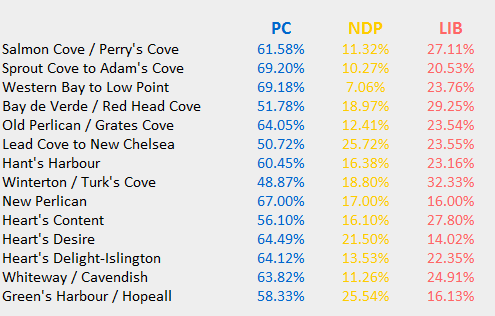
In 2011, Johnson won 62% of the vote in the riding. The Liberals finished second at 24%, and the NDP finished third with 14%. Johnson all but one poll in the riding, losing the community of New Chelsea to the NDP candidate, Sheina Lerman. The Liberals did not win any polls, despite placing second. Johnson's best area in the riding was the villages between Sprout Cove and Low Point along Conception Bay, where she won over 69% of the vote. Her weakest part of the riding was the Winterton/Turk's Cove area on Trinity Bay, where she won 49%. This was the best area for the Liberal candidate, Barry Snow, who won 32% there. Federally, the Bay de Verde peninsula is the most Liberal part of the entire Avalon Peninsula.

Trinity-Bay de Verde 2011 election results by area

Running for the Liberals is Steve Crocker, who is the assistant to Liberal leader Dwight Ball. Running for the Tories is Ronald Johnson, the father of the outgoing MHA. Running for the NDP is Tolson Rendell, who is a town councillor in Heart's Content, a small community on Trinity Bay. As the riding is a bellwether, and with the Liberals way ahead in the polls in the province, there is no doubt in my mind that the riding will be picked up by Crocker. After all, the next-door riding of Carbonear-Harbour Grace was recently won by the Liberals in a by-election, after the Tories won it by an even larger margin than Trinity-Bay de Verde in 2011.


Humber East


Tom Marhsall, Newfoundland's interim Premier before Paul Davis took over in September, not only resigned from the interim premiership, he resigned his seat as well, Humber East. This riding is located in Western Newfoundland, taking in the eastern half of the City of Corner Brook, and extending eastward to include part of the town of Pasadena. While the riding contains a handful of communities in between Corner Brook and Pasadena, the overwhelming majority of the population lives in Corner Brook. The riding is named for the Humber River, which bifurcates the riding, running from Pasadena to Corner Brook.

Humber East is historically much more conservative than Trinity-Bay de Verde. Since 1971, the Liberals have only held it for 7 years, when Bob Mercer represented the riding from 1996 to 2003. Marhsall easily won the riding in 2011 with 78% of the vote, with the Liberals in distant third at 8%. In addition to Marshall, the riding has been represented by one other premier, Clyde Wells, who held the riding from 1966 to 1971.


MHAs:

Humber
-C.H. Ballam, Liberal (1949-1956)

Humber East
-J.A. Forsey, Liberal (1956-1962)
-N.F. Murphy, Prog. Cons. (1962-1966)
-C.K. Wells, Liberal. (1966-1971)
-T.C. Farrell, Prog. Cons. (1971-1979)
-Ms. V.L. Verge, Prog. Cons. (1979-1996)
-R.D. Mercer, Liberal (1996-2003)
-T.W. Marshall, Prog. Cons. (2003-2014)


With Marshall winning easily in 2011, it stands as no surprise that he easily won every poll in the riding in 2011. Not only that, he won every single poll with at least 62% of the vote. Marhsall's strongest part of the riding was in the Corner Brook suburbs, winning 83% in Massey Drive and 84% in the Wheeler's Road / Elizabeth Drive area. His weakest area was the community of Humber Village, located halfway between Corner Brook and Pasadena, where he won 73% of the vote. Across the Humber River from Humber Village is the community of Little Rapids, where the NDP did the best, winning 20% of the vote. Steady Brook, a ski resort (as close as one can get to a ski resort in Newfoundland) just east of Corner Brook was the Liberals' best area, where they won 10%. Federally, this area is safe Liberal territory. The Tories have not won any polls in Humber East since 2000 (winning just 2), and have not done well in the area since 1997.

Humber East 2011 election results by area

Out of all by-elections held since 2011, Humber East is the riding that saw the best result for the Tories, and the worst result for the Liberals. The Liberals have been able to pick up four ridings from the Tories since 2011, but none have been safer for the Tories than Humber East. Having said that, other than it being a safer Tory seat than most, I don't see why the Liberals can't eke out a victory even here, as it has gone Liberal in the past, and it's very Liberal on a federal territory. Running for the Liberals is businessman Stelman Flynn, the former president of hospitality Newfoundland and Labrador. Hoping to stop the Liberal onslaught is the PC candidate, Larry Wells, who is the longtime executive assistant to Tom Marshall. The NDP is running Pasadena resident Martin Ware, a retired English professor at the Grenfell Campus (in Corner Brook) of Memorial University.

Polls close at 8pm (6:30 Eastern).


Wednesday, November 5, 2014

Provincial by-election in Conception Bay South, Newfoundland today

Voters in the riding of Conception Bay South in Newfoundland head to the polls today to elect a new member of the House of Assembly in a provincial by-election. The by-election will be the first test of the new Premier in the province, Paul Davis, who was elected as Premier, and leader of the governing Progressive Conservative Party in a very fractured leadership race in September. (Despite there only being three candidates, the race had to go to an unexpected third ballot, as Davis had not secured “50%+1” on the second ballot, having led his rival by just one vote, with another spoilt). The riding is especially important to Davis because he is the former Deputy Mayor of Conception Bay South, and represents the neighbouring riding of Topsail.

Conception Bay South has been a safe Tory seat for nearly two decades. In the 1996 provincial election, it was one of only 9 ridings in the entire province to vote for the Progressive Conservatives. The riding was won by Bob French, who held the seat until his death in 2002. His son, Terry French won the subsequent by-election, and held the riding until resigning in September. French had been the Justice Minister of the province, and is one of several MHAs to have resigned this year. He had been quite popular in the riding, winning about 80% of the vote in the 2002 by-election and in both the 2003 and 2007 general elections. This was reduced to 69% in the 2011 general election.


MHAs:


Harbour Main (2 members)

-R.J. Fahey, Prog. Cons. (1949-1951)
-D.I. Jackman, Prog. Cons. (1949-1956)

-P.J. Lewis, Liberal (1951-1971)
-Matthew Whalen, Liberal (1956-1959)

-Albert Furey, Prog. Cons. (1959-1962)
-Clifton Joy, Liberal (1962-1966)
-Jn. Mahoney, Liberal (1966-1971)

-Gordon Dawe, Prog. Cons. (1971-1975)
-C.W. Doody, Prog. Cons. (1971-1975)


Conception Bay South (1 member)

-J.A. Nolan, Liberal (1975-1979)

-Jn. Butt, Prog. Cons. (1979-1989)
-P. Cowan, Liberal (1989-1996)
-Rbt. French, Prog. Cons. (1996-2002)
-T. French, Prog. Cons. (2002-2014)


Geography


The riding of Conception Bay South contains about half of the Town of Conception Bay South.  The Town of Conception Bay South was formed in an amalgamation of nine municipalities in 1973.  The riding contains the former municipalities of Foxtrap, Long Pond, Manuels, Kelligrews and part of Chamberlains. It also contains some remote areas on the western fringes of the City of St. John's. As the name indicates, the riding is located at the south end of Conception Bay, and is a western suburb of the capital of St. John's.


Demographics


Due to its proximity to the province's largest city, Conception Bay South is one of the fastest growing municipalities in the province, seeing a 13% population increase from 2006 to 2011. This is quite an achievement in a province that has for much of the last 20 years seen a decrease in population. This increase has moved the town ahead of Mount Pearl as the second largest municipality in the province.

Not only is Conception Bay South growing rapidly, it is also wealthier than the province as a whole. The average income in the town is $40,000, which is $5000 more than the provincial average. As one would expect, the town is overwhelmingly White and overwhelmingly English speaking. Its main cleavage is religion. Within the riding, about 43% of residents are Anglican, while 27% are Catholic and 12% are United Church. In terms of ethnicity, about half of the population identify as English, while there is also a substantial population with Irish ancestry. 


Political geography


In 2011, French won every single polling division for the Tories, with a majority of the vote. In his worst poll, #2, which is in Chamberlains in the north of the riding, he still won 57% of the vote. The Manuels / Chamberlains area as a whole was the worst part of the riding for French, only winning 66% of the vote. French broke the 75% mark in several polls in the riding. Altogether, his best part of the riding was in Foxtrap, where he won 71%. For the NDP, which finished second in the riding, their best area was in Manuels / Chamberlains, perhaps due to the fact that it lies in the federal riding of the St. John's East, currently held by popular NDP MP Jack Harris. The southern part of the riding can be found in the federal riding of Avalon. The area of Conception Bay South in Avalon is a bellwether for the riding (and its predecessor of St. John's East), going Liberal in 2004, 2008 and 2011 when the riding went Liberal, and going Tory in 1997, 2000 and 2007 when the riding went Conservative or PC.


2011 election results by area


Outlook


The Tories have had a bad track record with recent provincial by-elections in the province, losing every single one since the 2011 provincial election. If this hemorrhaging will stop, it might be tonight in this Tory-friendly riding. However, the Liberals do have the potential of picking it up. After all, it's not like they have never won the riding before, as they have previously held it in the early 1990s. Additionally, the area is a bellwether in federal elections, and went Liberal in the last federal election. Recent polls have not seen a bounce for the Tories under Paul Davis' premiership, and using a uniform swing from the last election, the Tories would lose this seat. However, due to Davis being from the area, I expect there will be a “favourite son” effect, with the Tories possibly winning the race in a squeaker.

One thing that may help the Liberals win election is the fact that they're running a local town councillor, Rex Hillier, who represents Ward 1 in Conception Bay South, which covers Chamberlains and part of Manuels. Running for the Tories is Barry Petten, the former executive assistant for French. The NDP, which finished a distant second in 2011 is running Memorial University student Cameron Mercer-Maillet. The NDP has had many internal struggles recently, and has been faltering in the polls as a result. They should not be a factor in this Liberal-PC race. We'll see what happens when polls close at 8pm (6:30 Eastern).


Tuesday, August 26, 2014

Provincial by-election today in St. George's-Stephenville East, Newfoundland

Location of St. George's-Stephenville East in Newfoundland
Voters in the southwestern Newfoundland riding of St. George's-Stephenville East will head to the polls today to elect a new member of the Newfoundland and Labrador House of Assembly (MHA) for their district. The seat became vacant in June, when its MHA, Progressive Conservative Joan Shea (nee Burke), Newfoundland's Environment Minister resigned, citing a lack of energy. Shea's departure is yet another sign of the declining fortunes of Newfoundland's governing Progressive Conservative party, which is currently amidst a postponed leadership election. (The party was set to acclaim businessman Frank Coleman as leader in July, but he had to withdraw amidst controversy, citing family matters, thus delaying the vote until September).


Map of the riding, showing poll boundaries and various geographic features


Geography

The riding of St. George's-Stephenville East can be found in the southwestern corner of the Island of Newfoundland. It takes in the eastern half of the Town of Stephenville, the riding's largest municipality, and wraps around St. George's Bay, including the towns of Stephenville Crossing and St. George's. The riding continues southward along the southwestern coast of the province, ending at the tiny community of Red Rocks, northwest of Port aux Basques. Stephenville, Stephenville Crossing and St. George's are the only incorporated municipalities in the riding. However, there are many smaller unincorporated communities dotting the coastline. The three municipalities are located in the north of the riding, close to the mouth of the St. George's River. The population in the rest of the riding are concentrated in two regions: Bay St. George South in the central part of the riding, and the Codroy Valley, in the south.


Demographics


The riding has a large unemployment rate, with labour force participation in most communities being below 50%. This fact makes the riding fairly poor, with most communities in the low $20,000 range for median individual income, which is nearly $5,000 below the provincial median. Those who do work tend to work in Sales and Trades, with the traditional fishing industry having been decimated in recent years. Ethnically speaking, the riding has a good mix of English, French, First Nations and Irish roots. Catholicism is the majority religion, while Anglicanism is the largest Protestant denomination.


History


St. George's-Stephenville East was formed in 1996 when the riding of Stephenville was split in half, with its eastern section joining the riding of St. George's to form the new riding of St. George's-Stepheville East. While most of the territory in the new riding came from St. George's, the MHA from Stephenville (Kevin Aylward) would represent the new riding.


Including the preceding St. George's riding, the riding has been a good bellwether, having voted for the party that would go on to form government in every election since 1979. The Liberals most recently won the seat in 1999, with 53% of the vote. Since then, they bottomed out at 25% in 2007, but increased their share of the vote in 2011 to 33% when their leader (Kevin Aylward) ran in the seat. The Tories have held the seat since 2003, when Shea (then Burke) defeated Liberal Ron Dawe, who held the seat as Tory in the 1980s. Burke defeated Daw by less than 500 votes, or about 8%. She was easily re-elected in 2007 with 74% of the vote, but Aylward gave her a run for her money in 2011, when she won 49%. The NDP has rarely ever run in the riding. In fact, the party has only run in the seat once since the district was created 18 years ago. Bernice Hancock ran for the New Democrats in 2011, winning a respectable 17% of the vote.


MHAs

W.J. Keough, Liberal (1949-1971)
A.M. Dunphy, Prog. Cons. (1971-1975)
Mrs. H.A. McIsaac, Liberal (1975-1979)
R.G. Dawe, Prog. Cons. (1979-1989)
L. Short, Liberal (1989-1993)
B. Hulan, Liberal (1993-1996)
K. Aylward, Liberal (1996-2003)
Mrs. J. Shea (Burke), Prog. Cons. (2003-2014)


Political geography


Shea's victory in 2011 was helped by winning large margins in the southern, more rural parts of the riding where she won all but one poll. Her best region was in the Bay St. George South area, where she won 62% of the vote. Her best poll was also in this region, #25, where she won 76% of the vote. This poll covers the community of McKay's. The Liberals did their best in the Stepheville area, where they won 38% of the vote. This was still not enough to beat Shea there, but they did win four of their eight polls in this region. However, the strongest poll for the Liberals was #17, where they won 78% of the vote. This poll covers the community of Mattis Point, which is across the St. George's River from Stephenville Crossing, Aylward's hometown. The NDP's best region was also the Stephenville area, where they won 21% of the vote. Their best poll was #11, which covers the community of Black Duck Siding in the northern part of the riding. In this poll, the NDP won 35% of the vote, which was not enough to win the poll. However, the NDP did tie one poll with the Liberals, #29. This poll covers the community of Highlands in the Bay St. George South area.


Results of the 2011 provincial election by polling division


Federally, the area belongs to the riding of Random—Burin—St. George's. The area was much more Liberal in the 2011 federal election, with Liberal MP Judy Foote winning 38% of the vote in St. George's-Stephenville East polls. However, this number was much lower than her 50% she won across the federal riding. Within St. George's-Stephenville East, St. George's area was the best region for Foote, while the Tories did the best in Bay St. George South, the only region in St. George's-Stephenville East where they beat the Liberals. This region tends to be the most anti-Liberal area in the riding, both provincially and federally, while Stephenville has historically been the most Liberal. In the 2011 election, the NDP's best region was actually the Codroy Valley in the south. Across the provincial riding, the federal Conservatives won 33% of the vote, the NDP won 27% and the Greens won 2%.

Recent election results by region


Despite the NDP having only run in the seat once in the riding's history, the federal party has had a lot of success in the region, sweeping the Catholic-majority region in 2004 with the candidacy of Des McGrath, a Catholic priest. The party also did well in 2008, capturing a number of rural polls.


Outlook


In today's by-election, the Tories are running Kippens (a town outside the riding) resident Wally Childs, a principal at a school in St. George's. The Liberals are running Scott Reid, a political science instructor at Memorial University, who was raised in the Codroy Valley. The NDP are running their candidate from 2011, Bernice Hancock, who is a program director from Stephenville.

The most recent province-wide polling suggests the Liberals are headed to a landslide majority government in the next provincial election. This means that bellwether seats, like St. George's-Stephenville East will more than likely be caught up in the Liberal tide. This is why I am fairly confident that the Liberals will win the riding tonight.

Polls close at 8:00pm Newfoundland time, or 6:30pm Eastern.

Wednesday, April 9, 2014

Virginia Waters, Newfoundland by-election today

Location of Virginia Waters in St. John's

A provincial by-election is being held today in the riding of Virginia Waters, Newfoundland and Labrador. The riding had been represented by former Progressive Conservative Premier Kathy Dunderdale, but she resigned the seat on February 28, following her resignation as premier a month earlier. Her resignation had followed a huge hit to her personal popularity in the province, but also in her party's support. Since her resignation, the province has been run by Tom Marshall, who will serve as interim Premier until the Tories can elect a leader in July, with the winner to become the province's 12th Premier.


Profile

Virginia Waters is located in St. John's northeastern suburbs, containing the neighbourhoods of Wedgewood Park, Ricketts Bridge, Penetanguishene and Airport Heights. The riding runs roughly from the shores of Virginia Lake in the east to the tip of Windsor Lake in the West, and is named for both the lake, and the Virginia River, which flows through the district.

The riding contains mostly newer housing developments, and is growing in population. The Airport Heights/Penetanguishene area is especially growing, seeing a 44% population increase between 2006 and 2011. That area is home to newer homes, most being built since 1991. The rest of the riding is slightly older, with homes being mostly built in the 1980s.

The riding is also quite wealthy, with the median income of the riding being around $40,000, and the average income being around $50,000. Compare this to the provincial numbers of $25,000 and $35,000 respectively, and the St. John's totals of $30,000 and $40,000 respectively. The area around Virginia Lake is especially wealthy.

Demographically, the area is similar to the rest of St. John's. It has a large Catholic plurality, and ethnically is dominated by those of English and Irish ancestry. 


Political geography

2011 results by polling division


In the 2011 election, when Dunderdale was much more popular, she was able to sweep the riding, winning all but one poll, where she still managed to tie the NDP candidate. Dunderdale won the district with 60% of the vote, well ahead of her NDP opponent, who won 30%. She did even better in the 2007 election, where she won 73% and the NDP won 13%. The Liberals finished third in both elections winning 8% in 2007 and 10% in 2011.

The lone polling division that Dunderdale did not outright win in 2011 was poll #17, which corresponds to the Torbay Estates Apartments. Both her and her NDP opponent, David Sullivan won 44% of the vote there. Dunderdale's best poll was #26, which consists of a number of wealthy homes on the shores of Virginia Lake in the district's far east end. In that poll, she won 75% of the vote.

Federally, the district is located in the riding of St. John's East, which is represented by popular NDP MP Jack Harris. In both the 2008 and 2011 federal elections, Harris swept the area, winning every single poll by large margins. His worst area in 2011, was in the neighbourhood around Virginia Lake, where he “only” won 60% of the vote, much lower then the rest of Virginia Waters where he averaged more than 70% of the vote. The area hasn't always gone NDP however. The Tories won most polls in the area in the 2006 federal election, while the Liberals won the area in 2004. In 2000, the Progressive Conservatives swept Virginia Waters, while in 1997 the Tories edged out a win against a strong NDP campaign.


History

Dunderdale has held the district since 2003, when she defeated the Liberal MHA, Walter Noel. Noel had represented the area from 1989 to 2003. Before 1989, the area was a Tory strong hold, as the St. John's area has historically been very pro-Tory dating back to the province joining Confederation in 1949. Traditionally, Catholics and the upper class in Newfoundland have backed the conservatives, and they have historically been concentrated in the St. John's area. They opposed confederation in 1949, while the poorer, Protestant class outside the city supported confederation, and in turn the Liberals who also supported confederation. In recent decades this political cleavage has been less evident, as the Liberals have been able to win in the St. John's area, however traces of the old political polarization in the province still remain.

Since 1971, the riding has been a perfect bellwether riding, voting for the winning party in every election since.

MHAs

St. John's East
J.G. Higgins, Prog. Cons. (1949-1951)
J.D. Higgins, Prog. Cons. (1951-1959)
J.J. Greene, Prog. Cons. (1959-1962)

St. John's East Extern
W.J. Browne, Prog. Cons. (1962-1966)
T.V. Hickey, Prog. Cons (1966-1975)

Pleasantville
J.W. Dinn, Prog. Cons. (1975-1989)
W. Noel, Liberal (1989-1996)

Virginia Waters
W. Noel, Liberal (1996-2003) continued
Mrs. K.M.M. Dunderdale, Prog. Cons. (2003-2014)


Outlook

The candidates

Running to replace Dunderdale for the Tories is St. John's city councillor Danny Breen. Breen is the councillor for Ward 1 which covers much of Virginia Waters. Breen has represented Ward 1 since 2009 when he defeated the incumbent councillor Art Puddister by a narrow margin. He was acclaimed in the 2013 election. Running for the NDP in the riding is another local politician, Sheilagh O'Leary. O'Leary sat on city council from 2009 to 2013, when she ran for mayor of St. John's. O'Leary was elected as one of four at-large councillors in 2009, when she won more votes than any of the other candidates running for an at large position, far ahead of the three incumbents running. When O'Leary ran for mayor last year, she was endorsed by the federal NDP, an unusual event for municipal politics. She ran a strong campaign against the popular Tory mayor, Dennis O'Keefe, winning 42% of the vote. Running for the Liberals is local businesswoman Cathy Bennett, who is the CEO of the Bennett Group of Companies. Bennett ran for the Liberal leadership in 2013, finishing in third place.

The most recent province-wide poll in Newfoundland was released in March, and was conducted by Corporate Research Associates. It showed the Liberals at 53%, the Tories at 33% and the NDP at just 13%. If this poll is accurate, than it is safe to say that the Tories are in trouble in a riding like Virginia Waters, which has been a reliable bellwether in the province, voting for the governing party in every election since 1971. However, all three parties are running strong candidates, which makes the result of today's by-election somewhat harder to predict.

Both the Tories and the NDP have suffered from internal struggles over the last couple of years that have really hurt their poll numbers. The Liberals however, which were nearly wiped out in the last two elections, have returned in full force. This is due to not only a divided opposition, but also an Atlantic Canada-wide resurgence for the Liberal brand, thanks in part to federal leader Justin Trudeau. Had the Liberals been in the political wilderness, and had the NDP not gone through its recent internal divisions, this riding would have been a prime pick-up opportunity for New Democrats, as the party did well in the St. John's area in the last election. However, the NDP has been discredited, and despite the strong candidacy of O'Leary, they are unlikely to do well today. The Tories on the other hand might still have a chance to win the seat, as they are running a more high profile candidate than the Liberals, in a riding that was once a Tory stronghold. However, I do not believe that will be enough for the Tories to win. So, I am personally predicting a Liberal victory.

We will find out for sure what happens when the polls close tonight at 8pm (6:30 Eastern).