Friday, March 21, 2014

2014 Quebec provincial election - Week 3 projection

Week 3 projection map
Over the course of the last week, the Quebec political landscape has made a dramatic shift, if the polls are to be believed. Last week I reported that according to polls at the time, the PQ was headed for a slim majority government. Flash forward to this week, and it looks like the Liberals will be the party headed towards a majority.

As the campaign goes forward, there have been a number of events that could have caused the shift over the last week. Firstly, the appointment of media baron Pierre Karl Peladeau (aka “PKP”) as the PQ candidate in Saint-Jerome made big news, and recent polls have shown that voters are now less likely to support the PQ as a result. PKP  is a controversial character in Quebec politics, and leading a right wing media empire is sure to scare off some of the PQ's traditional left of centre base. Another cause for the shift might be controversial statements that some PQ candidates have made, such as the candidate in Gouin, Louise Mailloux, comparing baptism and circumcision to rape and making other controversial statements, and LaFontaine candidate Jean Carrière making Islamophobic comments and supporting far-right French politician Marine Le Pen. While Carrière was fired, Mailloux was kept, which shows --at least in part-- that the PQ is doubling down on these controversies, perhaps in an effort to show its base how nationalist they are. After all, most of the minority communities they are alienating live in safe Liberal seats. In addition to these controversies, it is possible that the Liberal campaign of scaring voters by suggesting a PQ majority would definitely lead to another referendum is working. Evidence of this could be seen in the leaders debate last night where PQ leader Pauline Marois acted very defensive about the issue, promising not to hold a referendum unless Quebecers wanted one.

Since my last projection map from last week, there have been four polls released that I have now factored into my current projection. Leger, CROP, Ipsos Reid and Forum Research all released polls during this time frame, and each one has progressively shown the Liberal lead get larger. Leger's poll released a week ago showed the race tied 37-37 between the Liberals and PQ. Forum Research's poll released yesterday showed the lead now at 45-32 in favour of the Liberals.

Each of the four polling firms all have different ways of breaking down their regional numbers, so I had to create overlap regions to take into account the overlap between the regions defined by the different polling companies. For example, CROP appears to have a region called “Couronne de Montreal” (Crown of Montreal), which was described as being the 450 area code. The 450 is much larger than the Montreal Metropolitan Region which other pollsters used. This overlap region I have called the “Outer 450”, and consists of 13 ridings. I had to further divide this region because Forum Research divides its “Rest of Quebec” region into north and south (at the St. Lawrence), and this area includes the outer 450 as well. Both CROP and Ispsos Reid also separates the Island of Montreal from the surrounding area which meant that I had to divide those regions as well in my projection. 

As for tweaking my numbers in individual ridings, I held off on making any new changes for the time being. One exception is in the riding of La Piniere where the PQ has confirmed they are not running a candidate. The incumbent Member in that riding, Fatima Houda-Pepin is running as an Independent after quitting the Liberal Party. Houda-Pepin, despite being a Muslim, is a fierce supporter of the PQ's controversial charter of values. The PQ decided they did not want to run a candidate against her. After much thought, I decided in my projection to use the PQ vote from the 2012 election as a base for her support. It's not perfect, but obviously without a candidate, most of the PQ vote could go to her. The point is moot though, as the seat is a safe Liberal one- that is unless Houda-Pepin carries a significant personal vote with her, which is rare for independents in Quebec politics.

This week's projection shows a 12 seat swing from last week, with the Liberals picking up all 12 seats from the PQ for a total of 68. The PQ would win 52 seats, with the CAQ at 3 and the QS at 2 (no change from my last projection for either the CAQ or QS). Two of the 12 seats the Liberals have picked up since my last projection are in Laval (Sainte-Rose and Laval-des-Rapides; the latter has voted for the governing party in every election since it was created in 1981, and is Quebec's best bellwether). Two more gains for the Liberals in the inner 450 region would be La Prairie and Montarville (both ridings currently held by CAQ).  Out of the remaining eight seats where my projection has changed, one is in Quebec City (Jean-Lesage), while the remaining ridings are located outside the two major metropolitan areas: Abitibi-Est, Saint-Maurice, Ungava, Megantic, Richmond, Saint-Francois and Argenteuil.

Tomorrow is the last day to file candidacies before the election, so my next projection will take into account which candidates will actually be on the ballot.

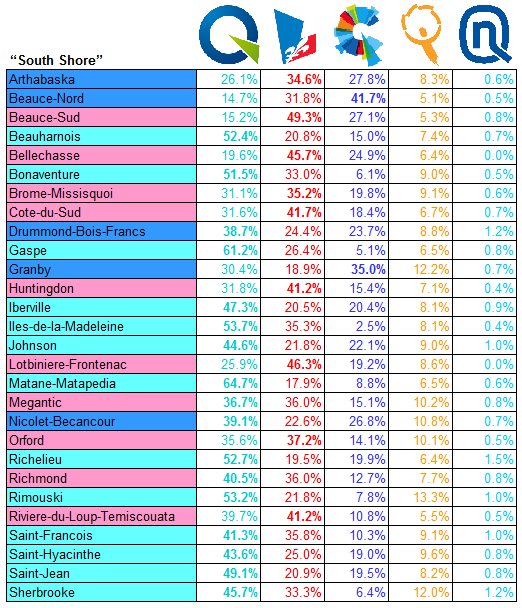
Here are my current projections for each riding. Ridings are shaded based on how they voted in the 2012 election. In La Piniere, I have Independent candidate Fatima Houda-Pepin at 13.3%.

A note about the following tables: the percentages in each row may not add up to 100%, as I am waiting till after the filing deadline for candidates, and thus certain parties and independents are not yet included.


Thursday, March 13, 2014

2014 Quebec provincial election - Week 2 projection

Week 2 projection map


The Quebec election campaign is now in its second week, so it's now time to present my Week 2 projection map. For this map, I have tweaked my projection model to take into account two important factors that effect riding-level election results: a lack of incumbency and the presence of a party leader on the ballot.

The Quebec election will feature at least 14 seats with no incumbents (open seats). The results in these seats will no doubt have different trends in their results than seats that do have incumbents. In taking a look at open seats in the 2012 election, I noticed that the parties that saw a positive 2008-2012 swing across the province (i.e. CAQ [compared to the ADQ in 2008] and QS) saw an even stronger swing in open seats compared to seats with incumbents. Likewise, parties that saw a negative swing between the 2008 and 2012 elections saw stronger swings against them in open seats. The difference between the province-wide swing and the open-seat swing for all parties showed a similar ratio, averaging to be about 1:1.23. That is, for every 1% a party's share of the vote would swing in either direction province wide, their swing in an open seat would be 1.23%. For my model, I applied this ratio to the parties in each of the 14 seats that will have no incumbent on the ballot.

The second major tweak I applied to my model was the “leader bounce”. Liberal leader Philippe Couillard is running in the normally-safe PQ seat of Roberval. Couillard, being a leader of a major party in the province, is likely to see a large swing towards him on election day. To estimate how much of a swing he will get, I took a look at similar scenarios from the 2012 election. One similar-ish scenario was in the riding of L'Assomption where CAQ leader Francois Legault was running in. In L'Assomption, Legault was able increase the share of the CAQ vote (compared to its predecessor, the ADQ) by 23.7 points. This was much higher than the province-wide swing to the CAQ, which was 10.7%. Another similar-ish example was in the riding of Nicolet-Becancour, where Option Nationale leader Jean-Martin Aussant was running. Option Nationale didn't run in the 2008 election, so I compared his result to what Quebec Solidaire won in 2008, since they didn't run in Nicolet-Becancour out of courtesy to Aussant. Comparing the two results gave Aussant a 22% swing, a full 20.1% more than the province wide swing for the Opinin Nationale (which was from 0% in 2008 because they didn't exist for that election). I make the assumption that in both cases (for Legault and Aussant) that their swings were also inflated because Legault was running in an open seat, and Aussant was the incumbent in his riding (he was elected as Pequiste in 2008). To calculate the estimated boost that Couillard could get, I took the average swing above the province-wide swing in both cases, and reduced it to factor in the fact that Couillard will be running in a seat that already has an incumbent, PQ MNA Denis Trottier.

I also created a second “leader bounce” estimate for Quebec Solidaire co-spokesperson Andres Fontecilla who is running in the Montreal riding of Laurier-Dorion. For most of its history, Quebec Soildaire was led by both Amir Khadir and Francoise David as "co-spokespeole". However, their party constitution states that only one co-spokesperson can sit in the National Assembly, so when both Khadir and David were elected in 2012, Khadir stepped down as co-spokesperson, and was replaced by Fontecilla. Fontecilla will likely see a boost in his share of the vote in Laurier-Dorion, much like Khadir and David saw in their ridings over the last two election. The question is, how much will Fontecilla's boost be? To calculate this, I took a look at the average swing that both Khadir and David saw in 2008 and 2012 in their ridings and compared it to the QS province-wide swing in both elections. Their swing came out to be an increase of about 8.1%, with an average of 5.5% coming from the PQ and 2.3% coming from the Liberals (the rest coming from minor parties). To calculate what Fontecilla may get on election day, I used these averages to factor in my projection for Laurier-Dorion.

In Roberval, my tweaks pushed Couillard into a narrow lead over his PQ opponent. In Laurier-Dorion, my projection tweaks put Fontecilla in a close race with Liberal MNA Gerry Sklavounos, however I still have Sklavounos ahead. The other projection tweaks I made for the open seats didn't result in much change, however they could play a factor if polls change dramatically.

Outside of these tweaks, I also inputted three new polls into my projection. Forum Research released a poll last week, and CROP released a poll on Monday. In addition, Leger published a Quebec City regional poll this morning. Forum Research's regional breakdowns divided the Rest of Quebec region into “North Shore” and “South Shore” which I can assume refers to whether or not the respondent was north or south of the Saint Lawrence River. Because of this, I have also split my projection model "rest of Quebec" region into two. CROP unfortunately did not publish their regional breaks, so I divided their results proportionally based on the Leger poll from earlier in the campaign and the Forum poll. For my projection, I have included both the Forum Research and CROP polls, the Leger Quebec City poll from today, and the Leger poll I used last week, but replacing their Quebec City numbers with their new poll. 


Changes from my last map

The biggest change from last week came in the Quebec City region, where my projection shows three seats swinging towards the Liberals. My projection now shows the Liberals ahead in Chauveau and La Peltrie (both from CAQ) and ahead in Jean-Talon (from the PQ). Outside the Quebec City region, I have the Liberals now ahead in Maskinonge, Papineau and Roberval (the latter based on the aforementioned projection tweak). In all three of those ridings, my projection from last week had the PQ ahead. One further change came in Megantic, where my projection last week had the Liberals winning, but now shows the PQ ahead.

With these changes, the PQ still is sitting in majority territory, but just barely- with 64 seats in the 125 seat assembly.  63 seats are needed to win a majority.


Here are my Week 2 seat-by seat projections (ridings coloured by 2012 winner):


I plan on making further tweaks to my model as the campaign goes on. If you have any suggestions as to what tweaks I should make, please let me know, by commenting here, emailing me, or by sending me a message on Twitter.

Wednesday, March 5, 2014

2014 Quebec provincial election - Week 1 projection

March 5 projection


Today the National Assembly of Quebec was dissolved upon the announcement that Quebecers will be heading to the polls for a provincial election on April 7. This ends months of speculation about when the current minority government would finally come to an end. As you may recall, Quebecers just went to the polls back in September of 2012.

As per tradition, I will be publishing projection maps each week of the election, and perhaps even more frequently. Yesterday, Leger released its final pre-campaign poll showing the governing Parti Quebecois with a 2 point lead over the opposition Liberal Party (37-35). This may be a small lead, but it may be enough to win the elusive majority they haven't had since 1998. (This is due to the massive Liberal vote sink in West Montreal). The centre-right Coalition Avenir Quebec was third in the poll with 15 points, and the left wing Quebec Solidaire party was in fourth at 8%. This would mark a large decrease for the CAQ, as they won 27% of the vote in 2012.

Leger was nice enough to produce regional cross-tabs of their poll, divided by the Census Metropolitan Areas (CMAs) of Montreal and Quebec City, and a third breakdown of everything else (Rest of Quebec). To produce my numbers, I extrapolated the 2012 vote within each of the 3 regions to match the regional poll numbers.  I only made one modification; in the riding of Nicolet-Becancour, I based my projection on a simulated 2012 vote count based on regional trends. This is because the Option Nationale leader, Jean-Martin Aussant had run in the seat in 2012, and while he did not win, he had a strong vote. Since he is no longer leader of the party, it didn't make any sense to have the ON with a high projected vote total in the riding. I will likely make more modifications as the campaign goes on to effect odd results of my projection model. But since it's the beginning of the campaign, I feel it is unecessary at this point.

Without further ado, here is my projected seat count:


 According to my numbers the PQ would win a majority (67) of the 125 seats in the National Assembly. They would be able to win enough seats in the nationalist heartland of the province, and in the Montreal suburbs to win a majority of seats. This would be a gain of 13 seats for the party. The Liberals would actually gain a net of one seat, up from the 50 they won in 2012. The CAQ would be decimated to a rump of 5 seats, down from the 19 they won in 2012. The QS would win the 2 seats they currently hold.

In 2012, the CAQ had won 6 seats in the Montreal suburbs, but my projection shows them being wiped out, with all of them going to the PQ. Four of the 5 seats they'd be left with would be in the Quebec City area, with the fifth seat being in Granby. Their leader, Francois Legault would lose his seat of L'Assomption. Additionally, the CAQ would lose 8 seats in the Quebec City area, however this seat loss favours the Liberals, as my projections shows the Liberals gaining 6 of the 8, with the PQ gaining the remaining 2. The remaining 5 seats that change hands are seats that the Liberals won in 2012 but my projection has the PQ picking up.  These seats would be Papineau, Richmond, Maskinonge, and two seats in Quebec City: Jean-Talon and Jean-Lesage. The Liberals' new troubadour leader, Philippe Coullard would lose the seat he plans on running in, Roberval by a huge margin (although, I may make some adjustments there). For the record, the Liberals would still win his current riding of Outremont where he has chosen not run for re-election in. In fact, all of the Island of Montreal's seats would not change hands.

Here are my seat-by seat projections (ridings coloured by 2012 winner):


Thursday, February 13, 2014

Provincial by-elections today in Ontario


Two Ontario provincial by-elections will be held today in the ridings of Thornhill and Niagara Falls. Both ridings are in Ontario’s infamous bellwether “905 region”, but both are very different ridings. Thornhill was held by a Tory MPP, Peter Shurman while Niagara Falls was held by a Liberal in Kim Craitor. The Conservatives hold both ridings federally, but the similarities seem to stop there. Thornhill is a relatively affluent riding (average income is $48,000) on the edge of Toronto, and is notable for its large Jewish population. Niagara Falls is a more middle income riding, and is as far away as you can go from Toronto in the 905.

Thornhill stands out as a riding, as it is the lone Tory riding in a seat of Liberal ridings in southern York Region and is bounded on the south by a sea of Liberal ridings in North York. Its high Jewish population has influenced the riding enough to make it much more conservative than the surrounding ridings. Niagara Falls meanwhile is a bellwether riding, and has voted for the party that would form the government in every election since 1985. Federally Niagara Falls is a strong bellwether as well. Only twice since 1963 has the riding not voted for the winning party in federal elections (1972 and 2004).


Niagara Falls


The riding of Niagara Falls includes the world-famous city of Niagara Falls, and two other municipalities, Niagara-on-the-Lake to its north, and Fort Erie on its south. The riding flanks the entirety of the west bank of the Niagara River, running from Lake Erie in the south to Lake Ontario in the north. The City of Niagara Falls makes up the majority of the riding’s population, as it is home to 83,000 of the riding’s 128,000 people. The riding is mostly urban, but all three municipalities contain large rural areas. Niagara-on-the-Lake is fairly affluent (Average income: $46,000), while both Niagara Falls and Fort Erie have a smaller average income at around $34,000 each.

The riding was vacated when its MPP Kim Craitor resigned in September citing mental exhaustion and wanting to focus on his health and family. He has since declared his intentions to run for Niagara Falls city council.

History

As mentioned, the riding has swung the same way as the province since 1985. It elected Liberal Vince Kerrio when the Peterson Liberals were in power (1985-1990), it elected NDPer Margaret Harrington when Bob Rae was Premier (1990-1995), it elected Tory Bart Maves during the Mike Harris years (1995-2003) and has elected Liberal Kim Craitor under Dalton McGuinty ever since.

Before the 1980s, the riding was mostly Liberal, with some instances of the Tories and other parties winning.

Welland
Wm. Beatty, Liberal (1867-1871)
J.G. Currie, Liberal (1871-1879)
Daniel Near, Liberal (1879-1883)
J.E. Morin, Liberal (1883-1890)

Wm. McCleary, Cons. (1890-1894)
W.M. German, Liberal (1894-1900)
J.F. Gross, Liberal (1900-1904)

E.E. Fraser, Cons. (1904-1914)


Niagara Falls
G.J. Musgrove, Cons. (1914-1919)
C.F. Swayze, Labour (1919-1923)
W.G. Wilson, Liberal (1923-1934)
W.L. Houck, Liberal (1934-1943)

C.A.G. Overall, CCF (1943-1945)
C.D. Hanniwell, Prog. Cons. (1945-1948)
W.L. Houck, Liberal (1948-1953) 2nd time
A.C. Jolley, Prog. Cons. (1953-1959)
Geo. Bukator, Liberal (1959-1971)
J.T. Clement, Prog. Cons. (1971-1975)
V.G. Kerrio, Liberal (1975-1990)
Mrs. M.H. Harrington, NDP (1990-1995)
B. Maves, Prog. Cons. (1995-2003)
Kim Craitor, Liberal (2003-2013)


Political geography

Niagara Falls - 2011 results by polling division


The 2011 provincial election saw a three-way race in the riding, with Craitor narrowly winning by 541 votes over Tory opponent George Lepp. His NDP opponent, Wayne Redekop was just 4000 votes behind in third. 

2011 results by municipality:
Municipality Liberal PC NDP
Others
Niagara-on-the-Lake
41.6%
43.7%
12.2%
2.5%
Niagara Falls
41.1%
30.1%
25.2%
3.6%
Fort Erie
18.8%
41.0%
38.3%
1.9%

The 2011 election saw unique results for each of the three municipalities in the riding. In the affluent Niagara-on-the-Lake, the race was a close affair between the Liberals and the Tories, with the NDP in a distant third. The Liberals won the urban part of Niagara-on-the-Lake, while the Tories won the rural area. In the City of Niagara Falls, the Liberals were the clear winners, picking up most of the polls across the urban parts of the city. Both the NDP and the Tories won a splattering of polls in the urban part of the city, while the Tories won all of the rural polls south of the city. In Fort Erie, the Liberals were a distant third, with the race being between the Tories and the NDP. The NDP was boosted in Fort Erie by the fact that their candidate was the former mayor of the town. The urban part of Fort Erie was a near even split between the Tories and NDP, while the rural areas leaned to the Tories. Notably, the New Democrats won the community of Crystal Beach in the west end of the town.  

Strongest polls (2011):
  • Liberal: Poll #712, Valley Park Lodge (Lundy’s Lane, Niagara Falls) – 64%; Strongest regular poll: Poll #7 in central Niagara-on-the-Lake – 55%
  • Progressive Conservatives: Poll #704, Heritage Place (Virgil, Niagara-on-the-Lake) – 65%; Strongest regular poll: Poll #3 (rural north-central Niagara-on-the-Lake) – 54%
  • New Democratic Party: Poll #195 (north urban Fort Erie) – 59%.

Outlook

All three of the main candidates running are Niagara Falls city councillors. Running for the Liberals is Joyce Morocco, the NDP is running Wayne Gates and the Tories are running Bart Maves (who is also a former MPP).  For interest’s sake, the City of Niagara Falls elects its councillors on an at-large basis, and Gates won nearly 10,879 votes in the city in the last municipal election, Morocco won 9,720 and Maves won 9,564 votes.  Both Morocco and Gates have run federally in the riding (Morocco in 2008, Gates in 2004 & 2006). Maves held the riding provincially from 1995 to 2003 when he lost to Craitor. The Greens are running local chef Clarke Bitter.

CORRECTION: Maves is a Niagara regional councillor. His nephew of the same name is on Niagara City Council, and the above numbers reflect his nephew's vote totals. 

The only firm that I’ve seen doing polls for these by-elections is Forum Research, which has had a sketchy track record as of late. However, with no other polls available, I will have to use their data to speculate on the result of today’s elections. In Niagara Falls, the NDP’s Wayne Gates holds a commanding lead over the Tories’ candidate Bart Maves (48%-33%). The Liberals’ Joyce Morocco is in third at 17%. For the Liberals, this would be a huge blow to the party, which has already lost three by-elections (in seats they held) since the 2011 election. For the NDP, the win would be another by-election boost for the party, which has already picked up three by-election wins (two in seats that are not known to be NDP-friendly) since the 2011 election. For the Tories, a loss here would be another blow for the party, in leader Tim Hudak’s backyard (he hold’s the neighbouring riding of Niagara West-Glanbrook, and actually has held parts of this riding in the past). The Tories have only won one by-election since 2011, while they have also surrendered a seat that they had previously held.


Thornhill

Thornhill is a suburban riding located on the northern edge of Toronto. The riding spans two municipalities; it contains the southeastern corner of the City of Vaughan and the southwestern corner of the City of Markham. While these two areas are in separate municipalities, they together form the large suburban community of Thornhill. The riding extends from the 404 in the east to the 400 in the west, is bounded by the City of Toronto in the south and by a line following Rutherford Road to Bathurst Street to Highway 7 on the north. Thornhill is most notable for its large Jewish population. It has the largest Jewish concentration of any federal riding (remember, provincial ridings in southern Ontario have the same borders as their federal counterparts) in Canada at 33%. Much of the Jewish population is Orthodox, making the Jews in this riding especially conservative. The riding marks the northern node of a Jewish-belt that extends southward into Toronto along Bathurst Street until Forest Hill.

Thornhill was vacated by Peter Shurman on the last day of 2013 following a reprimand from Tory leader Tim Hudak for Shurman claiming mileage from his home in Niagara-on-the-Lake to Toronto (not in Thornhill) as an expense.


History

Thornhill as a riding has only existed since 1999. All four of the provincial elections held in the riding since its creation have been close. In 1999, the Tories won the seat by just 400 votes. The Liberals gained it back in 2003 by winning by just 800 votes. Shurman won the seat back for the Tories in 2007, in a race decided by less than 2000 votes. In 2011, Shurman increased his lead to 2,600 votes. The key to winning the riding has been about winning enough of the non-Jewish vote to carry the seat, as in recent years, the Jewish vote has been very homogenously behind the PCs.

Before 1999, the riding was typically split between ridings containing Markham and ridings containing Vaughan. The following list of MPPs follows the Markham portion before 1999 (The 1999 redistribution saw a larger chunk of Markham become part of Thornhill):

York East
H.P. Crosby, Liberal (1867-1874)
Jn. Lane, Liberal (1874-1879)
G.W. Badgerow, Liberal (1879-1886)
G.B. Smith, Liberal (1886-1894)
Jn. Richardson, Liberal (1894-1905)
Alex. McCowan, Cons. (1905-1913)
G.S. Henry, Cons. (1913-1943)

Ms. A.C. Macphail. CCF (1943-1945)
Jn. Leslie, Prog. Cons. (1945-1948)
Ms. A.C. Macphail, CCF (1948-1951) 2nd time
H.E. Beckett, Prog. Cons. (1951-1963)


York North
A.A. MacKenzie, Prog. Cons. (1963-1967)

York Centre

D.M. Deacon, Liberal (1967-1975)
A.J. Strong, Liberal (1975-1981)

W.D. Cousens, Prog. Cons. (1981-1987)


Markham
W.D. Cousens, Prog. Cons. (1987-1995) continued
David Tsubouchi, Prog. Cons. (1995-1999)


Thornhill
Ms. T.R. Molinari, Prog. Cons. (1999-2003)
M.G. Racco, Liberal (2003-2007)
Peter Shurman, Prog. Cons. (2007-2013)


Political geography

Thornhill - 2011 results by polling division


The biggest biggest political cleavage in the riding is between the Jewish areas vs. the non-Jewish areas. The Jewish population of the riding is concentrated in the Vaughan half of the riding, which went strongly for the Progressive Conservative candidate, Peter Shurman in 2011. Some of the most Jewish polls had Shurman winning over 70% of the vote. However, in the less Jewish Markham half of the riding, the Liberals edged out the Tories in 2011, as was typical for this part of the province. The Tories beat the Liberals by 12 points in the Vaughan half of the riding, while the Liberals only beat the Tories by six points in the Markham half, which was not enough to overcome the Tory lead. The NDP has been a non-factor in this riding, although they did win one poll in 2011.

2011 Results by municipal ward:

Ward
PC Liberal NDP
Others
Vaughan Ward 4 (part)
48.9%
37.9%
9.6%
3.7%
Vaughan Ward 5
50.4%
38.3%
8.2%
3.1%
Markham Ward 1
38.7%
44.7%
12.0%
4.5%
Markham Ward 2
39.9%
45.5%
10.5%
4.0%

Strongest polls (2011)
  • Progressive Conservatives: Poll #112 (Central Thornhill, Ward 5, Vaughan) – 79%
  • Liberals: Poll #701 (Constantia Retirement Residence, Beverly Glen, Ward 5, Vaughan) – 63%; Strongest regular poll: Poll #190 (Thornlea East, Ward 2, Markham) – 60%
  • New Democratic Party: Poll #413 (Chateau Parc, west Thornhill, Ward 5, Vaughan) – 33% (Only poll win)


Thornhill religious plurality by Census Tract

Outlook


Running for the Tories is optometrist Gila Martow. Her past political experience includes running for Vaughan City Council in 2010 in the heavily Jewish Ward 5. She has been noted as having "strong roots in the Jewish community", and her biography strategically includes a picture of her with Stephen Harper and Israeli Prime Minister Benjamin Netanyahu. Running for the Liberals is Vaughan City Councillor Sandra Yeung Racco, who represents Ward 4, which is partly in the riding. She is married to the riding’s former MPP, Mario Racco. Yeung Racco is of Chinese descent, which could help her in the Markham half of the riding which has a large Chinese population. The NDP’s sacrificial lamb is high tech manager Cindy Hackelberg, who was the candidate in 2011.   The Greens are running Dr. Teresa Pun, whose past political experience involves running provincially in Manitoba.

Forum Research has this race as the Tories’ to lose. Their candidate Gila Martow leads with a commanding 51% in their most recent poll. Liberal candidate Sandra Yeung Rocco was at 40% in the poll and the NDP was in single digits at 5%. In the last round of by-elections last summer, Forum tended to show the Tories as being stronger then they actually were, so it’s possible this race could be close. For the Tories, if they lose this heavily Jewish riding, it would be a huge blow for the party, especially since it would be the first gain for the Liberals in a by-election since the last provincial election.


Polls close in both ridings at 9:00 pm local time.

Tuesday, January 28, 2014

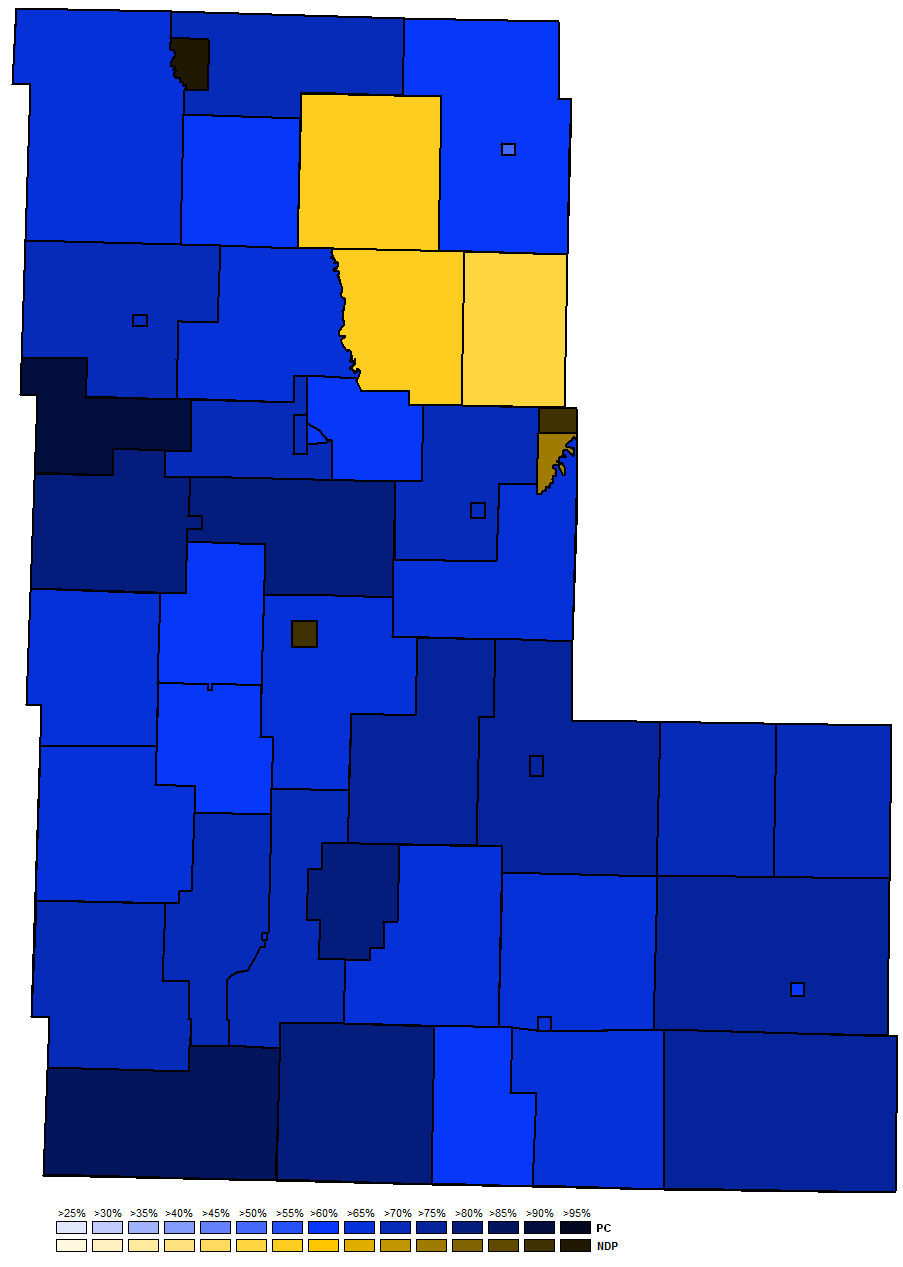
Manitoba provincial by-elections today (Morris & Arthur-Virden)

Location of Arthur-Virden and Morris
Voters in two Manitoba provincial ridings go to the polls today to elect new members of the Legislative Assembly of Manitoba. The two vacated ridings are located in rural Manitoba, and are considered safe Tory ridings. The vacated ridings are Morris and Arthur-Virden. Morris borders the city of Winnipeg on the southwest, while Arthur-Virden is located in the southwest corner of the province.

The governing New Democratic Party has come under huge scrutiny for waiting to call these by-elections. Morris in particular has been vacant for nearly a year!- 11 ½ months to be exact. Premier Greg Selinger has made many excuses for the delay, but the politically cynical would suggest that he was in no hurry to call by-elections in two safe Tory seats. After all, Manitoba law dictates that a by-election can be called as late as a year after a seat becomes vacant. Selinger’s inaction may have cost his party in the polls. A recent poll conducted by Probe Research gave the opposition Progressive Conservatives a 48-29 lead over the NDP in the province.

Large parts of both ridings just had federal by-elections in November. The Morris, Ste. Agathe and Niverville areas of Morris are part of the Provencher federal riding, while most of Arthur-Virden is located in the Brandon—Souris federal riding. In fact, Arthur-Virden was vacated in October because its MLA, Larry Maguire, ran (and won) in the Brandon—Souris by-election for the federal Conservatives. Morris however was vacated in February when its MLA, Mavis Tailleiu resigned due to family and health reasons.


Morris


Morris is a sprawling rural riding on the west, and southwest of Winnipeg. It stretches from the Assiniboine River valley in the north, down to the Town of Morris in the south. On the northeast, it stretches to the Winnipeg City limits, and consists of the Red River valley south of the city. The riding contains the communities of Morris, Niverville, Ste. Agathe, Sanford, Oak Bluff, La Salle, Starbuck and Elie. It has a sizable German and French population. Niverville is the largest community.

History

The riding has existed for most of Manitoba’s history, having been created in 1879. Before that, it was part of Ste. Agathe riding.  The riding is very safe for the Progressive Conservatives. They have held the riding since the 1940s, and have won every election in the seat comfortably since 1969. In 2011, Taillieu won 74% of the vote for the Tories. The NDP has never won the riding, and the Liberals haven’t won the riding in 118 years.

MLAs:

Geo. Klyne, Ind. (1870-1874)
A.-F. Martin, Opp. (1874-1878)
J.N. Taillefer, Govt. (1878-1883)
H.J. Tennant, Cons. (1883-1886)

A.-F. Martin, Liberal (1886-1896) 2nd time
Stewart Mulvey, Liberal (1896-1899)

C.H. Campbell, Cons. (1899-1913)
Jacques Parent, Cons. (1913-1918)

W.R. Clubb, Farmer/UFM/Lib.-Prog. (1920-1941)
J.C. Dryden, Ind./Lib.-Prog. (1941-1949)

H.P. Shewman, Ind/Prog. Cons. (1949-1968)
W.H. Jorgenson, Prog. Cons. (1969-1981)
Clayton Manness, Prog. Cons. (1981-1995)
F. Pitura, Prog. Cons. (1995-2003)
Ms. Mavis Taillieu, Prog. Cons. (2003-2013)


Political geography

2011 results by polling division in Morris (urban polls combined)
PC MLA Mavis Taillieu’s steamroll victory over the NDP’s Mohamed Alli in 2011 (she defeated him by over 4000 votes or 74%-19%) ensured that every poll in the riding backed her. Her strongest poll was #17, located in Cartier Rural Municipality in the northwest of the riding. In this poll, she won 93% of the vote. The poll contains a number of Hutterite Colonies surrounding the community of Elie. Her worst poll was also located in Cartier, which was poll #11. In this poll, she won just 57% of the vote. Poll 11 is concentrated on the community of Lido Plage, on the south shore of the Assiniboine River. Federally, the riding is split between Provencher and Portage—Lisgar. All of the Morris polls in both federal ridings also went Tory in the last election.

Outlook

The Tories are running former Manitoba director of the Canadian Federation of Independent Business Shannon Martin. He has been the candidate since May of last year. Opposing him from the NDP is actor/director/writer Dean Harder. The Liberals are running University of Manitoba student Jeremy Barber. It is no question that the Tories should easily win this riding. They won it easily in 2011 when they lost the provincial election as a whole, so now that they have a massive lead in the polls, it should be a cakewalk. The real question is, how big of a victory can they get? Can they reach 80%? And who will finish second? The Liberals only won 7% of the vote in 2011, but they are currently polling at 20% province-wide, which is a 12-point gain from the 2011 election. Plus, the last provincial by-election held in Fort Whyte, another safe Tory seat- saw the Liberals vault from third to second.  It is quite possible that this will happen again in Morris. The Liberals last finished second in this riding in 1999.


Arthur-Virden


Arthur-Virden is nestled in the southwest corner of the province, and is almost completely rural in nature. Its western boundary is the province of Saskatchewan, and on the south it’s bounded by the United States. The riding is shaped like an "L", with its northern wing extending northward past the community of Hamiota, and its eastern wing extending east past Boissevain. In addition to Hamiota and Boissevain, the riding also includes the communities of Hartney, Melita, Deloraine, Oak Lake, Virden and Elkhorn. Virden is the largest community. The riding also has a large German population.

History 

The riding was created in 1989 when the previous ridings of Arthur and Virden were merged into one. The area became part of Manitoba in 1881 when the western boundary of the province moved west. The area was covered by the riding of Turtle Mountain from 1881 to 1886 and then by Souris from 1886 to 1903. Virden was created in 1899 and Arthur was created in 1903. The Tories have dominated the region since 1953, with the Progressive Conservatives winning both Arthur and Virden in every election since. The NDP has never won either riding, and the Liberals haven’t held either seat since 1922.  Since Arthur-Virden was created in 1989, the Tories have won a majority of the vote in the riding in every election except 1999 when Larry Maguire won with 49% and the NDP winning 36%. In 2011, Maguire won 66% of the vote, with the NDP winning 30%. 

MLAs:

Arthur (Turtle Mountain 1881-1886; Souris 1886-1903)

J.P. Alexander, Cons. (1881-1883)
F.M. Young, Liberal (1883-1886)
J.P. Alexander, Cons. (1886-1888) 2nd time
A.M. Campbell, Liberal (1888-1899)
A.E. Thompson, Cons. (1899-1907)
Jn. Williams, Liberal (1907-1910)
A.M. Lyle, Cons. (1910-1914)
Jn. Williams, Liberal (1914-1922) 2nd time
D.L. McLeod, Prog./Lib.-Prog. (1922-1936)
J.R. Pitt, Lib.-Prog. (1936-1953)

J.A. Ross, Prog. Cons. (1953-1958)
J.G. Cobb, Prog. Cons (1958-1962)
J.D. Watt, Prog. Cons. (1962-1977)
J.E. Downey, Prog. Cons. (1977-1990)


Virden
Jas. Simpson, Cons. (1899-1903)
J.H. Agnew, Cons. (1903-1908)
H.C. Simpson, Cons. (1909-1914)

Geo. Clingan, Liberal (1914-1922)
R.H. Mooney, Prog./Lib.-Prog. (1922-1953)
J.W.M. Thompson, Prog. Cons. (1953-1962)
D.M. McGregor, Prog. Cons. (1962-1981)
H.E. Graham, Prog. Cons. (1981-1986)
G.M. Findlay, Prog. Cons. (1986-1990)

Arthur-Virden
J.E. Downey, Prog. Cons. (1990-1999) continued
L. Maguire, Prog. Cons. (1999-2013)


Political geography
2011 results by polling division in Arthur-Virden (urban polls combined)


Unlike Morris, the NDP actually did win polls in Arthur-Virden in the 2011 election. The NDP won a total of 7 polls, 4 of which were on Indian Reserves. The other 3 polls the NDP won were rural polls in the northern part of the riding. The Tories did win every other poll in the riding. The best poll for the Tories was #14, in the west-central part of the riding, where they won 93% of the vote. This poll is located in the Wallace Rural Municipality, and contains the community of Kola, and a Hutterite colony. The Strongest NDP poll was #2, which covers the Birdtail Sioux First Nation, located near the northern boundary of the riding. The NDP’s Garry Draper won 95% of the vote on the reserve, with Maguire unable to win a single vote. The Liberal candidate won one vote there. Federally, the riding is mostly located in Brandon—Souris, with the far northern portion located in Dauphin—Swan River—Marquette. In the 2011 federal election, all but one poll in Arthur-Virden went Conservative.


Outlook

Running for the Tories is Russell native Doyle Piwniuk, who is a local businessman. The NDP is running local educator Bob Senff, who ran previously for the party in 2007 as well as in the 2006 federal election.  The Liberals are running Floyd Buhler, the CAO of Wallace Rural Municipality. Just like Morris, the race in Arthur-Virden will be for second place. The way the polls are going, it would take a lot to stop Piwniuk from winning. It will be an uphill battle for the Liberals to place 2nd, as they won just 4% of the vote in 2011. They haven’t received more than 10% since 1999. However, the Liberals did finish second in 1990.

Conclusion 

For the Tories to “win” tonight, they will need to increase their vote share in both ridings. For the Liberals, they will need to finish 2nd in at least Morris to have a successful night. For the NDP, they need to hold their ground, by staying in 2nd place in both ridings. We’ll find out what happens when the polls close at 8:00pm Central (9:00 pm Eastern).

Monday, December 9, 2013

Provincial by-elections today in Viau and Outremont, Quebec

Location of both ridings in Montreal
Voters in two provincial ridings in Quebec head to the polls today to elect new Members of the National Assembly of Quebec in by-elections. Both ridings- Viau and Outremont - are considered safe Liberal seats, and both are located on the Island of Montreal. Viau was vacated in August when its MNA, Emmanuel Dubourg, resigned to run for the federal Liberals in neighbouring Bourassa in a by-election that was in-turn caused by the resignation of Denis Coderre to run for mayor of Montreal. Outremont was also vacated in August upon the resignation of MNA Raymond Bachand. New Liberal leader Philippe Coullard, who sits outside the legislature, will be contesting the seat. Following tradition, the two other main parties in Quebec (the governing PQ and the third place CAQ) will be sitting that by-election out.

Due to both seats being considered safe ridings for the Liberals, there has not been much focus on these by-elections. It will be interesting, however, to see how well the PQ does in Viau, as their popularity has taken a hit since winning a minority government last year. One particular issue, their proposed Quebec Charter of Values (which would make the wearing of religious paraphernalia illegal in government work places), has created much controversy, and may prove to be quite unpopular in the multicultural riding.


Viau


Viau is located in the Montreal Borough of Villeray—Saint-Michel—Parc-Extension. It consists of all of the Saint-Michel District, and most of Francois-Perrault District (east of Papineau Avenue). Most of the riding falls within the former municipal limits of the City of Saint-Michel, which was annexed by Montreal in 1968. The riding is very ethnically diverse, being home to not only French Canadians, but Haitians, Italians, Arabs, Asians and Hispanics. Federally, the riding is split between three districts: Papineau, Saint-Leonard—Saint-Michel and a small part in Ahuntsic.

History

MNAs:

Laval
  • J.-H. Bellerose, Cons. (1867-1875)
  • L.-O. Loranger, Cons. (1875-1882)
  • P.-E. Leblanc, Cons. (1882-1883)
  • Amedee Gaboury, Liberal (1883-1884)
  • P.-E. Leblanc, Cons. (1884-1908)
  • J.W. Levesque, Liberal (1908-1919)
  • J.-O. Renaud, Cons. (1919-1931)
  • Jos. Filion, Liberal (1931-1935)
  • F.-J. Leduc, Cons./U. N./Liberal (1935-1948)
  • Omer Barriere, U. N. (1948-1956)
  • Leopold Pouliot, U. N. (1956-1960)
Bourget
  • Jean Meunier, Liberal (1960-1966)
Olier
  • Fernand Picard, Liberal (1966-1973)
Viau
  • Fernand Picard, Liberal (1973-1976) continued
  • C-A. Lefebvre, P. Q. (1976-1981)
  • Wm. Cusano, Liberal (1981-2007)
  • Emmanuel Dubourg, Liberal (2007-2013)

Since the Liberals won the seat back from the PQ in 1985, the riding has been a safe Liberal and a safe Federalist seat. Since 1985, only once have the Liberals not won a majority of the vote in this riding, and that was in the last election. Even then, Dubourg defeated his nearest rival, PQ candidate Gabriel Arbieto Munayco by nearly 6000 votes, or 47% to 24%. In that election, both the CAQ's candidate Walid Hadid and QS candidate Genevieve Fortier-Moreau ate into traditional Liberal support, winning about 12% of the vote each. In Quebec's two sovereignty referendums, the “NO” side won easily in Viau. In 1980, NO won 66%-34%, while in 1995, it won 69%-31%.

Political geography


Viau in 2012. Map credit: MaxQue, uselectionatlas.org

In the 2012 election, Dubourg dominated the Saint-Michel District of the riding, winning all but three of the district's polls. It was in this area where the Liberals had their best district, poll #64, where they won 79% of the vote. This poll is in the 2nd & 6th Ave areas. The PQ was stronger in the south end of the riding, in Francois-Perrault District, specifically in the southwest corner. It was in this area that the PQ scored their best poll, #98 in the De Lorimier / De Bordeaux / Belanger / Jean-Talon area, with Arbieto Munayco winning 41%. Federally, despite the riding covering three federal electoral districts, the area shows a similar political geography. In the 2011 federal election, the Liberals did the best in Saint-Michel, while the NDP did strong in the southwest corner of the riding (getting votes from traditional BQ/PQ areas).


Outlook


Running for the Liberals is David Heurtel, former CEO of Montreal's Olympic Park. Heurtel is also a former advisor to former PQ Premier Bernard Landry, but Heurtel has explained that his position (on separation, presumably) has “evolved”. Running for the PQ is Tania Longpre, a French teacher for immigrants. The CAQ is running lawyer Jamilla Lebouef of BNP Paribas. Running again for the QS is special education teacher Genevieve Fortier-Moreau, who also ran in 2012.

With PQ popularity much lower than it was a year ago, it seems unlikely they will make any gains in this by-election. In fact, with their controversial Charter of Values sure to anger residents of this multicultural riding, they are sure to lose much of their support; in fact, it's possible they may lose their 2nd place standing in the riding. The QS could perhaps surpass them, or even the CAQ (which has seen a drop in their support as well). The overall split in the anti-Liberal vote may lead to a large-percentage victory for Heurtel, and could lead to him winning more polls than Dubourg did in 2012.


Outremont


The riding of Outremont is also located in Montreal, and contains all of Outremont Borough, most of Cote-des-Neiges District (south of Cote-Sainte-Catherine), part of Snowdon District (south of Cote-Sainte-Catherine and east of Autoroute 15) and part of Mile-End District (west of Ave. de l'Esplanade). Cote-des-Neiges and Snowdon are in the Borough of Cote-des-Neiges—Notre-Dame-de-Grace while Mile-End is in Plateau-Mont-Royal Borough. Each of the three boroughs gives the riding a different character: Outremont is fairly wealthy, with a large Hasidic Jewish population, Mile-End is a neighbourhood of artists and culture, while Cote-des-Neiges is an ethnically diverse area with a high student population. Federally, most of the riding can be found in the federal riding of Outremont. Parts of Snowdon and Cote-des-Neiges are in the federal ridings of Mount Royal and Westmount—Ville-Marie.


History

MNAs:

Hochelaga
  • Louis Beaubien, Cons. (1867-1886)
  • J.-O. Villeneuve, Cons. (1886-1887)
  • Chas. Champagne, Liberal (1888-1890)
  • J.-O. Villeneuve, Cons. (1890-1897) 2nd time
  • D.J. Decaire, Liberal (1897-1904)
  • J.L. Decaire, Liberal (1904-1912)
Westmount
  • C.A. Smart, Cons. (1912-1936)
  • W.R. Bulloch, U. N. (1936-1939)
Montreal-Outremont
  • Henri Groulx, Liberal (1939-1953)
  • G.-E. Lapalme, Liberal (1953-1966)
Outremont
  • Jerome Choquette, Liberal (1966-1976)
  • Andre Raynauld, Liberal (1976-1980)
  • Pierre Fortier, Liberal (1980-1989)
  • Gerald Tremblay, Liberal (1989-1996)
  • P.-E. Laporte, Liberal (1996-2003)
  • Yves Seguin, Liberal (2003-2005)
  • Raymond Bachand, Liberal (2005-2013)

The riding has been held by the Liberals since its creation as Montreal-Outremont in 1939. The seat has been generally a safe Liberal seat since then, although the PQ has come somewhat close on a handful of occasions. The closest the Liberals have come to losing the seat since 1939 was in 1973, when Liberal Andre Raynauld defeated PQ candidate Pierre Harvey by 2400 votes, or 45%-37%. Despite the riding being a “safe seat” the Liberals have only received a majority of the vote once in the last 4 elections. Bachand's 42% mark in the last election was the lowest the Liberals have ever received in this riding since 1939. His nearest rival, Roxanne Gendron, however, received just 23% of the vote, which was that party's worst showing in the riding since 1970. These vote share drops came at the expense of a strong QS campaign by Edith Laperle, who won 18% of the vote. The CAQ candidate Claude Michaud won 14% of the vote, which was much higher than its predecessor party, the ADQ, ever won in the riding. In the two sovereignty referendums, the riding has been expectedly federalist. In 1996, the “NO” side won 66%-34%, while NO previously won by a similar margin in 1980, 65%-35%.

Political geography


Outremont in 2012. Map credit: MaxQue, uselectionatlas.org

In the 2012 election, the Liberals received the most votes in each of the three parts of the riding. However, each of the three parts have unique political charactaristics. The Liberals were strongest in the west end of the riding in the Cote-des-Neiges / Snowdon area. In that region, they won 51% of the vote, and in every polling division. Their strongest poll was in this area, poll #2 on Bonavista Ave. in Snowdon, where they won 81%. In Outremont and in Mile-End, the Liberals won just one third of the vote. In Outremont Borough, the PQ finished a strong second. Their strongest poll came in the borough, in #102 by the Outremont Metro Station. The PQ won 46% there. Quebec Soildaire was especially strong in Mile-End, losing the popular vote there by just 14 votes. QS's strongest poll came in Mile-End, winning 42% in poll #142, which is on Park Ave. bewtween St. Joseph and Mount Royal Ave. The PQ finished third in Mile-End, winning just two polls. The CAQ was strongest in wealthy Outremont, but won no polls.

2012 results by borough (calculated by MaxQue, uselectionatlas.org):


CDN - NDG Outremont Plateau-Mont-Royal
Liberal 50.68% 34.00% 32.67%
PQ 17.32% 28.82% 20.69%
QS 14.48% 18.06% 32.24%
CAQ 13.76% 16.36% 9.62%
Others 3.75% 2.76% 4.78%

Federally, much of the riding went NDP in the last election due to the fact that most of the provincial riding of Outremont can be found in the federal riding of Outremont, which is represented by NDP leader Thomas Mulcair. However, the part of the riding that falls within the Mount Royal federal electoral district (the area around Mackenzie King Park) went Liberal, but the NDP still did well, considering that riding is traditionally a safe Liberal seat. Also, the part of Outremont provincial riding located in the federal riding of Westmount—Ville-Marie was less NDP friendly than the rest of Outremont, but it still went NDP.


Outlook


Both the PQ and the CAQ will not be running candidates in this by-election. Both parties have respected parliamentary tradition by not running any candidates against the Liberal leader, Philippe Couillard who is the Liberal candidate. Couillard was previously an MNA for neighbouring Mont-Royal from 2003 to 2007 and then represented Jean-Talon in Quebec City from 2007 to 2008. He then resigned from political office and was later appointed to the Security Intelligence Review Committee. He became Liberal leader in March, and has led the party from outside the legislature since. His main opposition will come from Quebec Solidaire, who has opted not to follow parliamentary tradition, but instead will at least give voters a choice on today's ballot. Running once again for QS is Edith Laperle, a labour union consultant. There are five other candidates running, of those the Greens and Option Nationale will each perhaps have the best chance of finishing third. Option Nationale is a hardline separatist party that finished fifth in 2012 with 2%. The Greens didn't run in 2012 in the riding, but did get a respectable 6% of the vote in the 2008 election, ahead of the ADQ candidate. Plus, they are running their new leader in the riding, Alex Tyrrell. The Greens could take away some QS voters who couldn't vote Green in 2011.

In all likelihood Quebec Solidaire, as the only real alternative to Couillard, will see their vote share dramatically increase from the 18% they received in 2012. If they get enough PQ voters, they could give Couillard a run for his money. After all, the combined PQ and QS result from 2011 was just 79 votes less than the Liberal candidate. However, the CAQ vote will likely mostly go to the Liberals, ensuring their victory. Geographically, expect the QS to easily win Mile-End, while the Liberals will win Cote-des-Neiges. The real race will be in Outremont Borough.

---

I'd like to personally thank MaxQue, a poster on the uselectionatlas.org Forum (and former Montrealer) who made the maps (using my colour scale as well!), as well as identifying which polls each party did the strongest in, and also calculating the results by borough in Outremont.

Polls close in both ridings at 8pm Eastern.