Thursday, February 13, 2014

Provincial by-elections today in Ontario


Two Ontario provincial by-elections will be held today in the ridings of Thornhill and Niagara Falls. Both ridings are in Ontario’s infamous bellwether “905 region”, but both are very different ridings. Thornhill was held by a Tory MPP, Peter Shurman while Niagara Falls was held by a Liberal in Kim Craitor. The Conservatives hold both ridings federally, but the similarities seem to stop there. Thornhill is a relatively affluent riding (average income is $48,000) on the edge of Toronto, and is notable for its large Jewish population. Niagara Falls is a more middle income riding, and is as far away as you can go from Toronto in the 905.

Thornhill stands out as a riding, as it is the lone Tory riding in a seat of Liberal ridings in southern York Region and is bounded on the south by a sea of Liberal ridings in North York. Its high Jewish population has influenced the riding enough to make it much more conservative than the surrounding ridings. Niagara Falls meanwhile is a bellwether riding, and has voted for the party that would form the government in every election since 1985. Federally Niagara Falls is a strong bellwether as well. Only twice since 1963 has the riding not voted for the winning party in federal elections (1972 and 2004).


Niagara Falls


The riding of Niagara Falls includes the world-famous city of Niagara Falls, and two other municipalities, Niagara-on-the-Lake to its north, and Fort Erie on its south. The riding flanks the entirety of the west bank of the Niagara River, running from Lake Erie in the south to Lake Ontario in the north. The City of Niagara Falls makes up the majority of the riding’s population, as it is home to 83,000 of the riding’s 128,000 people. The riding is mostly urban, but all three municipalities contain large rural areas. Niagara-on-the-Lake is fairly affluent (Average income: $46,000), while both Niagara Falls and Fort Erie have a smaller average income at around $34,000 each.

The riding was vacated when its MPP Kim Craitor resigned in September citing mental exhaustion and wanting to focus on his health and family. He has since declared his intentions to run for Niagara Falls city council.

History

As mentioned, the riding has swung the same way as the province since 1985. It elected Liberal Vince Kerrio when the Peterson Liberals were in power (1985-1990), it elected NDPer Margaret Harrington when Bob Rae was Premier (1990-1995), it elected Tory Bart Maves during the Mike Harris years (1995-2003) and has elected Liberal Kim Craitor under Dalton McGuinty ever since.

Before the 1980s, the riding was mostly Liberal, with some instances of the Tories and other parties winning.

Welland
Wm. Beatty, Liberal (1867-1871)
J.G. Currie, Liberal (1871-1879)
Daniel Near, Liberal (1879-1883)
J.E. Morin, Liberal (1883-1890)

Wm. McCleary, Cons. (1890-1894)
W.M. German, Liberal (1894-1900)
J.F. Gross, Liberal (1900-1904)

E.E. Fraser, Cons. (1904-1914)


Niagara Falls
G.J. Musgrove, Cons. (1914-1919)
C.F. Swayze, Labour (1919-1923)
W.G. Wilson, Liberal (1923-1934)
W.L. Houck, Liberal (1934-1943)

C.A.G. Overall, CCF (1943-1945)
C.D. Hanniwell, Prog. Cons. (1945-1948)
W.L. Houck, Liberal (1948-1953) 2nd time
A.C. Jolley, Prog. Cons. (1953-1959)
Geo. Bukator, Liberal (1959-1971)
J.T. Clement, Prog. Cons. (1971-1975)
V.G. Kerrio, Liberal (1975-1990)
Mrs. M.H. Harrington, NDP (1990-1995)
B. Maves, Prog. Cons. (1995-2003)
Kim Craitor, Liberal (2003-2013)


Political geography

Niagara Falls - 2011 results by polling division


The 2011 provincial election saw a three-way race in the riding, with Craitor narrowly winning by 541 votes over Tory opponent George Lepp. His NDP opponent, Wayne Redekop was just 4000 votes behind in third. 

2011 results by municipality:
Municipality Liberal PC NDP
Others
Niagara-on-the-Lake
41.6%
43.7%
12.2%
2.5%
Niagara Falls
41.1%
30.1%
25.2%
3.6%
Fort Erie
18.8%
41.0%
38.3%
1.9%

The 2011 election saw unique results for each of the three municipalities in the riding. In the affluent Niagara-on-the-Lake, the race was a close affair between the Liberals and the Tories, with the NDP in a distant third. The Liberals won the urban part of Niagara-on-the-Lake, while the Tories won the rural area. In the City of Niagara Falls, the Liberals were the clear winners, picking up most of the polls across the urban parts of the city. Both the NDP and the Tories won a splattering of polls in the urban part of the city, while the Tories won all of the rural polls south of the city. In Fort Erie, the Liberals were a distant third, with the race being between the Tories and the NDP. The NDP was boosted in Fort Erie by the fact that their candidate was the former mayor of the town. The urban part of Fort Erie was a near even split between the Tories and NDP, while the rural areas leaned to the Tories. Notably, the New Democrats won the community of Crystal Beach in the west end of the town.  

Strongest polls (2011):
  • Liberal: Poll #712, Valley Park Lodge (Lundy’s Lane, Niagara Falls) – 64%; Strongest regular poll: Poll #7 in central Niagara-on-the-Lake – 55%
  • Progressive Conservatives: Poll #704, Heritage Place (Virgil, Niagara-on-the-Lake) – 65%; Strongest regular poll: Poll #3 (rural north-central Niagara-on-the-Lake) – 54%
  • New Democratic Party: Poll #195 (north urban Fort Erie) – 59%.

Outlook

All three of the main candidates running are Niagara Falls city councillors. Running for the Liberals is Joyce Morocco, the NDP is running Wayne Gates and the Tories are running Bart Maves (who is also a former MPP).  For interest’s sake, the City of Niagara Falls elects its councillors on an at-large basis, and Gates won nearly 10,879 votes in the city in the last municipal election, Morocco won 9,720 and Maves won 9,564 votes.  Both Morocco and Gates have run federally in the riding (Morocco in 2008, Gates in 2004 & 2006). Maves held the riding provincially from 1995 to 2003 when he lost to Craitor. The Greens are running local chef Clarke Bitter.

CORRECTION: Maves is a Niagara regional councillor. His nephew of the same name is on Niagara City Council, and the above numbers reflect his nephew's vote totals. 

The only firm that I’ve seen doing polls for these by-elections is Forum Research, which has had a sketchy track record as of late. However, with no other polls available, I will have to use their data to speculate on the result of today’s elections. In Niagara Falls, the NDP’s Wayne Gates holds a commanding lead over the Tories’ candidate Bart Maves (48%-33%). The Liberals’ Joyce Morocco is in third at 17%. For the Liberals, this would be a huge blow to the party, which has already lost three by-elections (in seats they held) since the 2011 election. For the NDP, the win would be another by-election boost for the party, which has already picked up three by-election wins (two in seats that are not known to be NDP-friendly) since the 2011 election. For the Tories, a loss here would be another blow for the party, in leader Tim Hudak’s backyard (he hold’s the neighbouring riding of Niagara West-Glanbrook, and actually has held parts of this riding in the past). The Tories have only won one by-election since 2011, while they have also surrendered a seat that they had previously held.


Thornhill

Thornhill is a suburban riding located on the northern edge of Toronto. The riding spans two municipalities; it contains the southeastern corner of the City of Vaughan and the southwestern corner of the City of Markham. While these two areas are in separate municipalities, they together form the large suburban community of Thornhill. The riding extends from the 404 in the east to the 400 in the west, is bounded by the City of Toronto in the south and by a line following Rutherford Road to Bathurst Street to Highway 7 on the north. Thornhill is most notable for its large Jewish population. It has the largest Jewish concentration of any federal riding (remember, provincial ridings in southern Ontario have the same borders as their federal counterparts) in Canada at 33%. Much of the Jewish population is Orthodox, making the Jews in this riding especially conservative. The riding marks the northern node of a Jewish-belt that extends southward into Toronto along Bathurst Street until Forest Hill.

Thornhill was vacated by Peter Shurman on the last day of 2013 following a reprimand from Tory leader Tim Hudak for Shurman claiming mileage from his home in Niagara-on-the-Lake to Toronto (not in Thornhill) as an expense.


History

Thornhill as a riding has only existed since 1999. All four of the provincial elections held in the riding since its creation have been close. In 1999, the Tories won the seat by just 400 votes. The Liberals gained it back in 2003 by winning by just 800 votes. Shurman won the seat back for the Tories in 2007, in a race decided by less than 2000 votes. In 2011, Shurman increased his lead to 2,600 votes. The key to winning the riding has been about winning enough of the non-Jewish vote to carry the seat, as in recent years, the Jewish vote has been very homogenously behind the PCs.

Before 1999, the riding was typically split between ridings containing Markham and ridings containing Vaughan. The following list of MPPs follows the Markham portion before 1999 (The 1999 redistribution saw a larger chunk of Markham become part of Thornhill):

York East
H.P. Crosby, Liberal (1867-1874)
Jn. Lane, Liberal (1874-1879)
G.W. Badgerow, Liberal (1879-1886)
G.B. Smith, Liberal (1886-1894)
Jn. Richardson, Liberal (1894-1905)
Alex. McCowan, Cons. (1905-1913)
G.S. Henry, Cons. (1913-1943)

Ms. A.C. Macphail. CCF (1943-1945)
Jn. Leslie, Prog. Cons. (1945-1948)
Ms. A.C. Macphail, CCF (1948-1951) 2nd time
H.E. Beckett, Prog. Cons. (1951-1963)


York North
A.A. MacKenzie, Prog. Cons. (1963-1967)

York Centre

D.M. Deacon, Liberal (1967-1975)
A.J. Strong, Liberal (1975-1981)

W.D. Cousens, Prog. Cons. (1981-1987)


Markham
W.D. Cousens, Prog. Cons. (1987-1995) continued
David Tsubouchi, Prog. Cons. (1995-1999)


Thornhill
Ms. T.R. Molinari, Prog. Cons. (1999-2003)
M.G. Racco, Liberal (2003-2007)
Peter Shurman, Prog. Cons. (2007-2013)


Political geography

Thornhill - 2011 results by polling division


The biggest biggest political cleavage in the riding is between the Jewish areas vs. the non-Jewish areas. The Jewish population of the riding is concentrated in the Vaughan half of the riding, which went strongly for the Progressive Conservative candidate, Peter Shurman in 2011. Some of the most Jewish polls had Shurman winning over 70% of the vote. However, in the less Jewish Markham half of the riding, the Liberals edged out the Tories in 2011, as was typical for this part of the province. The Tories beat the Liberals by 12 points in the Vaughan half of the riding, while the Liberals only beat the Tories by six points in the Markham half, which was not enough to overcome the Tory lead. The NDP has been a non-factor in this riding, although they did win one poll in 2011.

2011 Results by municipal ward:

Ward
PC Liberal NDP
Others
Vaughan Ward 4 (part)
48.9%
37.9%
9.6%
3.7%
Vaughan Ward 5
50.4%
38.3%
8.2%
3.1%
Markham Ward 1
38.7%
44.7%
12.0%
4.5%
Markham Ward 2
39.9%
45.5%
10.5%
4.0%

Strongest polls (2011)
  • Progressive Conservatives: Poll #112 (Central Thornhill, Ward 5, Vaughan) – 79%
  • Liberals: Poll #701 (Constantia Retirement Residence, Beverly Glen, Ward 5, Vaughan) – 63%; Strongest regular poll: Poll #190 (Thornlea East, Ward 2, Markham) – 60%
  • New Democratic Party: Poll #413 (Chateau Parc, west Thornhill, Ward 5, Vaughan) – 33% (Only poll win)


Thornhill religious plurality by Census Tract

Outlook


Running for the Tories is optometrist Gila Martow. Her past political experience includes running for Vaughan City Council in 2010 in the heavily Jewish Ward 5. She has been noted as having "strong roots in the Jewish community", and her biography strategically includes a picture of her with Stephen Harper and Israeli Prime Minister Benjamin Netanyahu. Running for the Liberals is Vaughan City Councillor Sandra Yeung Racco, who represents Ward 4, which is partly in the riding. She is married to the riding’s former MPP, Mario Racco. Yeung Racco is of Chinese descent, which could help her in the Markham half of the riding which has a large Chinese population. The NDP’s sacrificial lamb is high tech manager Cindy Hackelberg, who was the candidate in 2011.   The Greens are running Dr. Teresa Pun, whose past political experience involves running provincially in Manitoba.

Forum Research has this race as the Tories’ to lose. Their candidate Gila Martow leads with a commanding 51% in their most recent poll. Liberal candidate Sandra Yeung Rocco was at 40% in the poll and the NDP was in single digits at 5%. In the last round of by-elections last summer, Forum tended to show the Tories as being stronger then they actually were, so it’s possible this race could be close. For the Tories, if they lose this heavily Jewish riding, it would be a huge blow for the party, especially since it would be the first gain for the Liberals in a by-election since the last provincial election.


Polls close in both ridings at 9:00 pm local time.

Tuesday, January 28, 2014

Manitoba provincial by-elections today (Morris & Arthur-Virden)

Location of Arthur-Virden and Morris
Voters in two Manitoba provincial ridings go to the polls today to elect new members of the Legislative Assembly of Manitoba. The two vacated ridings are located in rural Manitoba, and are considered safe Tory ridings. The vacated ridings are Morris and Arthur-Virden. Morris borders the city of Winnipeg on the southwest, while Arthur-Virden is located in the southwest corner of the province.

The governing New Democratic Party has come under huge scrutiny for waiting to call these by-elections. Morris in particular has been vacant for nearly a year!- 11 ½ months to be exact. Premier Greg Selinger has made many excuses for the delay, but the politically cynical would suggest that he was in no hurry to call by-elections in two safe Tory seats. After all, Manitoba law dictates that a by-election can be called as late as a year after a seat becomes vacant. Selinger’s inaction may have cost his party in the polls. A recent poll conducted by Probe Research gave the opposition Progressive Conservatives a 48-29 lead over the NDP in the province.

Large parts of both ridings just had federal by-elections in November. The Morris, Ste. Agathe and Niverville areas of Morris are part of the Provencher federal riding, while most of Arthur-Virden is located in the Brandon—Souris federal riding. In fact, Arthur-Virden was vacated in October because its MLA, Larry Maguire, ran (and won) in the Brandon—Souris by-election for the federal Conservatives. Morris however was vacated in February when its MLA, Mavis Tailleiu resigned due to family and health reasons.


Morris


Morris is a sprawling rural riding on the west, and southwest of Winnipeg. It stretches from the Assiniboine River valley in the north, down to the Town of Morris in the south. On the northeast, it stretches to the Winnipeg City limits, and consists of the Red River valley south of the city. The riding contains the communities of Morris, Niverville, Ste. Agathe, Sanford, Oak Bluff, La Salle, Starbuck and Elie. It has a sizable German and French population. Niverville is the largest community.

History

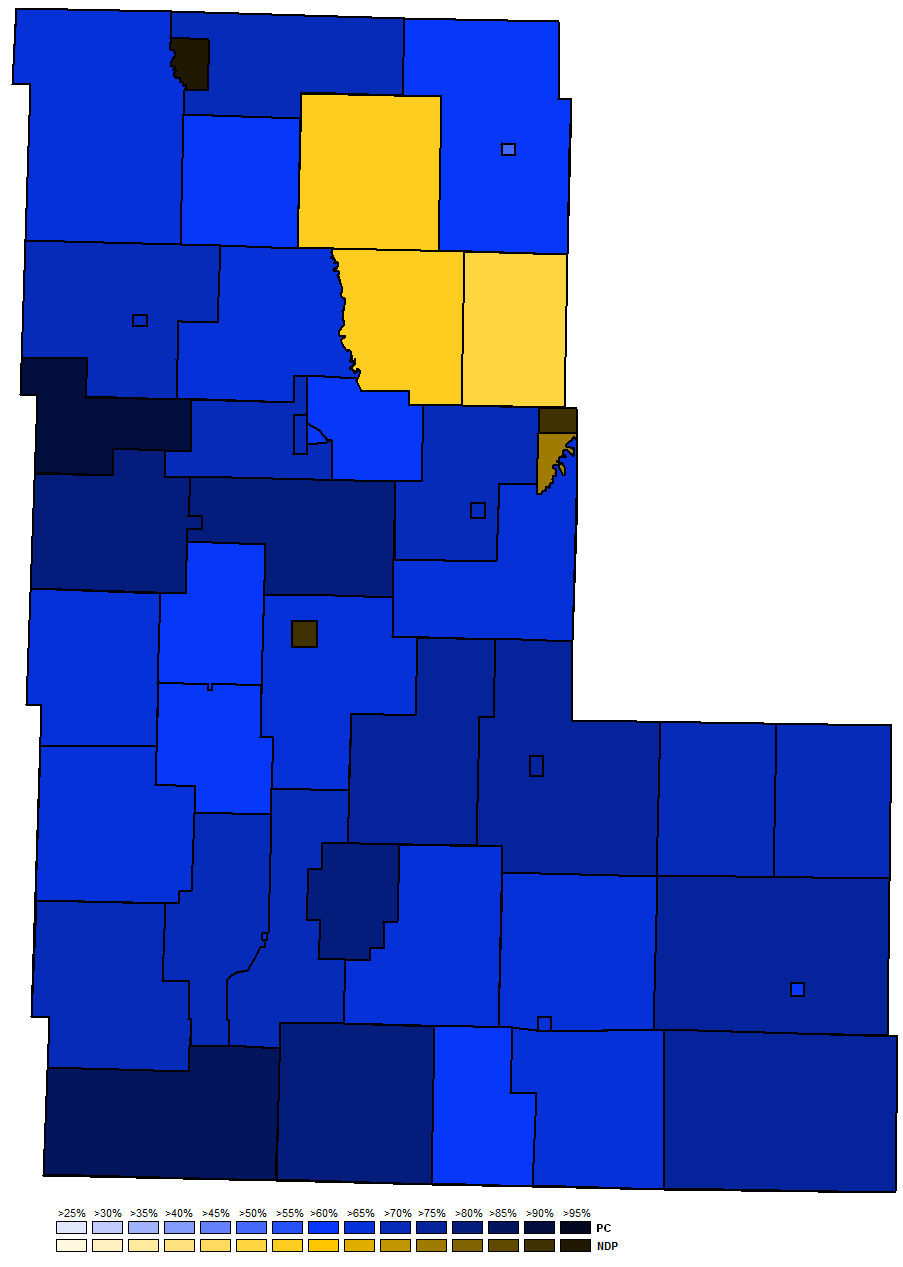
The riding has existed for most of Manitoba’s history, having been created in 1879. Before that, it was part of Ste. Agathe riding.  The riding is very safe for the Progressive Conservatives. They have held the riding since the 1940s, and have won every election in the seat comfortably since 1969. In 2011, Taillieu won 74% of the vote for the Tories. The NDP has never won the riding, and the Liberals haven’t won the riding in 118 years.

MLAs:

Geo. Klyne, Ind. (1870-1874)
A.-F. Martin, Opp. (1874-1878)
J.N. Taillefer, Govt. (1878-1883)
H.J. Tennant, Cons. (1883-1886)

A.-F. Martin, Liberal (1886-1896) 2nd time
Stewart Mulvey, Liberal (1896-1899)

C.H. Campbell, Cons. (1899-1913)
Jacques Parent, Cons. (1913-1918)

W.R. Clubb, Farmer/UFM/Lib.-Prog. (1920-1941)
J.C. Dryden, Ind./Lib.-Prog. (1941-1949)

H.P. Shewman, Ind/Prog. Cons. (1949-1968)
W.H. Jorgenson, Prog. Cons. (1969-1981)
Clayton Manness, Prog. Cons. (1981-1995)
F. Pitura, Prog. Cons. (1995-2003)
Ms. Mavis Taillieu, Prog. Cons. (2003-2013)


Political geography

2011 results by polling division in Morris (urban polls combined)
PC MLA Mavis Taillieu’s steamroll victory over the NDP’s Mohamed Alli in 2011 (she defeated him by over 4000 votes or 74%-19%) ensured that every poll in the riding backed her. Her strongest poll was #17, located in Cartier Rural Municipality in the northwest of the riding. In this poll, she won 93% of the vote. The poll contains a number of Hutterite Colonies surrounding the community of Elie. Her worst poll was also located in Cartier, which was poll #11. In this poll, she won just 57% of the vote. Poll 11 is concentrated on the community of Lido Plage, on the south shore of the Assiniboine River. Federally, the riding is split between Provencher and Portage—Lisgar. All of the Morris polls in both federal ridings also went Tory in the last election.

Outlook

The Tories are running former Manitoba director of the Canadian Federation of Independent Business Shannon Martin. He has been the candidate since May of last year. Opposing him from the NDP is actor/director/writer Dean Harder. The Liberals are running University of Manitoba student Jeremy Barber. It is no question that the Tories should easily win this riding. They won it easily in 2011 when they lost the provincial election as a whole, so now that they have a massive lead in the polls, it should be a cakewalk. The real question is, how big of a victory can they get? Can they reach 80%? And who will finish second? The Liberals only won 7% of the vote in 2011, but they are currently polling at 20% province-wide, which is a 12-point gain from the 2011 election. Plus, the last provincial by-election held in Fort Whyte, another safe Tory seat- saw the Liberals vault from third to second.  It is quite possible that this will happen again in Morris. The Liberals last finished second in this riding in 1999.


Arthur-Virden


Arthur-Virden is nestled in the southwest corner of the province, and is almost completely rural in nature. Its western boundary is the province of Saskatchewan, and on the south it’s bounded by the United States. The riding is shaped like an "L", with its northern wing extending northward past the community of Hamiota, and its eastern wing extending east past Boissevain. In addition to Hamiota and Boissevain, the riding also includes the communities of Hartney, Melita, Deloraine, Oak Lake, Virden and Elkhorn. Virden is the largest community. The riding also has a large German population.

History 

The riding was created in 1989 when the previous ridings of Arthur and Virden were merged into one. The area became part of Manitoba in 1881 when the western boundary of the province moved west. The area was covered by the riding of Turtle Mountain from 1881 to 1886 and then by Souris from 1886 to 1903. Virden was created in 1899 and Arthur was created in 1903. The Tories have dominated the region since 1953, with the Progressive Conservatives winning both Arthur and Virden in every election since. The NDP has never won either riding, and the Liberals haven’t held either seat since 1922.  Since Arthur-Virden was created in 1989, the Tories have won a majority of the vote in the riding in every election except 1999 when Larry Maguire won with 49% and the NDP winning 36%. In 2011, Maguire won 66% of the vote, with the NDP winning 30%. 

MLAs:

Arthur (Turtle Mountain 1881-1886; Souris 1886-1903)

J.P. Alexander, Cons. (1881-1883)
F.M. Young, Liberal (1883-1886)
J.P. Alexander, Cons. (1886-1888) 2nd time
A.M. Campbell, Liberal (1888-1899)
A.E. Thompson, Cons. (1899-1907)
Jn. Williams, Liberal (1907-1910)
A.M. Lyle, Cons. (1910-1914)
Jn. Williams, Liberal (1914-1922) 2nd time
D.L. McLeod, Prog./Lib.-Prog. (1922-1936)
J.R. Pitt, Lib.-Prog. (1936-1953)

J.A. Ross, Prog. Cons. (1953-1958)
J.G. Cobb, Prog. Cons (1958-1962)
J.D. Watt, Prog. Cons. (1962-1977)
J.E. Downey, Prog. Cons. (1977-1990)


Virden
Jas. Simpson, Cons. (1899-1903)
J.H. Agnew, Cons. (1903-1908)
H.C. Simpson, Cons. (1909-1914)

Geo. Clingan, Liberal (1914-1922)
R.H. Mooney, Prog./Lib.-Prog. (1922-1953)
J.W.M. Thompson, Prog. Cons. (1953-1962)
D.M. McGregor, Prog. Cons. (1962-1981)
H.E. Graham, Prog. Cons. (1981-1986)
G.M. Findlay, Prog. Cons. (1986-1990)

Arthur-Virden
J.E. Downey, Prog. Cons. (1990-1999) continued
L. Maguire, Prog. Cons. (1999-2013)


Political geography
2011 results by polling division in Arthur-Virden (urban polls combined)


Unlike Morris, the NDP actually did win polls in Arthur-Virden in the 2011 election. The NDP won a total of 7 polls, 4 of which were on Indian Reserves. The other 3 polls the NDP won were rural polls in the northern part of the riding. The Tories did win every other poll in the riding. The best poll for the Tories was #14, in the west-central part of the riding, where they won 93% of the vote. This poll is located in the Wallace Rural Municipality, and contains the community of Kola, and a Hutterite colony. The Strongest NDP poll was #2, which covers the Birdtail Sioux First Nation, located near the northern boundary of the riding. The NDP’s Garry Draper won 95% of the vote on the reserve, with Maguire unable to win a single vote. The Liberal candidate won one vote there. Federally, the riding is mostly located in Brandon—Souris, with the far northern portion located in Dauphin—Swan River—Marquette. In the 2011 federal election, all but one poll in Arthur-Virden went Conservative.


Outlook

Running for the Tories is Russell native Doyle Piwniuk, who is a local businessman. The NDP is running local educator Bob Senff, who ran previously for the party in 2007 as well as in the 2006 federal election.  The Liberals are running Floyd Buhler, the CAO of Wallace Rural Municipality. Just like Morris, the race in Arthur-Virden will be for second place. The way the polls are going, it would take a lot to stop Piwniuk from winning. It will be an uphill battle for the Liberals to place 2nd, as they won just 4% of the vote in 2011. They haven’t received more than 10% since 1999. However, the Liberals did finish second in 1990.

Conclusion 

For the Tories to “win” tonight, they will need to increase their vote share in both ridings. For the Liberals, they will need to finish 2nd in at least Morris to have a successful night. For the NDP, they need to hold their ground, by staying in 2nd place in both ridings. We’ll find out what happens when the polls close at 8:00pm Central (9:00 pm Eastern).

Monday, December 9, 2013

Provincial by-elections today in Viau and Outremont, Quebec

Location of both ridings in Montreal
Voters in two provincial ridings in Quebec head to the polls today to elect new Members of the National Assembly of Quebec in by-elections. Both ridings- Viau and Outremont - are considered safe Liberal seats, and both are located on the Island of Montreal. Viau was vacated in August when its MNA, Emmanuel Dubourg, resigned to run for the federal Liberals in neighbouring Bourassa in a by-election that was in-turn caused by the resignation of Denis Coderre to run for mayor of Montreal. Outremont was also vacated in August upon the resignation of MNA Raymond Bachand. New Liberal leader Philippe Coullard, who sits outside the legislature, will be contesting the seat. Following tradition, the two other main parties in Quebec (the governing PQ and the third place CAQ) will be sitting that by-election out.

Due to both seats being considered safe ridings for the Liberals, there has not been much focus on these by-elections. It will be interesting, however, to see how well the PQ does in Viau, as their popularity has taken a hit since winning a minority government last year. One particular issue, their proposed Quebec Charter of Values (which would make the wearing of religious paraphernalia illegal in government work places), has created much controversy, and may prove to be quite unpopular in the multicultural riding.


Viau


Viau is located in the Montreal Borough of Villeray—Saint-Michel—Parc-Extension. It consists of all of the Saint-Michel District, and most of Francois-Perrault District (east of Papineau Avenue). Most of the riding falls within the former municipal limits of the City of Saint-Michel, which was annexed by Montreal in 1968. The riding is very ethnically diverse, being home to not only French Canadians, but Haitians, Italians, Arabs, Asians and Hispanics. Federally, the riding is split between three districts: Papineau, Saint-Leonard—Saint-Michel and a small part in Ahuntsic.

History

MNAs:

Laval
  • J.-H. Bellerose, Cons. (1867-1875)
  • L.-O. Loranger, Cons. (1875-1882)
  • P.-E. Leblanc, Cons. (1882-1883)
  • Amedee Gaboury, Liberal (1883-1884)
  • P.-E. Leblanc, Cons. (1884-1908)
  • J.W. Levesque, Liberal (1908-1919)
  • J.-O. Renaud, Cons. (1919-1931)
  • Jos. Filion, Liberal (1931-1935)
  • F.-J. Leduc, Cons./U. N./Liberal (1935-1948)
  • Omer Barriere, U. N. (1948-1956)
  • Leopold Pouliot, U. N. (1956-1960)
Bourget
  • Jean Meunier, Liberal (1960-1966)
Olier
  • Fernand Picard, Liberal (1966-1973)
Viau
  • Fernand Picard, Liberal (1973-1976) continued
  • C-A. Lefebvre, P. Q. (1976-1981)
  • Wm. Cusano, Liberal (1981-2007)
  • Emmanuel Dubourg, Liberal (2007-2013)

Since the Liberals won the seat back from the PQ in 1985, the riding has been a safe Liberal and a safe Federalist seat. Since 1985, only once have the Liberals not won a majority of the vote in this riding, and that was in the last election. Even then, Dubourg defeated his nearest rival, PQ candidate Gabriel Arbieto Munayco by nearly 6000 votes, or 47% to 24%. In that election, both the CAQ's candidate Walid Hadid and QS candidate Genevieve Fortier-Moreau ate into traditional Liberal support, winning about 12% of the vote each. In Quebec's two sovereignty referendums, the “NO” side won easily in Viau. In 1980, NO won 66%-34%, while in 1995, it won 69%-31%.

Political geography


Viau in 2012. Map credit: MaxQue, uselectionatlas.org

In the 2012 election, Dubourg dominated the Saint-Michel District of the riding, winning all but three of the district's polls. It was in this area where the Liberals had their best district, poll #64, where they won 79% of the vote. This poll is in the 2nd & 6th Ave areas. The PQ was stronger in the south end of the riding, in Francois-Perrault District, specifically in the southwest corner. It was in this area that the PQ scored their best poll, #98 in the De Lorimier / De Bordeaux / Belanger / Jean-Talon area, with Arbieto Munayco winning 41%. Federally, despite the riding covering three federal electoral districts, the area shows a similar political geography. In the 2011 federal election, the Liberals did the best in Saint-Michel, while the NDP did strong in the southwest corner of the riding (getting votes from traditional BQ/PQ areas).


Outlook


Running for the Liberals is David Heurtel, former CEO of Montreal's Olympic Park. Heurtel is also a former advisor to former PQ Premier Bernard Landry, but Heurtel has explained that his position (on separation, presumably) has “evolved”. Running for the PQ is Tania Longpre, a French teacher for immigrants. The CAQ is running lawyer Jamilla Lebouef of BNP Paribas. Running again for the QS is special education teacher Genevieve Fortier-Moreau, who also ran in 2012.

With PQ popularity much lower than it was a year ago, it seems unlikely they will make any gains in this by-election. In fact, with their controversial Charter of Values sure to anger residents of this multicultural riding, they are sure to lose much of their support; in fact, it's possible they may lose their 2nd place standing in the riding. The QS could perhaps surpass them, or even the CAQ (which has seen a drop in their support as well). The overall split in the anti-Liberal vote may lead to a large-percentage victory for Heurtel, and could lead to him winning more polls than Dubourg did in 2012.


Outremont


The riding of Outremont is also located in Montreal, and contains all of Outremont Borough, most of Cote-des-Neiges District (south of Cote-Sainte-Catherine), part of Snowdon District (south of Cote-Sainte-Catherine and east of Autoroute 15) and part of Mile-End District (west of Ave. de l'Esplanade). Cote-des-Neiges and Snowdon are in the Borough of Cote-des-Neiges—Notre-Dame-de-Grace while Mile-End is in Plateau-Mont-Royal Borough. Each of the three boroughs gives the riding a different character: Outremont is fairly wealthy, with a large Hasidic Jewish population, Mile-End is a neighbourhood of artists and culture, while Cote-des-Neiges is an ethnically diverse area with a high student population. Federally, most of the riding can be found in the federal riding of Outremont. Parts of Snowdon and Cote-des-Neiges are in the federal ridings of Mount Royal and Westmount—Ville-Marie.


History

MNAs:

Hochelaga
  • Louis Beaubien, Cons. (1867-1886)
  • J.-O. Villeneuve, Cons. (1886-1887)
  • Chas. Champagne, Liberal (1888-1890)
  • J.-O. Villeneuve, Cons. (1890-1897) 2nd time
  • D.J. Decaire, Liberal (1897-1904)
  • J.L. Decaire, Liberal (1904-1912)
Westmount
  • C.A. Smart, Cons. (1912-1936)
  • W.R. Bulloch, U. N. (1936-1939)
Montreal-Outremont
  • Henri Groulx, Liberal (1939-1953)
  • G.-E. Lapalme, Liberal (1953-1966)
Outremont
  • Jerome Choquette, Liberal (1966-1976)
  • Andre Raynauld, Liberal (1976-1980)
  • Pierre Fortier, Liberal (1980-1989)
  • Gerald Tremblay, Liberal (1989-1996)
  • P.-E. Laporte, Liberal (1996-2003)
  • Yves Seguin, Liberal (2003-2005)
  • Raymond Bachand, Liberal (2005-2013)

The riding has been held by the Liberals since its creation as Montreal-Outremont in 1939. The seat has been generally a safe Liberal seat since then, although the PQ has come somewhat close on a handful of occasions. The closest the Liberals have come to losing the seat since 1939 was in 1973, when Liberal Andre Raynauld defeated PQ candidate Pierre Harvey by 2400 votes, or 45%-37%. Despite the riding being a “safe seat” the Liberals have only received a majority of the vote once in the last 4 elections. Bachand's 42% mark in the last election was the lowest the Liberals have ever received in this riding since 1939. His nearest rival, Roxanne Gendron, however, received just 23% of the vote, which was that party's worst showing in the riding since 1970. These vote share drops came at the expense of a strong QS campaign by Edith Laperle, who won 18% of the vote. The CAQ candidate Claude Michaud won 14% of the vote, which was much higher than its predecessor party, the ADQ, ever won in the riding. In the two sovereignty referendums, the riding has been expectedly federalist. In 1996, the “NO” side won 66%-34%, while NO previously won by a similar margin in 1980, 65%-35%.

Political geography


Outremont in 2012. Map credit: MaxQue, uselectionatlas.org

In the 2012 election, the Liberals received the most votes in each of the three parts of the riding. However, each of the three parts have unique political charactaristics. The Liberals were strongest in the west end of the riding in the Cote-des-Neiges / Snowdon area. In that region, they won 51% of the vote, and in every polling division. Their strongest poll was in this area, poll #2 on Bonavista Ave. in Snowdon, where they won 81%. In Outremont and in Mile-End, the Liberals won just one third of the vote. In Outremont Borough, the PQ finished a strong second. Their strongest poll came in the borough, in #102 by the Outremont Metro Station. The PQ won 46% there. Quebec Soildaire was especially strong in Mile-End, losing the popular vote there by just 14 votes. QS's strongest poll came in Mile-End, winning 42% in poll #142, which is on Park Ave. bewtween St. Joseph and Mount Royal Ave. The PQ finished third in Mile-End, winning just two polls. The CAQ was strongest in wealthy Outremont, but won no polls.

2012 results by borough (calculated by MaxQue, uselectionatlas.org):


CDN - NDG Outremont Plateau-Mont-Royal
Liberal 50.68% 34.00% 32.67%
PQ 17.32% 28.82% 20.69%
QS 14.48% 18.06% 32.24%
CAQ 13.76% 16.36% 9.62%
Others 3.75% 2.76% 4.78%

Federally, much of the riding went NDP in the last election due to the fact that most of the provincial riding of Outremont can be found in the federal riding of Outremont, which is represented by NDP leader Thomas Mulcair. However, the part of the riding that falls within the Mount Royal federal electoral district (the area around Mackenzie King Park) went Liberal, but the NDP still did well, considering that riding is traditionally a safe Liberal seat. Also, the part of Outremont provincial riding located in the federal riding of Westmount—Ville-Marie was less NDP friendly than the rest of Outremont, but it still went NDP.


Outlook


Both the PQ and the CAQ will not be running candidates in this by-election. Both parties have respected parliamentary tradition by not running any candidates against the Liberal leader, Philippe Couillard who is the Liberal candidate. Couillard was previously an MNA for neighbouring Mont-Royal from 2003 to 2007 and then represented Jean-Talon in Quebec City from 2007 to 2008. He then resigned from political office and was later appointed to the Security Intelligence Review Committee. He became Liberal leader in March, and has led the party from outside the legislature since. His main opposition will come from Quebec Solidaire, who has opted not to follow parliamentary tradition, but instead will at least give voters a choice on today's ballot. Running once again for QS is Edith Laperle, a labour union consultant. There are five other candidates running, of those the Greens and Option Nationale will each perhaps have the best chance of finishing third. Option Nationale is a hardline separatist party that finished fifth in 2012 with 2%. The Greens didn't run in 2012 in the riding, but did get a respectable 6% of the vote in the 2008 election, ahead of the ADQ candidate. Plus, they are running their new leader in the riding, Alex Tyrrell. The Greens could take away some QS voters who couldn't vote Green in 2011.

In all likelihood Quebec Solidaire, as the only real alternative to Couillard, will see their vote share dramatically increase from the 18% they received in 2012. If they get enough PQ voters, they could give Couillard a run for his money. After all, the combined PQ and QS result from 2011 was just 79 votes less than the Liberal candidate. However, the CAQ vote will likely mostly go to the Liberals, ensuring their victory. Geographically, expect the QS to easily win Mile-End, while the Liberals will win Cote-des-Neiges. The real race will be in Outremont Borough.

---

I'd like to personally thank MaxQue, a poster on the uselectionatlas.org Forum (and former Montrealer) who made the maps (using my colour scale as well!), as well as identifying which polls each party did the strongest in, and also calculating the results by borough in Outremont.

Polls close in both ridings at 8pm Eastern.

Tuesday, November 26, 2013

Provincial by-election today in Carbonear-Harbour Grace, Newfoundland


Location of Carbonear-Harbour Grace within Newfoundland

With all the excitement of federal by-elections last night, one provincial by-election in Newfoundland has been overlooked by political pundits and media alike. Voters in the Avalon peninsula riding of Carbonear-Harbour Grace in Newfoundland and Labrador are heading to the polls today to elect a new member of the House of Assembly.

Carbonear-Harbour Grace is located on the western shore of Conception Bay, about 100km around the bay from St. John's. The main communities are obviously Carbonear and Harbour Grace, but the riding also contains the municipalities of Bryant's Cove and Victoria.  The riding was vacated on Oct 2 when the Tory MHA and Finance Minister Jerome Kennedy resigned.

Politically, the province has been undergoing a bit of a transformation since the last provincial election in 2011. The governing Progressive Conservatives are now widely unpopular, and the Liberals- perhaps buoyed by federal leader Justin Trudeau are now on top of the polls, despite finishing third in the popular vote in the last election. The NDP had been gaining in popularity since the election, but party infighting in the last few weeks has left the party in shambles.

Kennedy was very popular in the riding, he won the seat in 2007 and 2011 with three quarters of the vote (although, this could've been more to do with the popularity of Premier Danny Williams and his legacy). Kennedy won the riding for the first time in 2007. Before then it had been a Liberal district for much of its history. The NDP has never been competitive in this seat, often not even running candidates.


MHAs


Carbonear-Bay de Verde (1949-1962); Carbonear (1962-1995)

Herbert Pottle, Liberal (1949-1956)
Geo. Clarke, Liberal (1956-1971)
Augustus Rowe, Prog. Cons. (1971-1975)
R. Moores, Liberal Reform (1975-1982)
Milton Peach, Prog. Cons. (1982-1989)
A. Reid, Liberal (1989-1995) 


Harbour Grace (1949-1996)

Jas. Chalker, Liberal (1949-1956)
Claude Sheppard, Liberal (1956-1966)
A. Moores, Liberal (1966-1971)
Hubert Kitchen, Liberal (1971-1972)
Haig Young, Prog. Cons. (1972-1989)
Jn. Crane, Liberal (1989-1995)


Carbonear-Harbour Grace (1996-present)

A. Reid, Liberal (1996-1998)
Geo. Sweeney, Liberal (1998-2007)
Jerome Kennedy, Prog. Cons. (2007-2013)


Political geography


2011 results by polling division


In 2011, Kennedy won with 76% of the vote. His victory allowed him to win every poll in the riding, with every polling division giving him at least 60% of the vote. Kennedy's worst poll in 2011 came from #19, which is located on the north side of Carbonear Harbour. That poll gave him just over 60%. You don't have to go very far to find his best poll, which was also in Carbonear.(in the south end of the town). This was poll #10 gave him 89% of the vote.

Federally, the the Carbonear-Harbour Grace area is in the Liberal-held riding of Avalon. In the last federal election, both the Liberals and Tories did well in the region. For the most part, the Liberals did better in Carbonear, while Harbour Grace was more of a mix.


Outlook


Based on the riding history, and the fact that the Liberals are polling well in Newfoundland, it looks like the Liberals will probably win the by-election- at least in my opinion. The fact that Kennedy received over three quarters of the vote in 2011 is not an indication of this riding being a conservative riding. Plus the Liberals are running the most high profile candidate in Carbonear mayor Sam Slade. His Tory opponent is Carbonear native Jack Harrington, Kennedy's Executive Assistant. The NDP candidate is Freshwater resident Charlene Sudbrink, who is a potter and singer who works for the Newfoundland Liquor Corp. 

Polls close at 8pm Newfoundland time (6:30 Eastern).


Monday, November 25, 2013

November 25 federal by-election profiles: Brandon-Souris

The final installment in my four-part series covering today's by-elections takes a look at Brandon—Souris, in the southwestern corner of the province. Somewhat unexpectedly, due to mostly local factors, this formerly safe Conservative district has become the most likely to switch hands of the four by-elections today. The seat was vacated in August when Tory backbencher Merv Tweed resigned.

Brandon—Souris is dominated by the City of Brandon, which makes up just over half of the riding's population. Brandon is the hub of western Manitoba, and is the province's second largest city. The rest of the riding is very rural in nature, covering most of the southwest corner of the province, running from the community of Rivers in the north, and past Highway 5 in the east. Smaller communities in the riding include Virden, Killarney, Souris, Carberry, Boissevain and Melita.

Brandon-Souris guide map

History


Brandon-Souris was created in the 1952 redistribution following a merger of the former Brandon and Souris ridings. At the time, the riding was slightly smaller than today's boundaries, but contained mostly the same communities. The northern boundary passed just north of Virden and Brandon, the northeast boundary was formed by the Assiniboine River, and the eastern boundary was just east of Killarney. In 1966, the riding boundary was moved westward to exclude Killarney, and also moved northward to include the Elkhorn area. In 1976, the boundary was moved back east to include Killareny. In 1987, the Riverside Rural Municipality was removed from the riding. In 1996, Riverside was added back, and the eastern and northern boundaries were pushed outward to include the South Cypress Rural Municipality in the northeast, and the Rivers area in the north. In 2003, the boundaries were pushed further outward to include Carberry and North Cypress Rural Municipality in the northeast and Argyle and Roblin Rural Municipalities in the southeast.

From 1903 to 1952, the area was covered by two ridings, Brandon and Souris. During this time, the Brandon riding always consisted of the communities of Brandon, Souris and Virden, while the Souris riding always consisted of the communities of Killarney, Boissevain and Melita. The northern boundary of the Brandon riding remained the same during this period, running along the north side of the 12th Townships, while the boundary between Brandon and Souris remained static as well, running along the north side of the 6th townships. However, the eastern boundaries of both ridings fluctuated over time. In 1903, Brandon riding extended just east of the City of Brandon, while Souris extended much further to include Argyle and Roblin Rural Municipalities. In 1914, Souris' eastern boundary as moved westward slightly. In 1924, both ridings' eastern boundaries were moved westward by one range. In 1933, Brandon's boundaries remained the same, while Souris' eastern boundary was moved east by one range, but the area north of Killarney and east of the Souris River were removed from the riding. Finally, in 1947, Brandon's eastern boundary was moved eastward by 3 ranges, to include the communities of Shilo and Wawanesa, while Souris eastern and northeastern boundary were extended outward to include the Tiger Hills area north of Killarney. It should be noted that during this time, the community of Souris was confusingly never located in the riding of Souris. Instead, the riding was most likely named for the Souris River, which flowed through the riding. Thus, when the riding's were merged in 1952, the new riding took the name of both of its predecessors, which is why the riding is named “Brandon—Souris” to this day. The “Souris” is named for this predecessor riding, not for the town, which is not even the second largest community in the riding.

From 1896 to 1903, the area was covered by the riding of Brandon (Souris was split off of it in 1903). The Brandon riding of 1892 covered most of the same area as today's Brandon-Souris riding, except for the eastern end, excluding communities such as Killarney and Carberry. At the time, Killarney was in the riding of Lisgar.
This region of the province was annexed by Manitoba in 1881. Only a small sliver (the area around Dry River) of today's Brandon—Souris was located in Manitoba before this time. Upon the first redistribution after joining the province, the Brandon and Souris areas were first found in the riding of Selkirk. Prior to this time, the riding of Selkirk was located in the Winnipeg area. However, for some reason, the Selkirk riding was moved to the southwestern corner of the province, to include the areas south and west of Brandon, as well as the border region of the province, running along the southern border as far east as Plum Coulee (just east of Winkler). The Selkirk riding during this time was not located anywhere near the City of Selkirk, north of Winnipeg. In 1896, Selkirk was moved back to a more logical location north of Winnipeg, and the southwestern corner of the province was transferred to the riding of Brandon.

Members of Parliament:

Selkirk (1882-1896)
  • H.M. Sutherland, Liberal (1882-1887)
  • T.M. Daly, Cons. (1887-1896)

Brandon (1896-1953)
  • Dalton McCarthy, McCarthyite (1896)
  • Clifford Sifton, Liberal (1896-1911)
  • J.A.M. Aikins, Cons. (1911-1917)
  • H.P. Whidden, Unionist (1917-1921)
  • Rbt. Forke, Prog. (1921-1926); Liberal Prog. (1926-1930)
  • T.A. Crerar, Liberal (1930)
  • D.W. Beaubier, Cons. (1930-1938)
  • J.E. Matthews, Liberal (1938-1950)
  • W.G. Dinsdale, Prog. Cons. (1951-1953)

Souris (1904-1953)
  • F.L. Schaffner, Cons. (1904-1917)
  • A.E. Finley, Unionist (1917-1921)
  • Jas. Steedsman, Prog. (1921-1930)
  • E.F. Willis, Cons. (1930-1935)
  • G.W. McDonald, Liberal Prog. (1935-1940)
  • J.A. Ross, Prog. Cons. (1949-1953)

Brandon—Souris (1953-present)
  • W.G. Dinsdale, Prog. Cons. (1953-1982) continued
  • W.L.R. Clark, Prog. Cons. (1982-1993)
  • Glen McKinnon, Liberal (1993-1997)
  • R. Borotsik, Prog. Cons. (1997-2004)
  • M. Tweed, Cons. (2004-2013)

Brandon—Soruis' boundaries are set to change again. The recent federal electoral district boundary commission has changed the boundaries of the riding, set to take effect in the next federal election. The northern boundary will move southward, as the Rural Municipalities of Woodworth, Daly, Elton and North Cypress and the Towns of Rivers and Carberry will be moved to the riding of Dauphin—Swan River—Neepawa. The eastern boundary will move eastward, taking in the Rural Municipalities of Victoria and Louise, the town of Pilot Mound and the Village of Crystal City.

Conservatives have dominated the Brandon—Souris area since the 1950s, with the Liberals only winning the riding once- in the Chretien wave of 1993 since then. Interestingly though, the riding was the only one in Western Canada to elect a Progressive Conservative in 1997, when Brandon mayor Rick Borostik was elected. The riding never voted for the Reform Party or the Canadian Alliance during this time, with Borostik being re-elected in 2000. A red Tory, he reluctantly joined the new Conservative Party in 2003 after the Canadian Alliance and Progressive Conservatives merged, but he did not run for re-election in 2004. Tory Merv Tweed has held the riding since then.

Prior to the 1950s, the area swung back and forth between the Liberals and Tories. However, the Liberals never held the more rural riding of Souris. The Progressive Party also did well in both Brandon and Souris, with Progressive leader Robert Forke holding Brandon between 1921 and 1930, James Steedsman holding Souris for the Progressives from 1921 to 1930 and Liberal Progressive G.W. McDonald representing Souris from 1935 to 1940. Thomas Crerar, who was also a Progressive Party leader held the riding of Brandon briefly in 1930, but as a Liberal. Additionally, Brandon was one of two ridings where the Anti-Catholic, Anti-French McCartyhite leader Dalton McCarthy ran in 1896. He won in Brandon as well as the Ontario riding of Simcoe North, where he chose to represent instead.


Political geography


Recent political dominance in this riding by the Conservatives dwarfs the political polarity in this riding between the city of Brandon and the rest of the riding. Brandon is far more moderate then the rural conservative parts of the riding. Except for a couple of Indian Reserves, the only polls the Tories have lost in the last three elections were in Brandon. If you go back to the 1997 and 2000 elections, Brandon backed their former mayor Progressive Conservative Rick Borostik, while rural Brandon—Souris backed the Reform or Canadian Alliance candidates. In provincial elections, the rural area surrounding Brandon votes overwhelmingly Tory, while Brandon itself is usually more competitive. Currently the NDP holds the provincial constituency of Brandon East, while the Tories have Brandon West.

Since first being elected in 2004, Merv Tweed has been able to win a majority of the vote in every election, including the 2011 election which was the first time he broke 60%. Since finishing second in 2004 with a quarter of the vote, the Liberal Party has been in steady decline in the riding, having their vote share decrease in every subsequent election. In 2006 they finished third with 18%, in 2008 they dropped to fourth with just 8%, and in 2011 they dropped to just 5%.This mark was the lowest ever for the Liberals since the riding was created over 60 years ago. The NDP has been the 2nd place party in this riding since 2006, and their 25.2% of the vote in 2011 was their best showing ever in the riding since its creation. While the Greens only won 6% of the vote in 2011, it was enough to eclipse the Liberals. The Greens were particularly strong in 2008, where they won 16% of the vote, just 600 votes fewer than the NDP candidate, and 2,600 votes more than the Liberal.

2011

2011 results by polling division

The 2011 race in Brandon—Souris saw Merv Tweed win with his highest vote share of his federal electoral career, winning 64% of the vote. He defeated the second place NDP candidate, Jean Luc Bouche by over 13,500 votes. Geographically, his win gave him every single rural poll in the riding (that is outside of Brandon) except for two Indian Reserves. Within Brandon, Tweed won most of the polls as well, but performed poorly within the central part of the city. Outside of Brandon, Tweed's support wasn't concentrated particularly in any specific region of the riding, generally however, the further one gets from Brandon, the better he did. The NDP was the only other party to win any polls. All but two of the NDP's poll wins came from within the city of Brandon. The NDP won 9 polls and tied in one more in Brandon. Six of wins came from within the Downtown area (plus the tie). Outside of Brandon, the NDP won the two Indian Reserve polls: the Sioux Valley Dakota Nation and the Canupawakpa Dakota First Nation (Oak Lake Reserve).

The Strongest Conservative poll in 2011 was Poll #3, which comprises of the community of Kola in the Wallace Rural Municipality in the northwest part of the riding. Tweed won 91% of the vote there. The second best Conservative poll was in the adjacent poll #4, centered on the community of Scarth. In this poll, the Tories won 89% of the vote. The strongest NDP poll was #22, covering the Sioux Valley Reserve, where they won 73% of the vote. The NDP also did well in Poll #21, which covers the Oak Lake Reserve, where they won 61% of the vote. Poll #55 was the best Brandon poll for the NDP, where they won 54% of the vote. This poll covers the Assiniboine Gardens neighbourhood of Brandon, which is located just north of Downtown.

2008

2008 results by polling division
 The 2008 election in Brandon—Souris was similar to 2011 in that the Tories won with a large majority of the vote, and won all of the rural polls (except the two Indian Reserves) and most of the city polls. The margin of victory was nearly the same as 2011 as well, with Tweed winning by 13,500 votes, as well the top two candidates were the same in the Conservative's Merv Tweed and the NDP's Jean Luc Bouche. The major difference between 2008 and 2011 was the strength of the Greens. The Green candidate, Dave Barnes ran a strong campaign, which resulted in a strong 16% of the vote. This resulted in 3rd place finish, behind the NDP, but allowed him to win a number of polls, all of which were in Brandon. Both the NDP and the Greens did well in Brandon, but the two parties split the non-Conservative vote, allowing the Tories to win more polls there than they did in 2011. Both the Greens and the NDP won four polls in Brandon, while the NDP tied in two more with the Conservatives. The Greens won three polls in the Downtown, plus the one poll that covers Brandon University. The NDP won two polls Downtown as well, plus their two ties.

As in 2011, the strongest poll for the Conservatives was poll #3 in Kola. The Tories picked up 88% of the vote there. Their second best poll this time was #173 in Holmfield, in the opposite (southeast) corner of the province. Holmfield is located just southeast of Killarney, and the Conservatives won 85% there. For the NDP, once again their two strongest polls came from the two Indian Reserves. They won 67% in Sioux Valley and 58% in Oak Lake. Their strongest Brandon poll was #116 in the East End of the city, where they won 47%. For the Greens, their best poll was #119, in Downtown Brandon, between 9 Street, 14 Street, Lorne Avenue and Victoria Avenue, winning 41% of the vote.

2008-2011 two-party swing

2008-2011 Conservative vs. NDP two-party swing

Both the 2008 and 2011 elections were races between the Conservatives and the NDP, so my two-party swing map analyzes the swing between those two parties from the 2008 election to the 2011 election. Both parties saw an increase in their vote share, with the Tories going up by 6.7% and the NDP up by 7.5%. This resulted in a small 0.4% swing to the NDP. The NDP benefited tremendously from the collapse of the Greens and the Liberals within the city of Brandon. Both the Greens and the Liberals had proportionally higher vote totals there, and with their collapse in 2011, much of their support went to the NDP. Outside of the Brandon area, most of the swing was towards the Conservatives, but usually only marginally so.


Demographics

Brandon—Souris is a fairly homogenous WASPy riding. 83% of the riding is White, and 10% is Aboriginal. Two-thirds of the riding is Christian, with the United Church leading all Christian denominations at 23%. 17% of the riding is Catholic, 6% Are Anglican, and nearly one third is non religious. Income levels are average for Manitoba, with the median income at $30,000 and the average income at $37,000. According to the 2011 National Household Survey, well over half the riding reported having British Isles origins, with English, Scottish and Irish having large proportions. The riding also has a significant German and Ukrainian population. 

 
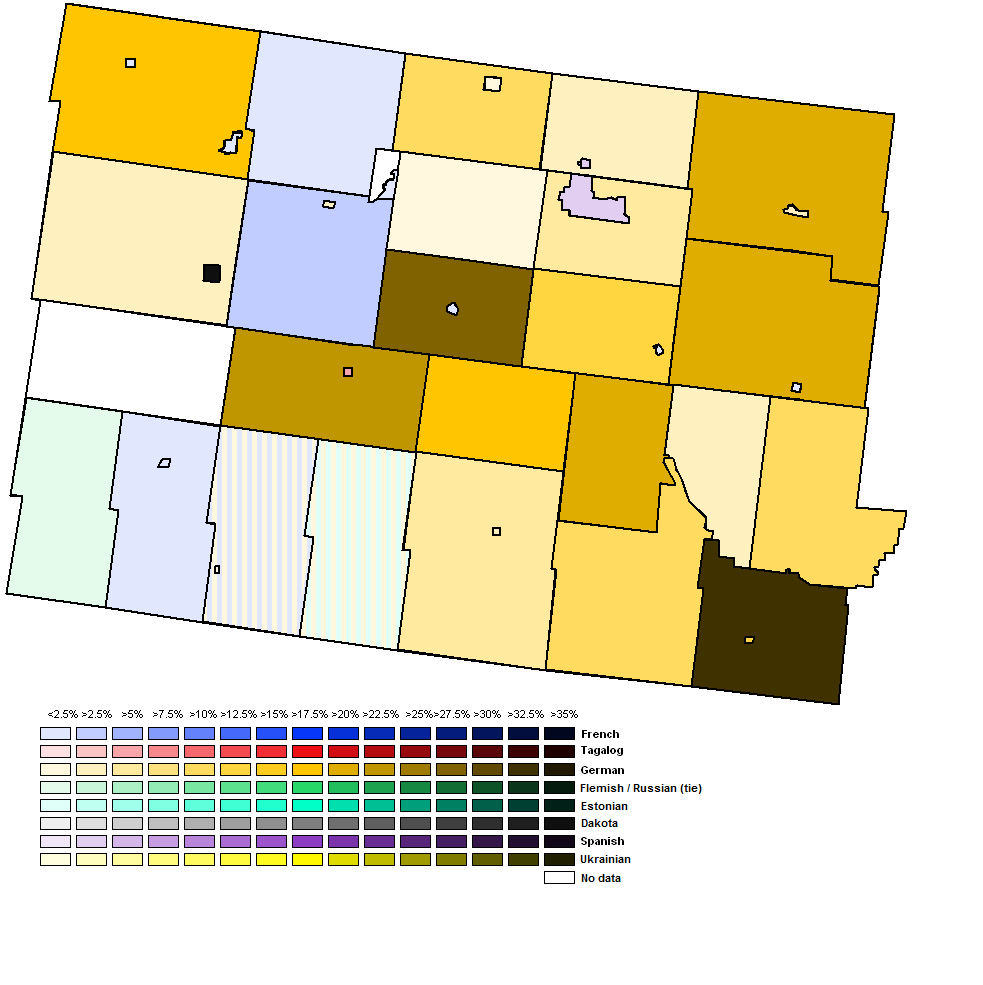
Leading non-English native language by Census Subdivision

Linguistically, English is by far the most common native language, with 86% of the riding having it as its mother tongue. The number two native language in the riding is German, at 4%, followed by Spanish (2%) and French (2%). German is the dominant second language in most parts of the riding, but they are concentrated mostly in the east. There are significant numbers of German native speakers (more than 20%) in the Rural Municipalities of Roblin, Glenwood, Cameron, North Cypress, South Cypress and Riverside. One other significant linguistic population lies in the Canupawakpa Dakota First Nation (Oak Lake), where 43% of residents are native Dakota speakers. One can assume that Dakota is widely spoken in Sioux Valley- the other Dakota Reserve, but no enumeration took place there. Also of note, Spanish is the second language of Brandon, although only 4% of the city are native Spanish speakers. Much of the southwestern corner of the riding lacks any linguistic diversity, which explains the light colours on the map. English is often the native language for 95-100% of the inhabitants in these areas. 


Candidates and expectations

Polls are suggesting that not only are the Liberals back to relevancy, but they are leading in this riding. Forum Research's most recent poll has the Liberals up 50-36 in this riding, an impressive lead indeed. So, what explains this? Well, the Liberal candidate in the riding brings some impressive name recognition. Their candidate is Rolf Dindsdale, who is the son of former Progressive Conservative MP Walter Dinsdale, who represented the area for 31 years. Rolf Dinsdale is a media executive with a colourful past, but the Dinsdale name runs deep in the city. Not only was his father a long time MP, but his grandfather was mayor of Brandon, and his brother is a two-time provincial Tory candidate. The Conservatives have a pretty strong candidate of their own in (now) former Athur-Virden MLA Larry Maguire. What's really hurting the Conservatives, however, is the ongoing Senate expenses scandal, among other things- that are really hurting the party. Another issue was with the nomination process with the Conservatives, which involved a candidate's nomination papers being rejected under dubious circumstances. With the riding supporting a Red Tory instead of a Reform or Canadian Alliance MP from 1997-2004 when surrounding ridings were electing Reform-Alliance Members of Parliament, it's not surprising to see the riding possibly going against the Conservatives, and electing a Liberal, son of a Tory MP. The NDP is running Labour Council president and Wawanesa resident Cory Szczepanski while the Greens are running greenhouse owner and Turtle Mountain resident David Neufeld.

If Forum Research is to be believed, the Liberals should take this riding, it what could be the only pick-up on by-election night. A Liberal win, would be the party would be sweeping the city of Brandon, where the Dinsdale name carries the most weight. Outside of Brandon will probably stay solidly conservative, especially the western part of the riding, which Maguire represented in the Manitoba Legislature. For the Liberals to win though, they have to break into the rural areas surrounding Brandon, as winning just the city will not be enough to win the riding. A Liberal pick up would be huge for the party, as it would be promoted as showing the public that they are the true alternative to the Conservatives, and would be a clear indicator that they are the number one party in the country at the moment.

Polls close in all four by-elections at 9:30 Eastern (8:30 Central).