Showing posts with label 2015. Show all posts

Tuesday, November 21, 2017

Mount Pearl North by-election preview

Voters in the riding of Mount Pearl North head to the polls today to elect a new member of the Newfoundland and Labrador House of Assembly. The riding has only been vacant since October 11, when its MHA, Steve Kent resigned to become the Chief Administrative Officer of the City of Mount Pearl. Kent was a member of the Progressive Conservative Party, and had been Deputy Prime Minister of the province under the Premiership of Kathy Dunderdale from 2014 to 2015. He was also mayor of Mount Pearl from 2003 to 2007, prior to being elected to the House. Mount Pearl North will be the first by-election held in the province since the Liberals swept into power in 2015, when they won a landslide majority government, capturing 31 of province's 40 seats. Mount Pearl North was one of only seven seats the Tories had won in the election.


Profile


Mount Pearl North is a suburban riding that covers the northern half of the City of Mount Pearl, the second largest city in the province, and the third largest municipality (after St. John's and the Town of Conception Bay South), located west of St. John's. The riding also covers two small subdivisions in St. John's itself: Brookfield Plains and Edison, which are made up of newly-built homes. The riding is shaped like an upside-down “U”, surrounding the central part of Mount Pearl. It covers the older part of the city in the east (mostly built before 1980), and newer subdivisions in the west and north which were mainly built in the 1980s, and since the 1990s respectively. The riding is more wealthy than the rest of of the province, with the average income being in the mid-$30,000 range (compared to $27,000 for the province) and is overwhelmingly White, with most residents being of English or Irish descent. 


MHAs since 1956

The riding is generally a safe Tory seat; it has elected Progressive Conservatives continuously since 1971 except for a by-election in 1988 which elected Liberal Eric Gullage and the subsequent provincial election in 1989 when he was re-elected (though, at the time the riding, then known as “Waterford-Kenmount” also covered what is now the riding of St. John's West). Gullage lost the seat in 1993 to Harvey Hodder, making the riding only one of 16 ridings to elect a Tory MHA that election. Hodder was re-elected in the new riding of Waterford Valley in 1996, a riding with similar borders to today's Mount Pearl North. The riding was one of only nine Tory seats won in 1996, with Hodder winning the seat by a nine-point margin. Hodder continued to represent the seat until Kent's election in 2007, winning increased majorities in 1999 (13 points) and 2003 (53 points!). Kent's first election win was a huge win, thanks to the coattails of the very popular Premier Danny Williams, winning the seat by a whopping 76 point margin over his Liberal opponent. He was re-elected in 2011 by a 54 point margin over the NDP candidate, and faced stiffer competition in 2015 against Mount Pearl mayor (Kent's successor) Randy Simms, whom he beat by nine points.

In the 2015 election, Kent won most of the polls on election day, but Simms won a scattering of polls across the riding. Kent's best neighbourhood was the new Brookfield Plains subdivision, where he won 59% of the election day vote. Simms only won one neighbourhood, that of Masonic Park which covers a nursing home which has since been shut down. 

Results by neighbourhood from the 2015 federal and provincial elections

In the federal election, the Tories were a non-factor, as the race was between incumbent NDP Member of Parliament Ryan Cleary and his Liberal opponent, Seamus O'Regan in the greater riding of St. John's South—Mount Pearl. O'Regan defeated Cleary, and easily won the election day polls corresponding to Mount Pearl North 60% to 35%. O'Regan won all but two polls in the area, with his best neighbourhood being Masonic Park (67%) and his worst neighbouhood being the Old part of the city, where he still won 55% of the vote (to Cleary's 41%).


Outlook

The front-runner in this race has to be the Tory candidate, Jim Lester, a farmer who owns and operates “Lester's Farm”, which is located on the southeastern border of the riding. He was the Tory candidate in the neighbouring Mount Pearl Southlands seat in the 2015 election, which he lost narrowly. The Liberal candidate in the by-election is St. John's businessman Jim Burton, who had previously sought the federal Liberal nomination in St. John's South—Mount Pearl, but withdrew in favour of O'Regan. The NDP candidate is Nicole Kieley, who is the executive director for the Newfoundland and Labrador Sexual Assault Crisis and Prevention Centre. There is a fourth candidate, businessman Hudson Stratton who is running as an independent.

Since winning the 2015 election, the popularity of the governing Liberals took a huge hit in 2016 after the government introduced a number of austerity measures, including the closing of most of the province's libraries. However, Liberal Party support has rebounded, but it is not back to where it was at the time of the last election. Both the Tories and the NDP have benefited from the Liberal's unpopularity, but Tory support is now back to where it was at the election, and the NDP, which currently has no leader is not fairing that much better. Needless to say though, I do not expect the Tories to lose this ordinarily safe-Tory seat.

Polls close at 8:00pm local time, which is 6:30 Eastern Time.


Thursday, September 7, 2017

Saskatoon Fairview by-election preview

The Fall election season kicks off today with a provincial by-election in the Saskatchewan riding of Saskatoon Fairview. The seat was vacated in July when its MLA, Jennifer Campeau of the governing Saskatchewan Party, accepted a job with a mining company in British Columbia. Campeau was a former cabinet minister in the government of Premier Brad Wall (who will also be resigning soon). This will be the second provincial by-election in the province since the last provincial election in 2016. The first by-election was held in March in Saskatoon Meewasin, and saw the NDP's Ryan Meili win the seat which was previously held by the Saskatchewan Party on an 11-point two-party average swing. Saskatoon Fairview is an even lower hanging fruit for the NDP, as Campeau won the seat in 2016 by just three points over her New Democratic opponent (compared to the eight point difference between the two parties in Meewasin). 


The once immensely popular conservative Saskatchewan Party government has been becoming more and more unpopular in recent months, with polls showing them and the NDP in a dead heat. It looks like the province may be heading toward the urban/rural polarization last seen in the early 2000s, which had the NDP gobble up nearly all of the urban seats and the Saskatchewan Party win most of the rural ridings. Since Wall's first victory in 2007, the Saskatchewan Party has been able to win ever increasing majority governments by winning suburban seats in Regina and Saskatoon and ridings in some of the smaller cities. Saskatoon Fairview as one of those suburban seats the Saskatchewan Party wrested away from the NDP.

For now, both parties are effectively leaderless, with Wall announcing last month his plans on resigning the province's premiership, and with the NDP in the midst of a leadership election which will culminate next Spring.


Profile


Saskatoon Fairview is a middle class suburban riding on the west-side of Saskatoon. Most the riding was built up in the 1960s and 1970s following the area being annexed by the city. It continues to grow to this day with new developments being built in the Kensington and Blairmore neighbourhoods. Its older, core neighbourhoods are (from north to south) Confederation Park, Pacific Heights and Parkridge. The riding also contains part of the Massey Place neighbourhood, which was added to the riding before the last election after redistribution.

Saskatoon MLA list since 1967 (previously Saskatoon was a multiple member seat)

The riding is a traditional NDP seat, only voting for right wing parties in landslide elections, specifically 1982, 2011 and 2016. Even in 2011 and 2016 the race in Saskatoon Fairview was close, with the Saskatchewan Party winning it by just five points and three points respectively. With its current borders, the 2011 election would've been just as close as in 2016 (three point difference). The two-party swing between the elections was just 0.1% to the NDP, which was the exact same as the province-wide swing between both elections.

The riding's main political cleavage runs down 22 Street, with the area north of that street being more friendly to the NDP and the area south of that street being more conservative leaning. The socio-economic and political differences between both sides of the street are fairly minimal, but large enough to have shown up in recent elections due to how close they have been in the riding. Even the last federal election was close, with my calculations showing the NDP having narrowly won more votes in Fairview than the Conservatives (37% to 36% respectively), with the Liberals winning 24% of the vote. 

Results by neighbourhood (2016 provincial and 2015 federal elections)
Click to enlarge

In both the 2015 federal election and the 2016 provincial election, both Confederation Park and Pacific Heights narrowly went NDP, while Parkridge voted for the Conservatives and the Saskatchewan Party by seven points and 10 points respectively. While only partly in the riding, Massey Place is the most pro-NDP neighbourhood, perhaps owing to the fact that it was it was in an NDP seat before being redistributed into Saskatoon Fairview. The new Blaimore SC development is becoming more NDP friendly as it grows, while the new Kensington neighbourhood is attracting more conservative voters, but was also the Liberal's best neighbourhood in both the last federal and provincial elections.

The political difference between the northern and southern parts of the riding is a result of its demographics. Massey Place has a median income of $29,000 (according to the 2010 National Household Survey) which is slightly below the provincial median, while Confederation Park and Pacific Heights have median incomes of $30,000 and $31,000 respectively. However, Parkridge in the south of the riding has a marginally higher median income of $34,000. Parkridge is also Whiter than the rest of the riding; It is 75% White, while the rest of the riding ranges from 60% to 66% White. Meanwhile, Confederation Park in the north part of the riding is especially diverse, with Indigenous Canadians making up 17% of the population and Filipinos making up 14% of the population. One other difference about Parkridge is that it is a newer neighbourhood, being built up in the 1980s and 1990s, while the northern neighbourhoods were built in the 1960s and 1970s.


Outlook


The NDP looks to recapture this riding with their candidate, Vicki Mowat who also ran there in 2016. She works as an executive assistant at the University of Saskatchewan, and defeated two other candidates for the nomination. Looking to retain the seat for the Saskatchewan Party is school trustee Cameron Scott. The Liberals, Greens and the somehow-not-dead-yet Progressive Conservatives are also running candidates, but should not be a factor. Despite the fact the Liberals got a quarter of the vote in the riding in the 2015 federal election, their provincial counterparts are not well organized at the moment.

There have been no polls published of the by-election race, and there has not been as much excitement as the Saskatoon Meewasin election in the Spring. To me, this is a sign of a probable NDP victory. The last election in Fairview may have been a close one, but it was only won by the Saskatchewan Party because the province-wide result was a landslide. With provincial polls suggesting the NDP is in a much better position, they should have no problem winning the seat. We will know for certain after polls close at 8pm (10pm Eastern).

Monday, October 24, 2016

Medicine Hat--Cardston--Warner federal by-election today

Today marks the first federal by-election of the 42nd Parliament, just as Canada's new Liberal government enters its sophomore year. Voters in the southern Alberta riding of Medicine Hat—Cardston—Warner head to the polls to elect a new Member of Parliament, following the death of Conservative MP Jim Hillyer who died last Spring due to cardiomyopathy. Hillyer was first elected to Parliament in 2011 in the neighbouring riding of Lethbridge, and switched to the Medicine Hat riding for the 2015 election when its boundaries shifted to encompass his hometown of Raymond, located just south of Lethbridge. While it pains me to speak ill of the dead, Hillyer's short tenure in Parliament was criticized by even those in his party for his 'poor service of his constituents'. When he first ran for office in 2011, he was criticized for not attending any candidate debates and for embellishing the truth in his campaign literature. It did not matter though, as he was easily elected in both 2011 and 2015 (though in a mostly different riding the second time), due to running in true blue Conservative country: southern Alberta.

Map of the riding
Since the 2015 federal election, the Justin Trudeau-led Liberals have enjoyed a tremendous honeymoon period, and are still polling nearly ten points higher than what they won in the last federal election, witch much of this coming at the expense of the (for all intents and purposes) leaderless NDP. The Conservatives, who are also leaderless, have not been hurt by The Liberal honeymoon, as they are polling at about what they won in 2015. Trudeau remains a very popular figure across the country, and even has a large swath of adoring fans in southern Alberta. While he is still mostly detested in that corner of the country, a rally he attended two weeks ago in Medicine Hat attracted nearly 2000 people.

Geography


Map of Medicine Hat neighbourhoods

Medicine Hat—Cardston—Warner can be found on the southern and southeastern boundary of Alberta. It is shaped like a backward “L”, with Saskatchewan on the east, and Montana on the south. In the west, the riding begins at the Belly River, and wraps around the Lethbridge area and Taber County, ending at CFB Suffield in the north. While the riding appears to be rural, and many have claimed it is, this is a misnomer. The City of Medicine Hat dominates the riding, as it is home to nearly two thirds of the riding's population. The rest of the riding is mostly empty ranching land, or oil and gas wells. Other than Medicine Hat, the riding is home to a few smaller communities, such as Cardston, Magrath, Raymond and Bow Island, while the Medicine Hat suburb of Redcliff is the riding's second largest city or town. The riding is also home to Canada's largest Indian Reserve (second largest in population), Blood #148, a Blackfoot reserve which is home to over 4000 people. The people in Blood #148 will be voting in their second federal by-election in just over two years, as they were previously located in the riding of Macleod which had a by-election in June 2014.

Demographics


Except for about a 9% Aboriginal population, the riding is overwhelmingly White. But despite this, the riding does have some interesting cultural and ethnic demographics. The riding has the highest ethnically German population in the country, with 36% of people claiming it. Germans immigrated to southern Alberta in the late 19th and early 20th centuries, and have long since been integrated into the country. Still though, 7% of residents indicate German as their first language in the census. This makes German the riding's #2 language, and some rural areas in the central part of the riding have large numbers (over 40%) of German speakers. After German, the riding is also home to significant populations with English, Scottish and Irish backgrounds. 10% of the riding claims some sort of Aboriginal background, most of this being Blackfoot. Blackfoot is the native tongue of about 1% of the riding.


The riding also has an interesting religious makeup, as it is home to Canada's largest Mormon population. Over a quarter of the riding is considered “Other Christian”, with much of this is Mormon, which was also the religion of Jim Hillyer. Mormons began settling the western part of the riding in the late 19th Century, and built the first Mormon Temple outside the United States in Cardston in 1887. Hillyer's hometown of Raymond was also settled by Mormons. The “other Christian” group also includes a sizable Mennonite population who are the descendants of some of the early German settlers to this region. In total, 72% of the riding is Christian, including 21% being Catholic, and 10% being United Church. Over one quarter of the riding has no religion.

The riding is poorer than the province as a whole. The median income is about $30,000 compared to $36,000 for all of Alberta. The average income is $40,000 which is over $10,000 less than the provincial average. While the riding has a reputation for cattle ranches and oil and gas extraction, the dominance of City of Medicine Hat in the riding has resulted in the leading industries in the riding being health care and social assistance, retail trade and construction.

History


A riding known as “Medicine Hat” existed all the way from 1908 until the most recent redistribution before last year's election. Medicine Hat—Cardston—Warner was originally going to be named just “Medicine Hat”, but the addition of the Cardston and Warner areas, which have not traditionally been lumped in with Medicine Hat in one riding meant that a name change was preferred.

From 1905 when Alberta joined confederation until 1908, Medicine Hat, then a town of 3000 people, was located in the riding of “Alberta (provisional district)”. In 1908 a riding called “Medicine Hat” was first created. This first Medicine Hat riding included a large swath of southeastern Alberta, including Lethbridge (then a home to 2000 people). In the north, the riding extended as far as (but not including) Hanna and as far as Strathmore in the west. Subsequent redistributions shrunk the riding down further, with a new Lethbridge riding being created in the west. The Cardston and Warner parts of the current riding of Medicine Hat—Cardston--Warner were usually located in the Lethbridge riding, but the Warner area was added to Medicine Hat in the 1966 redistribution but was removed once again in 1987, joining back with the Lethbridge riding. In the 2013 redistribution, the Cardston area was added to the riding for the first time since the 1908 redistribution and the Warner area was also added back to the riding. Both of these regions were previously in the Lethbridge riding. The 2013 redistribution also brought in the Blood 148 Indian Reserve which was previously located in the Macleod riding. To compensate, the Medicine Hat riding lost Taber and Newell Counties (which includes Brooks) to the new riding of Bow River. These counties have traditionally been part of the Medicine Hat riding, and this region had been continuously part of the riding since 1976. Also in 2013, the riding lost a small strip of territory in the far north of the riding (between the Red Deer River and the Suffield Air Force Base) to the new riding of Battle River—Crowfoot. 

MPs for Medicine Hat and Medicine Hat--Cardston--Warner
In its early days, the riding was competitive for the Liberals and even was won by the Progressive Party in 1921. However, following World War II, right wing parties have won every single election in Medicine Hat except for the first Trudeaumania in 1968. That election was an anomaly though, as the riding's MP, Bud Olson had switched from the quickly dying Social Credit Party to the Liberals, and was elected thanks to the splitting of the right wing vote between the SoCreds and the Progressive Conservatives. Olson had only beat his Tory opponent by 200 votes, and was shown the door in the next election when the Social Credit vote collapsed and Progressive Conservative candidate Bert Hargrave won. The Tories held the seat from that point on until 1993 when the Reform Party won the seat for the first time. Reform became Canadian Alliance which merged with the Progressive Conservatives in 2003 to form the Conservative Party and the Conservatives have won this seat ever since.

The 1993 election was the last to see the winning candidate receive less than 60% of the vote, and was the last time the Liberals won more than 20% of the vote. The riding usually votes overwhelmingly for the main right wing candidate, and only sees somewhat competitive elections when the right wing vote is split. In recent elections, the true battle has been for second place. In 2015, the Liberals finished second with 18% of the vote. In both 2008 and 2011 the second place party was the NDP which won 11% and 13% respectively.

Political geography


Medicine Hat—Cardston—Warner is a very, very Conservative riding. Except for the Blood 148 Indian Reserve, every single poll voted Conservative in 2015. Even in the city of Medicine Hat. And outside of the Blood 148 reserve, every single poll has voted Conservative in every single election since the Conservative merger in 2013. And most polls are won by quite large amounts.


The rural areas of the riding are much more Conservative than Medicine Hat itself. All of the rural counties in the riding gave Hillyer at least 80% of the vote in 2015, and only three rural towns did not give him at least 80% of the vote. Home to a large number of Mennonites and Mormons, Cardston County, in the riding's far west was the best municipality for Hillyer, where he won 89% of the vote. His worst municipality was Medicine Hat, where he still won 64.5% of the vote. However on the Blood Reserve, he won a minuscule 2.5% of the vote. There, the NDP (despite finishing third in the overall vote) won 62%, with the Liberals coming in second with 34%. Medicine Hat was the best municipality for both the Liberals and the NDP who won 22% and 9.5% of the vote respectively.

Within the city of Medicine Hat itself, Hillyer's best neighbourhood was Saamis Heights, a newer suburb on the city's south side, where he won 73% of the vote. Hillyer's worst neighbourhood was the Downtown, where he won 47% of the vote. Downtown Medicine Hat was the best neighbourhood for the NDP's candidate, who won 18% of the vote. The best neighbourhood for the Liberal candidate was the Southeast Hill / South Flats area, on the south side of downtown, where they won 31% of the vote. 

2015 federal election results by community


Overall, the best poll for the Conservatives was poll #170, which covers the community of Leavitt, south of Cardston. Leavitt is a Mormon village in Cardston County, which was founded by Thomas Rowell Leaveitt, who had fled the United States after a crackdown on polygamy laws. Hillyer won 94% of the vote there, with just ten people voting for all of the other parties combined. On the other end of the spectrum, there were three polls on the Blood Reserve where Hillyer won a grand total of zero votes (polls #148, #149 and #150). These polls cover the northeastern half of the reserve, and are close to Lethbridge.


Google Streetview photo of Leavitt, Alberta
Google Streetview photo of the Blood Reserve

When it comes to federal elections, voters in the Medicine Hat area are very inelastic. That is, they tend to not change their votes too often, even when the rest of the country is. Despite the Conservatives losing a lot of support across the country in 2011, they actually gained a swing 0.1% in the riding. The Liberals did see an uptick in support, receiving a swing of 6.8%, but this pails in comparison to the 21% national swing they won. Overall, the two party average swing to the Liberals was 3.3%. The Liberals saw the biggest swings in their direction in Medicine Hat and in the Blood Reserve. The Conservatives saw some reasonable swings in more rural areas, and especially in Cypress County. 


In the last provincial election, the election results were not as homogeneous as in past federal elections. The NDP orange crush was big enough to not only win a few polls outside of the Blood reserve (which they won by nearly 90% of the vote), but an entire riding: Medicine Hat, which covers the northern and central parts of the city. Within the Medicine Hat provincial riding, the NDP won the central part of the city, while the Wildrose won the more suburban parts, and the PCs won a few polls in the Norwood and Meadowlands neighbourhoods. Outside of Medicine Hat and the Blood First Nation, the NDP did not win any polls. Most of the rural polls voted for the Wildrose Party, except for a few scattering polls that the Tories won.

Historically, the provincial riding of Cardston-Taber-Warner which overlaps the western third of the Medicine Hat—Cardston—Warner riding has been very favourable to right wing third parties. In the 2004 provincial election, it was the only riding to vote for the Alberta Alliance (which later became the Wildrose Party), which helped give that party the credibility which led to its future success.

Outlook


The next MP for Medicine Hat—Cardston—Warner will likely be Conservative candidate Glen Motz, who is a retired Medicine Hat police officer. Motz is a social conservative, who became a police officer after following “God's call”, and has a bachelor's degree in religious education. His main opponent is Liberal candidate Stan Sakamoto, a Medicine Hat businessman who is credited as being the first Japanese-Canadian to be born there. Despite a Justin Trudeau rally in Medicine Hat that attracted 2000 people, it would be a huge surprise if Sakamoto could pull this off. Despite going NDP in the provincial election, Medicine Hat is a fairly conservative city, and the rural part of this riding is about as conservative as it gets.

Let's not forget there are other candidates running as well. The NDP is running Bev Waege, who was the party's candidate in Cypress-Medicine Hat in the 2015 election, but was not swept up in the orange wave, finishing third. The Greens are not running any candidates, but look for the Christian Heritage Party candidate (and leader) Rod Taylor to do well here- and by that I mean possibly finish ahead of the NDP. The Libertarians are also running a candidate, as is the Rhinoceros Party.

While I predict the Conservatives will easily win this by-election, I predict the Liberals will win a few polls in central Medicine Hat. They will also likely win the Blood 148 Reserve back from the NDP, as they did in the 2014 Macleod by-election (albeit with comically low turnout). We'll see just how well they do when the polls close at 8:30 Mountain Time (10:30 Eastern).

Tuesday, April 19, 2016

Manitoba election prediction: PC landslide

Seat prediction map
Manitobans are heading to the polls today in what will be an historic provincial election. If all the polls are correct, then voters are set to elect a Progressive Conservative government in a landslide election, kicking out the governing NDP, which has run the province since 1999, winning four straight majority governments in the process.

Polls are suggesting the PCs are hovering around 50% in the popular vote, which would be their highest vote share since 1910. If they get a few points higher than that, it would be their highest vote share in the province's history. This means that the Tories will be winning seats they have never won before, some of them quite easily, like Brandon East, Interlake and Selkirk. The NDP meanwhile is polling in the mid-20s, which would be their worst result since 1988. The Liberals on the other hand are just looking to gain back relevancy. After winning just one seat and 8% of the vote in 2011, they are now polling in the mid-teens, and could see their best result since 1995. The Greens are also polling well, averaging at 8%, which would be their best result ever.

This has been an election of awful leaders. NDP Premier Greg Selinger is coming off of last year's controversial leadership election, which followed a caucus revolt. Selinger won the election by a narrow result, thanks in part to the backing of major unions in the province. Not only that, Selinger is carrying 17 years of governing baggage behind him. The man who will become Premier, PC leader Brian Pallister is carrying baggage of his own. Many see him as being too right wing for the province, and is currently embroiled in a scandal in where it was discovered he had been to Costa Rica 15 times since 2012, and had lied about his travels. As for Liberal leader Rana Bokhari, she has run a lacklustre campaign which included an awful debate performance. At the beginning of the campaign, the Liberals had been polling ahead of the NDP for second place, but have now fallen considerably behind. The only leader that seems to be popular is Green Party head, James Beddome, who will definitely benefit from a high protest vote this election.


Predictions

For my riding predictions, I have come up with a “rating” for each riding (safe, likely, lean or toss up), which rates how comfortable I am in my predictions for each seat. I've made these ratings by using recent regional poll numbers and comparing them to the last provincial election as well as an average result of the last provincial and federal elections (see maps below). In taking a look at both elections, I feel I have a way to identify any abnormal riding results, and account for this in my predictions. Where my numbers contradict each other in a riding, or where they show a close race, I've declared the seat a “toss up” and offered my gut prediction in that riding, based on its history and its candidates. I've also taken into consideration a couple of riding polls that have come out over the course of the campaign.


Overall, I am predicting a landslide Progressive Conservative victory, with the Tories winning 43 of the 57 seats in the legislature. This would be their biggest electoral win in the province's history. I am predicting that the governing NDP will be reduced to just 11 seats, which would be their worst election since 1966. And ss for the Liberals, I am predicting they will win three seats, their best total since 1995.

Polls are suggesting the Tories are winning about two-thirds of the vote in rural Manitoba, which means they will likely sweep all of rural southern Manitoba (including Brandon), leaving the NDP to their northern stronghold (though they could close Flin Flon to the Liberals). In Winnipeg, polls indicate that the Tories have at least a 15 point lead over the NDP, which will see the PCs win back their former suburban strongholds in the south and west ends, and eat into traditional NDP territory in the north and east of the city. This will reduce the NDP to their stronghold in the central and north central parts of the city. Meanwhile the Liberals should hold on to their lone seat of River Heights, and maybe pick up one or two more seats thanks to vote splits. The Greens may also win a seat or two. 

Here are my seat by seat ratings. Ridings are coloured in by how they voted in 2011. 

Seat by seat rating.

Ridings to watch


I've identified ten ridings as “toss ups” - ridings where my numbers have shown a close race. For each of these ridings I went with my gut (with detailed reasoning) as to how I believe they will go:

Concordia: This north Winnipeg riding is being defended by incumbent NDP MLA Matt Wiebe, who has represented the seat since 2009, when he took over the riding from its predecessor, former Premier Gary Doer. The seat has voted NDP in every election since it was created in 1981. Wiebe won the seat in 2011 by 35 points, and it is one of only five provincial ridings to go NDP in the last federal election. On paper it is a safe NDP seat, but with the amount of swing the polls are predicting, this riding could be in play. I'm still predicting the NDP to hold on though.

Elmwood: Right next door to Concordia is Elmwood, which is being defended by long-time NDP MLA Jim Maloway, who has held this seat from 1986 to 2008 and since 2011. This riding has also voted NDP (and its predecessor, the CCF) in every election since it was created in 1958. The result in the last election in this seat was relatively close though, with Maloway defeating his Tory opponent by 21 points. One glimmer of hope for the NDP is that they did win the transposed federal result here. However, my numbers show the PCs winning this seat in a close result, which is why I am predicting they will win it.

Flin Flon: This riding, located in northwestern Manitoba will see an interesting race, as its defending MLA Clarence Pettersen is running as an independent, after he lost the NDP nomination. Flin Flon has been an NDP seat since 1969, but Pettersen's candidacy is expected to split the NDP vote. In the federal election, the NDP won Flin Flon over the Liberals by a slim margin, suggesting the Liberals could be the party that has the best chance at benefiting from the split. The provincial Liberals are also polling better than the NDP in rural Manitoba. This is why I think they will win the seat.

Fort Garry-Riverview: The NDP won this central Winnipeg seat in 2011, but this should be a Green-PC race. Green Party leader James Beddome is running in this riding, and of the four party leaders, he has the highest approval ratings. The Greens are polling quite high in the city (around 10%) which is enough to put this riding in play. Without riding polling, Green Party targets are hard to predict, so it is hard to say whether Beddome will win this seat. I'd prefer to hedge my bets though, and go with the PCs here, who could come up the middle against a divided progressive vote.

Fort Rouge: This central Winnipeg seat is the riding where Liberal leader Rana Bokhari has chosen to run. A riding poll from the beginning of the campaign showed a three-way race with Bokhari ahead of the PC candidate by just two points. At that point in the campaign the Liberals were doing much better in province-wide and city-wide polling, but now they are doing much more poorly. It is entirely possible that this drop in Liberal fortunes has happened in Fort Rouge as well. The NDP is running a star candidate in First Nations musician Wab Kinew, and I predict that this split in the non-PC vote could cause the Tories to come up the middle and win this seat for the first time since 1969.

St. Johns: My numbers suggest a tight NDP win in this north-end riding, but what will make it hard for the New Democrats to keep this seat is the fact that incumbent MLA Gord Mackintosh has decided to retire, making this an open seat. This seat has been won by the NDP, and its predecessor the CCF in every election since it was created in 1958, and Mackintosh won the riding in 2011 by an impressive 44 point margin. Because of these factors, I believe the NDP will manage to hang on to this seat.

The Maples: This ethnically diverse riding in the northwest corner of Winnipeg has had a history of electing Liberals to the provincial government, but none since 1995. A rebound in Liberal fortunes suggests that they will be competitive there, but will it be enough for them to win? The NDP, which holds this riding, is hoping for a split in the anti-NDP vote in order to hold on to the riding. However, I believe the surging Tories will pick this up, thanks to a split in the anti-PC vote, winning this riding for the first time ever.

Thompson: Way up in the north of the province is the riding of Thompson, which has been held by the NDP's Steve Ashton (who had challenged NDP leader Greg Selinger in last year's leadership election, following a caucus revolt) since 1981. The riding has only voted for the Tories once in its existence, in 1977. However, my numbers suggest that this riding may be in play. It is hard to fathom the PCs winning this seat though, considering Ashton won it by 40 points in 2011, and his daughter, Nikki won Thompson in last year's federal election. Because of this, I think the NDP will hold on to the riding.

Tyndall Park: The Liberals came a close second in this northwest Winnipeg seat in the last election, losing to the NDP's Ted Marcelino by a 10 point margin. Because of this, my numbers are suggesting a narrow Liberal win here. Though, with their faltering campaign, it is not a given, and either the NDP or the PCs might be able to win it as a result. Though, I think I will trust my numbers and predict a Liberal win here.

Wolseley: This central Winnipeg seat saw the Green's best result in 2011, when their leader, James Beddome won 20% of the vote, coming in second place. Beddome chose to run in Fort Garry-Riverview though, but the Greens are still running a star candidate in environmentalist David Nickarz in this riding. NDP MLA Rob Altemeyer defeated Beddome by a 40 point margin in 2011, a difference that will be very hard for Nickarz to overcome. It is hard to predict insurgent Green campaigns, and so I will play it safe and predict an NDP hold here.


Outlook


While losing will obviously be bad news for the NDP, it will mean finally getting rid of Selinger, and replacing him with a stronger leader. Also, beating out the Liberals for second place would be a minor victory, as we know from the results of the federal election, Manitobans would be quite willing to vote Liberal with the right leader, and a third place finish for the NDP would be a disaster for them.

As for the Tories, many people are suggesting it could be a “one and done” government for the party, due to weaknesses of Brian Pallister. He is being likened to former PC Premier Stirling Lyon who only lasted one term, before voters ditched his government in 1981. But, we may be getting ahead of ourselves here.

For the Liberals, they would be wise to ditch Bokhari as leader, though she will want to hang on if they make any seat gains. However, she will probably have to keep her seat first!

For those who want to follow the results, the polls close at 8pm Central Time, which is 9pm Eastern.

Monday, April 11, 2016

Chicoutimi by-election charts and maps

Today, there is a provincial by-election in the riding of Chicoutimi in Quebec. The riding has been vacant since last October when PQ MNA Stéphane Bédard resigned his seat.

The riding of Chicoutimi, located in northeastern Quebec has been a PQ stronghold since 1973. It consists of the former city of Chicoutimi, which is now part of the city of Saguenay. The riding is one of the most nationalist in Quebec, voting yes in both the 1980 and 1995 referendums by large margins.

I have been quite busy lately, so I haven't had the chance to do my usual by-election profile. The riding should be an easy PQ hold though, so it shouldn't be that interesting of a race.  The PQ is running businesswoman Mireille Jean as their candidate. Polls show her as the clear front runner.

Despite not having the time to do a write up, I have made plenty of charts and a map...


As you can see, the PQ won most of the riding in 2014, though the Liberals were strong in the southern and eastern suburbs. The CAQ won one poll as did Saguenay councillor Marc Pettersen, who ran as an independent.

Here are the results by city council district for the last provincial and federal elections:

2014 provincial election in Chicoutimi - results by municipal district

2015 federal election in Chicoutimi - results by municipal district


The following chart shows the vote progression of the riding since 1989. The boundaries have not shifted since then.


Chicoutimi vote progression

And finally here is a list of the MNAs who have represented Chicoutimi since confederation:


Polls close at 8pm.

Monday, November 30, 2015

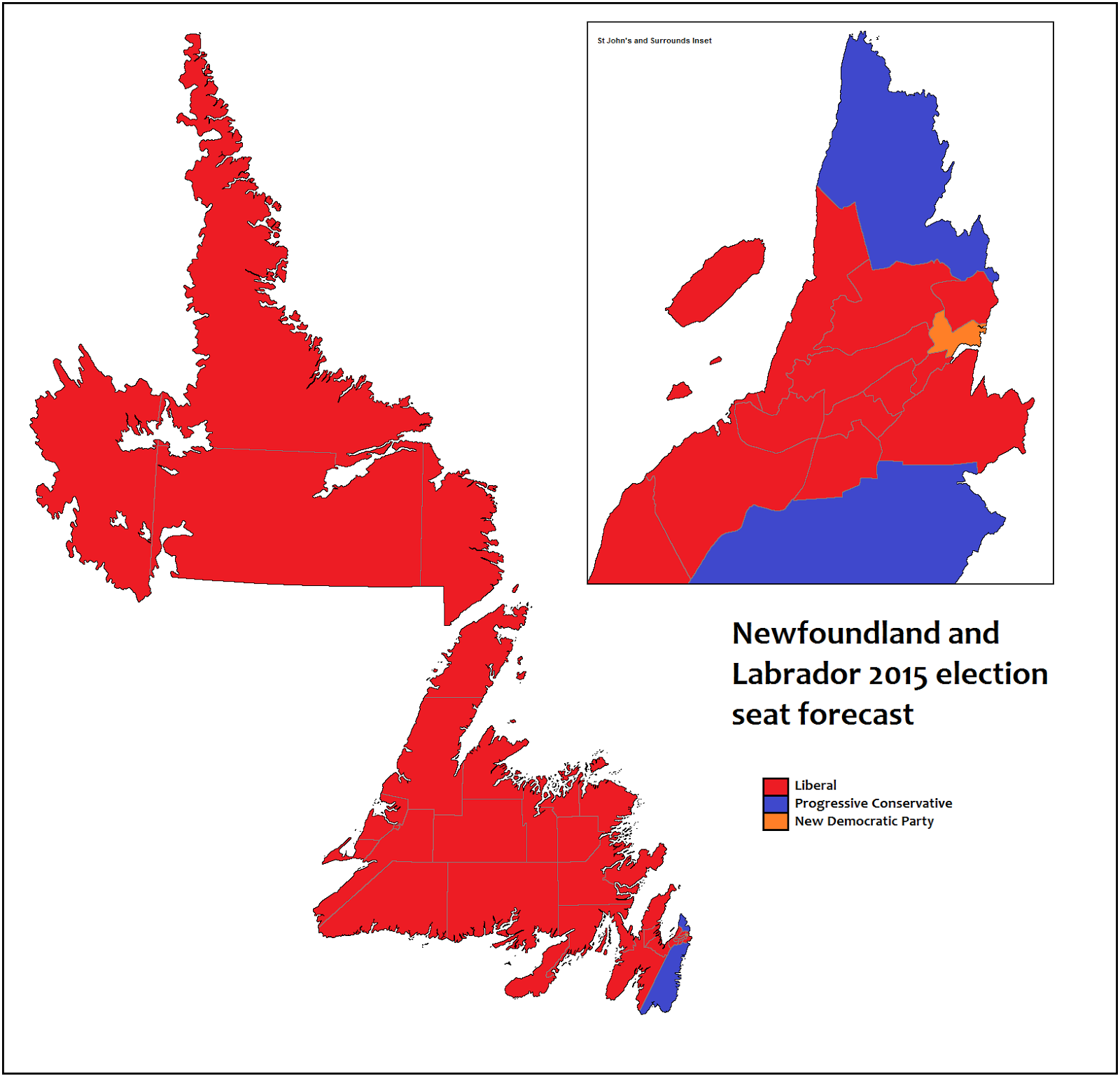
Newfoundland and Labrador election forecast

A very qualitative seat forecast for today's election
Today is the day of the 2015 Newfoundland and Labrador provincial election, where voters in that province will be electing members to the 40 seat Newfoundland and Labrador House of Assembly. After governing the province since 2003, the Progressive Conservative Party, led by Premier Paul Davis is expected to go down to defeat to the opposition Liberal Party, led by Dwight Ball. Polls have continuously shown the Liberals with the lead over the Tories since 2013, and their lead in recent polls has been quite substantial. With the outcome all but a certainty, the question will be, which seats will the Liberals not win, if any? The Liberals have been an unstoppable force since the 2011 election, winning every single by-election, and gaining a number of defectors from other parties along the way. The Liberals went from winning just six seats in 2011 to having 16 when the writs were dropped.

Recent polls by Abacus and Corporate Research Associates (CRA) both show the Liberals with more than a 40 point lead over the Tories (64-22 and 67-22, respectively), while Forum Research published a recent poll showing a closer race, with the Liberals at 52% to the Tories' 29%. All three polls showed the NDP in third, in the teens. If Abacus and CRA are correct, it would be the largest Liberal victory in the province since 1956. In that election, the Liberals won 32 of 36 seats in the Assembly and 66% of the vote. This was the highest share of the votes the Liberals have ever won in the province.

Newfoundland and Labrador voters are no strangers to voting en masse for one party, whether its in provincial or in federal elections. Just last month, 64.5% of voters in the province voted for the federal Liberals, leading to that party sweeping the province's seven seats. In the last three provincial elections, the Tories won the support of a healthy majority of voters, including winning 70% of the vote in 2007, the highest vote share any party has won in Canadian history. Despite that historic number, voters in four ridings bucked the trend, electing three Liberals and one New Democrat to oppose the PCs, who won 44 seats.

If winning 70% of the vote wasn't enough for the Tories to win every seat in the 2007 election, will the Liberals be able to do it today? The Tories could not win at least two of those four seats they lost in that election due to socio-economic and demographic factors in those ridings. Two of those seats, Burgeo-La Poile and Cartwright-L'Anse au Clair are both very remote, impoverished ridings facing large declines in their populations. They have the kind of demographics that are the very antithesis of Tory politics, even though the PC leader at the time was the populist Danny Williams, who built his majority on attacking the federal Conservatives. So, are there any ridings in the province that are the antithesis to Liberal politics, which will buck the trend tonight? Maybe, though I would argue the Liberal brand is strong enough in the province that they could win just about anywhere. There are three ridings in particular where I believe the Liberals may not win:

Cape St. Francis
This riding stands out in particular, because the Liberals have never won this riding located just north of St. John's. The St. John's area has long been the least friendly to Liberals, so if there is anywhere they will not win, it will be in historically Tory seats like this one. The Liberals did almost win the riding in 1996, in an election where they won 55% of the province-wide popular vote. PC MHA Jack Byrne held it by just 141 votes in that election. There was no NDP candidate however, and the NDP has proven to be competitive in this riding in subsequent elections. The NDP did quite well here in the 2011 election, winning 38% of the vote (while the Liberals won just 3%). How strongly the NDP does in Cape St. Francis will determine whether or not the Tories will be able to hold it. Their candidate in 2011, Geoff Gallant is now running for the Liberals, but they still have a strong candidate in defence attorney Mark Gruchy. If Gruchy can take enough votes away from Gallant, the Tories should manage to hold this seat. Tory fortunes are pinned on Kevin Parsons, who has held the seat since 2008, was the mayor of Flatrock before that, and is the son Kevin Parsons, Sr. who held the seat from 1986 to 1993.

Ferryland
This riding, located just south of St. John's is also a Tory stronghold, having voted for the Progressive Conservatives in every election since 1971. And unlike Cape St. Francis, the Liberals have not come close here in recent memory. In 2007, Tory Keith Hutchings won 84% of the vote in this riding, and was re-elected in 2011 with 72% of the vote. The NDP candidate won 24% of the vote here in 2011, while the Liberal candidate won just 4%. Hutchings, who is the province's Minister of Municipal and Intergovernmental Affairs is running for re-election. The Liberals are still aiming to pick this seat up though; their candidate, Jeff Marshall has been “campaigning for months” according to the CBC.

St. John's East-Quidi Vidi
This is the riding that former NDP leader Lorraine Michael has chosen to run in. It contains parts of two ridings that went NDP in 2011, St. John's East and Signal Hill-Quidi Vidi. Michael has held Signal Hill-Quidi Vidi since 2006, and the NDP have held on to this area since 1990, avoiding landslide elections that elected both Liberals and Tories. If there's one seat the NDP should keep in this election, it will be this one. Michael led the NDP to an historic five-seat victory in 2011, but her leadership of the party was divisive, and two of her MHAs defected to the Liberals. She resigned as leader, but will be running again in this seat. She may not be popular among many members of her party, but she remains popular in her riding.

Others?
Those are the ridings I believe will not go Liberal in today's election. However, there are other ridings either the PCs and NDP could win. Two historical Tory seats that could buck the trend are Baie Verte-Green Bay (Tory held since 1993) and Bonavista (also Tory held since 1993). Their chances are increased by the fact that they have incumbents running for re-election in both seats. Conception Bay East-Bell Island is another Tory-victory possibility. While the Liberals last won the riding in 1999, they only won 4% of the vote there in 2011. The NDP candidate, Bill Kavanagh won 41% of the vote in that election, and is trying again this time. The Liberals do have a strong candidate in former Labrador MHA Danny Dumaresque. The incumbent MHA, David Brazil, who is also the Minister of Transportation and Works is running for re-election, and could come up the middle to win the seat. There of course could be other seats the Tories could win, based on the personal popularity of their incumbents, but it's anyone's guess where those will be.

For the NDP, their next best hope after St. John's East-Quidi Vidi is St. John's Centre, where NDP MHA Gerry Rogers is running for re-election. Other than Lorraine Michael, Rogers is the only other MHA running for re-election for the New Democrats. When Rogers won the seat in 2011, it was the first time ever that the party won the riding. She won the seat with 54% of the vote, defeating the Tory incumbent by over 500 votes. The Liberals only won 2% of the vote. However in this election, her main competition will come from the Liberal candidate, accountant Lynn Sullivan.

Other than the Tories and the NDP, the best chance for an independent (there are no other parties running) to win is former MP Rex Barnes, who is running in Grand Falls-Windsor-Buchans. He was a Progressive Conservative MP for Gander—Grand Falls from 2002 to 2004, and served as mayor of Grand Falls-Windsor from 2005 to 2009.

Abacus conducted four riding level polls during the campaign for VOCM, including polling the ridings of Premier Paul Davis, who is running in Topsail-Paradise and NDP leader Earle McCurdy, who is running in St. John's West. Abacus' poll showed Davis losing in his riding to Liberal candidate (and Conception Bay South MHA) Rex Hillier 56-35. Abacus also showed the Liberals ahead in St. John's West, with their candidate, former MP Siobhan Coady leading McCurdy 57%-24%. If these polls prove to be correct, then both the Tories and NDP could be looking for new leaders fairly soon.

Forecast


Given all of this information, my (mostly) qualitative seat forecast is that the Liberals will win 37 of the 40 ridings in the province (the legislature will be reduced to 40 seats from 48 following a redistribution this year). The Tories will win two seats, and the NDP should win just one. Due to time constraints, I have not done a formal quantitative seat model for this election, but I do not expect to get many seats wrong, unless the polls are well off. In landslide elections, seat predictions become much easier, as the question only comes down to guessing which seats the winning party will not win.

In this seat-by-seat forecast, the riding names have been coloured based on how they voted in 2011:


We shall see the extent of the damage (both electorally, and to my forecast) after the polls close at 8:00pm local time (6:30 Eastern). It likely won't be a very long night.


Friday, November 27, 2015

Northwest Territories election summary

The Northwest Territories held a general election for its territorial legislative assembly on Monday, the 18th election since the formation of the assembly in 1951. The NWT Assembly is non partisan, using the “consensus government” model. The winning MLAs will come together next month to elect a new a Premier from among them. Only the Northwest Territories and Nunavut uses this system of government in Canada.

Since the creation of the office of Premier in 1980, no Premier has ever served in that capacity for more than one term. The tradition in the NWT is to choose a new Premier after every election. So, despite the fact that Premier Bob McLeod was re-elected in his Yellowknife South riding does not mean he will remain as Premier. It is more likely that the new assembly will choose someone different to become Premier.

The consensus model has been criticized as being somewhat undemocratic, as voters do not get to directly vote for Premier. While this is technically true in every other province and territory in Canada, the non-partisan nature of the NWT Legislature means that voters have no influence in who will become their Premier. MLAs choose the Premier behind closed doors, in secret meetings, and do not divulge their votes to the public. While there are no rules against members openly discussing their votes (it is not after all a papal conclave), members who do discuss details are often ostracized by their colleagues. The result is that there is no accountability for their decisions, as voters have no knowledge of which MLAs supported who for Premier, and cannot punish (or reward) their representatives in the ballot box for their actions.

The Northwest Territory's 19 ridings


Redistribution

Since the last election held in 2011, the boundaries of the NWT's 19 ridings have changed, following a controversial redistribution process, which had to be settled in the territorial supreme court. The size of the assembly was not changed, and most of the territory's rural ridings were not effected, but the boundaries in the territorial capital of Yellowknife were shifted around a bit. The most major change was when the abolition of the Tu Nedhe riding, the territory's least populous district, which consisted of two Dene communities in the eastern part of the NWT. Tu Nedhe was merged with part of the Weledeh riding, becoming “Tu Nedhé-Wiilideh”. The new riding is still underpopulated, becoming the second least populous riding in the NWT, after Deh Cho. The remainder of the Weledeh riding became the riding Yellowknife North, making it a strictly urban riding.

The controversy surrounding the redistribution came as a result of maintaining the imbalance of representation between Yellowknife and the rest of the territory. The City of Yellowknife makes up nearly half (46%) of the population of the NWT, but only 7 of the territory's 19 districts (37%) are in the city. The redistribution process did not address the imbalance, and as a result, every single Yellowknife district continues to be over populated, with most districts being more than 20% larger than the territorial average.

Results

In 2011, only one incumbent was defeated in the entire territory. In this election however, there were eight defeated incumbents. Coupled with three retiring MLAs, the election resulted in only eight returning MLAs. While Premier McLeod was re-elected, the territory's finance minister, Michael Miltenberger lost his seat of Thebacha (Fort Smith), a riding he had held since 1995. Despite the large turnover, the Assembly's most controversial incumbent, Michael Nadli was narrowly re-elected in Deh Cho, despite have spent eight days in prison during his term, after being convicted of assaulting his wife. Interestingly, Nadli was the only candidate to defeat an incumbent in 2011.


Out of the 19 ridings, there was one district where no election was held. In the riding of Monfwi, incumbent MLA Jackson Lafferty was re-elected with no opposition. Only two women were elected (Julie Green in Yellowknife Centre and Caroline Cochrane-Johnson in Range Lake), both of whom had to defeat incumbents to get into the legislature. This represents no change in the number of women elected to the assembly, as one MLA (Wendy Bisaro) did not run for re-election, while Jane Groenewegen was defeated in her Hay River South district. Green's election makes her the first out lesbian to be elected in the assembly's history.

Turnout by riding in the 2015 election
The overall turnout in the election was 44%, the lowest ever turnout in the history of the NWT. Turnout was especially low in Yellowknife, with most districts in the city seeing less than a third of voters showing up. The lowest turnout in the election was in Kam Lake, a suburban Yellowknife riding, which saw a turnout of just 25%. In contrast, many of the rural ridings saw large turnouts. The northern riding of Nunakput saw a turnout of 74%, while Tu Nedhé-Wiilideh saw a turnout of 71%.

The election was originally intended to be held in October, but was superseded by the October 19 federal election. According the territory's fixed election date legislation, the NWT is to hold elections on the first Monday in October every four years. However with the next federal election scheduled for October 2019, it is likely that the next NWT election will be held in November of 2019 unless the legislation is amended.